Once you have grasped index funds, you will eventually bump into "factors" — small-cap, value, momentum, quality — and the claim that tilting toward them can beat a plain index. The idea is grounded in real academic research, but it is also wrapped in marketing and a lot of wishful thinking. Here is an honest look at what factors are, what the evidence actually says, and why most people are fine ignoring them.
What a "factor" is
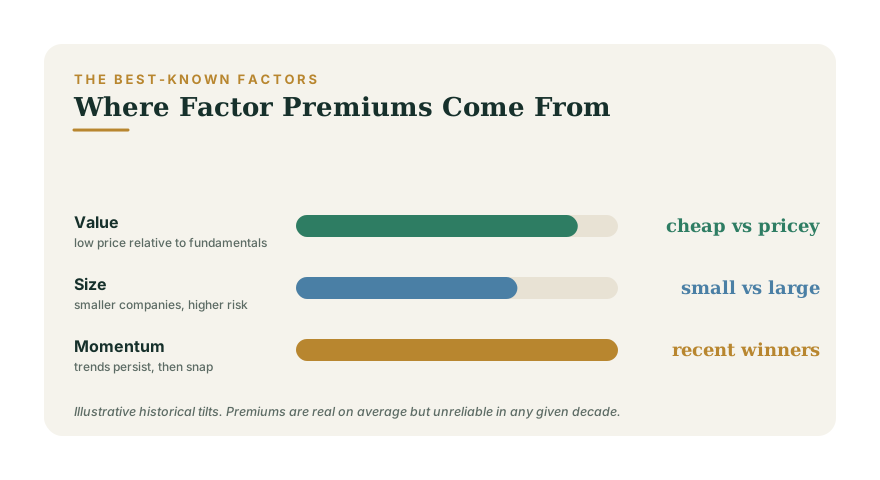
A factor is a shared characteristic of stocks that has historically been linked to higher returns. Instead of asking "which company is best," factor investing asks "which traits, across thousands of companies, have tended to earn extra return over time." Researchers identified several:
- Value — stocks that are cheap relative to their fundamentals (earnings, book value) have historically outperformed expensive "growth" stocks. This is the same divide explored in Growth vs Value Investing.
- Size — smaller companies have historically outpaced large ones, compensating investors for their greater risk and volatility.
- Momentum — stocks that have recently risen tend to keep rising for a while, until the trend abruptly reverses.
- Quality and low volatility — profitable, stable, less-volatile companies have delivered surprisingly good risk-adjusted returns.
A factor "tilt" means deliberately overweighting one of these traits — for example, holding a small-cap value fund instead of a plain total-market fund.
The evidence, told honestly
The premiums are real in the long-run data, and there are reasonable explanations for why they exist: some reflect extra risk you are being paid to bear, others reflect persistent behavioral mistakes by other investors. That is the strong case.
Now the caveats, which the marketing tends to mute:
- Premiums are wildly inconsistent. A factor can underperform the market for a decade or longer. Value famously lagged for years, testing the patience of even committed believers. "On average over a century" is cold comfort during a ten-year drought.
- Some shrink after discovery. Once a factor is published and packaged into products, money floods in and the edge can fade. The size premium, for instance, looks weaker in recent decades than in the original studies.
- Implementation costs eat returns. Factor funds often charge higher fees and trade more (momentum especially), and turnover creates taxes and transaction costs that quietly erode the theoretical premium.
- Behavior is the real enemy. Capturing a premium requires holding through long, demoralizing stretches of underperformance. Most investors who tilt end up bailing at the worst moment, locking in the lag and missing the rebound.
Why most investors don't need to tilt
Here is the part the fund industry would rather you skipped: a plain, total-market index fund already owns every one of these stocks — the small ones, the cheap ones, the recent winners — in proportion to their size. You are not missing the market by holding the whole market. Tilting toward a factor is a bet that a specific slice will beat the average, taken on faith that you will hold it through years of being wrong.
For the overwhelming majority of people, the gains from broad diversification, low costs, and consistent behavior dwarf any plausible factor premium. The same humility that explains why professional stock pickers fail applies here: the more you slice and tilt, the more chances you create to outsmart yourself. A simple, cheap, total-market portfolio is not a compromise — it is a genuinely excellent default.
If you still want a tilt, do it deliberately
None of this means factor investing is a scam. If you understand the trade-offs and want a modest value or small-cap tilt, it can be a reasonable, evidence-based choice — provided you do three things: keep it small (a tilt, not your whole portfolio), use low-cost diversified factor funds rather than narrow ones, and commit in advance to holding through the inevitable long droughts. A tilt you abandon after three bad years is worse than no tilt at all. Get grounded in the fundamentals first with the beginner's guide to index funds.
The bottom line
Factors are real, fascinating, and oversold. The premiums exist on average but vanish for years at a time, shrink after discovery, and demand a level of patience few investors actually have. A broad index fund already captures the entire market — including every factor — at rock-bottom cost. Before you complicate things, find out what kind of investor you actually are with the Investor Profile assessment.