The United States is one of a very small number of countries that tax based on citizenship rather than residence. That means if you are a US citizen — including a dual citizen who has never lived in the US, or one who moved abroad years ago — you are generally required to file a US tax return every year on your worldwide income, in addition to whatever your country of residence requires. It surprises a lot of people, and ignoring it can be expensive.
Citizenship-based taxation, in plain terms
Most countries tax you only while you live there. The US taxes its citizens wherever they live, for as long as they hold the passport. So a dual citizen earning a salary in another country still files a US return, reports that foreign salary, and follows US rules — even if they pay full tax in their home country and owe the US nothing. The obligation is to file, separate from whether you ultimately owe. This is why the rules around renouncing US citizenship exist as an escape valve, though that path has its own tax consequences.
Filing from abroad
Citizens living overseas generally get an automatic extension to file, but interest on any tax owed still starts from the regular spring deadline. You file the same Form 1040 as everyone else, converting your foreign income to US dollars. The complication is rarely the form itself — it is the extra reporting that comes with foreign accounts and assets, and choosing the right relief from double taxation. Many expats use a preparer who specializes in US citizens abroad, because the mistakes are easy to make and costly to fix.
The foreign earned income exclusion vs the foreign tax credit
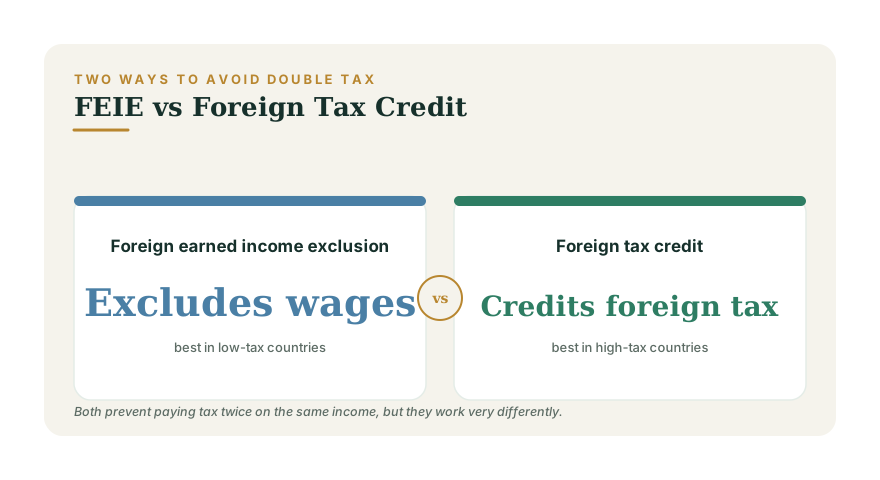
To avoid paying tax twice on the same income, the US offers two main tools, and picking the right one matters:
- The Foreign Earned Income Exclusion (FEIE) lets you exclude a large chunk of foreign earned income (wages and self-employment) from US tax if you meet a residence or physical-presence test abroad. It tends to work best when you live in a low-tax or no-tax country, because there is little foreign tax to credit anyway.
- The Foreign Tax Credit (FTC) gives you a dollar-for-dollar US credit for income taxes you paid to another country. It usually wins when you live in a high-tax country, because the foreign tax often equals or exceeds your US bill, wiping it out — and it can apply to investment income, which the FEIE cannot.
You can sometimes combine them, but the choice is not trivial and switching back and forth is restricted. The role tax treaties play in all of this is covered in Tax Treaties and Foreign Income.
FBAR and foreign-account reporting
Beyond the tax return, dual citizens face an information-reporting layer that trips up even careful people. If the combined value of your foreign financial accounts crosses a fairly low threshold at any point in the year, you must file an FBAR (the Foreign Bank Account Report) with the Treasury, and possibly Form 8938 under FATCA with your tax return. These are informational — they usually do not create tax — but the penalties for not filing are severe, even when no tax was owed. The full mechanics, thresholds, and how the two forms differ are in FBAR and FATCA, Explained.
Watch the foreign-investment traps
A dual citizen's normal home-country investments can become US tax landmines. Foreign mutual funds and many pooled investments are treated as PFICs, which carry punishing tax treatment and heavy reporting — explained in The PFIC Tax Trap. Foreign pensions, certain savings accounts, and life-insurance wrappers can also trigger US reporting. The practical lesson: before buying an investment abroad, check how the US will treat it.
Stay compliant, then optimize
If you have fallen behind, the IRS has offered streamlined programs for citizens abroad who were genuinely unaware — worth exploring with a professional before you owe penalties. Once you are current, the game is choosing FEIE or FTC wisely and keeping clean records of foreign income and accounts. Start by pressure-testing your situation with the Tax Health assessment, and map the bigger picture at the planning hub.