The United States is unusual: it taxes its citizens and residents on their worldwide income, no matter where in the world they earn or live. For an immigrant who still has a rental property back home, a foreign pension, dividends from an overseas account, or a spouse working in another country, that raises an alarming prospect — being taxed on the same dollar twice, once by each country. In reality, a layered system of tax treaties and credits exists specifically to prevent that outcome. Understanding the three main tools turns a frightening problem into a manageable one.
How tax treaties prevent double taxation
A tax treaty is a bilateral agreement between the United States and another country that sorts out who gets to tax what. The US has treaties with dozens of countries, and they do several things: they assign primary taxing rights over different kinds of income, they reduce withholding rates on cross-border payments like dividends and interest, and they include "tie-breaker" rules for people who could be considered a tax resident of both countries at once. A treaty does not usually mean income goes untaxed — it means the two countries coordinate so it is not taxed twice at full rates. The reduced dividend withholding for nonresident investors, covered in Investing in the US as a Nonresident Alien, is a direct product of these treaties.
The foreign tax credit
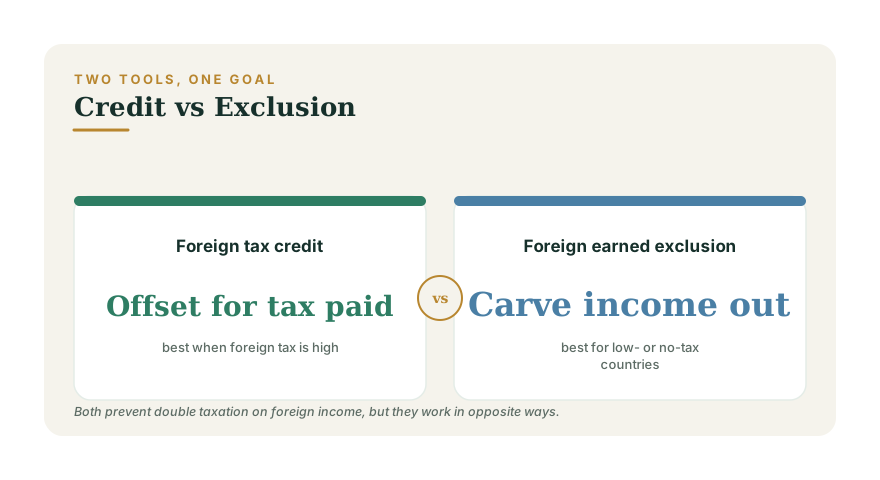
The workhorse for most people is the foreign tax credit. If you paid income tax to a foreign government on income that the US also taxes, you can generally claim a credit on your US return for the foreign tax you already paid — roughly dollar for dollar, up to the amount of US tax on that same income. The effect is that you end up paying, in total, about the higher of the two countries' rates, not the sum of both. The foreign tax credit shines when you live or earn in a country with relatively high income taxes, because the credit can wipe out most or all of the US tax on that foreign income. It applies broadly — to wages, interest, dividends, rental income, and more — which makes it the default tool for immigrants with ongoing income back home.
The foreign earned income exclusion
The other major tool, the foreign earned income exclusion, works in the opposite direction. Instead of crediting tax you paid, it lets qualifying people who live and work abroad simply carve a large chunk of their foreign earned wages out of US taxable income entirely. To use it you must meet residency or physical-presence tests showing you genuinely live abroad, and it applies only to earned income like wages and self-employment — not to investment income, pensions, or rental income. The exclusion is most valuable when you live in a country with low or no income tax, where there would be little foreign tax to credit. You generally cannot use the credit and the exclusion on the same dollars, so the choice between them is real, and for many people the foreign tax credit comes out ahead.
Reporting worldwide income — and the accounts behind it
Whichever tool you use, the starting point is the same: as a US tax resident you must report all of your worldwide income on your US return, then apply the credit or exclusion to avoid double taxation. Leaving foreign income off the return entirely is not a strategy — it is a problem. Reporting also extends beyond income to the accounts themselves. If you hold foreign bank or investment accounts above certain thresholds, you likely have separate disclosure obligations through the FBAR and FATCA regimes, which are about reporting account existence, not paying extra tax. The penalties for ignoring them are steep, and we walk through them in FBAR and FATCA, Explained.
A practical word on complexity
Cross-border tax is one of the few areas where do-it-yourself can backfire badly. Treaty positions, the credit-versus-exclusion decision, foreign pensions, and disclosure forms interact in ways that consumer tax software handles poorly. If you have meaningful foreign income or assets, a session with a tax professional who specializes in expatriate or immigrant taxation usually saves far more than it costs — and keeps you out of penalty territory. Foreign pensions, in particular, interact with US benefits in ways covered in Social Security for Immigrants and Totalization.
Get oriented before you file
The core idea is simple even if the forms are not: report everything, then use the treaty, the foreign tax credit, or the exclusion to make sure no dollar is taxed twice. To see where your overall cross-border setup might have gaps, run the Immigrant Financial Readiness assessment, and use the Tax Health assessment to check whether your reporting and planning are in good shape before tax season arrives.