Scams feel like a hundred different threats, but they are really a handful of scripts run over and over. Once you can name the major categories and recognize the manipulation underneath them, you stop reacting to each new variation and start seeing the same pattern every time. Here are the five most common financial scams and the universal red flags they all share.
The five most common scams
- Romance scams. A warm online relationship builds over weeks or months, then the new "partner" hits a crisis — a medical bill, a stuck shipment, a customs fee — and needs money. They never video-call, never visit, and the requests never stop. This is one of the most financially and emotionally devastating scams, precisely because it is patient.
- Investment scams. A "can't-lose" opportunity with guaranteed high returns, often in crypto, foreign exchange, or a private deal. Sometimes a fake app shows your balance growing to build trust, but when you try to withdraw, there are sudden "taxes" or "fees" — and the money is gone. Real investments never guarantee returns.
- IRS and government impersonation. A caller claims to be the IRS, Social Security, or police, says you owe money or your number is "suspended," and threatens arrest unless you pay immediately. Real agencies contact you by mail first and never demand instant payment by gift card or wire.
- Prize and lottery scams. "You've won!" — but to claim the prize, you must first pay taxes or processing fees. You cannot win a lottery you never entered, and legitimate prizes never require you to pay to receive them.
- Tech-support scams. A pop-up or call warns that your computer is infected. The "technician" asks for remote access and then either steals data or charges for fake repairs. No legitimate company monitors your personal computer and calls you about a virus.
The universal red flags
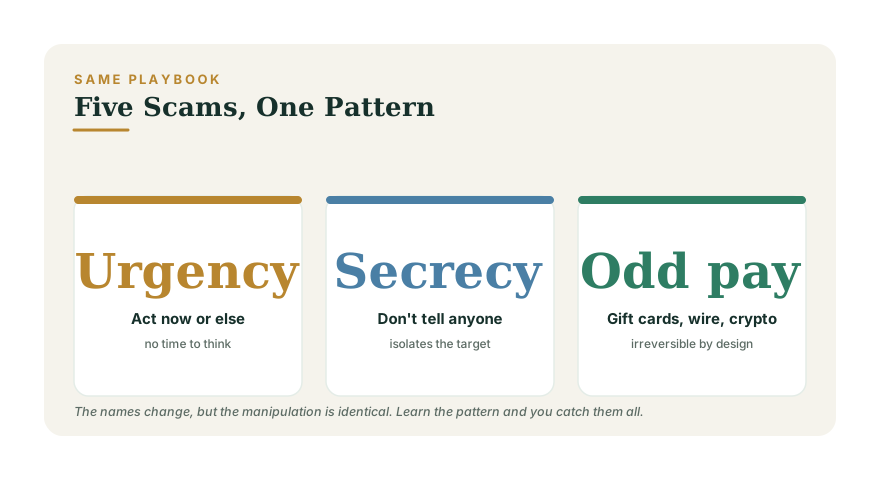
Notice how different those stories sound — and how identical the mechanics are. Almost every scam carries the same three signals.
- Manufactured urgency. You must act now, today, this hour. Urgency exists to stop you from thinking, checking, or asking someone you trust. A real institution will give you time.
- A demand for secrecy. "Don't tell your bank." "Keep this between us." Isolation is the scammer's best friend, because a second opinion almost always breaks the spell.
- An unusual, irreversible payment. Gift cards, wire transfers, cryptocurrency, or a peer-to-peer payment app. These are favored precisely because they are hard or impossible to reverse — which is also why instant-pay app scams are so punishing, as covered in Check Fraud and Payment-App Scams.
If a request hits two of these three, treat it as a scam until proven otherwise.
The one habit that defeats most of them
Slow down and verify independently. Hang up and call the company back using the number on the back of your card or its official website — never a number the caller gave you. Tell one trusted person before sending money anywhere unusual. Scammers engineer pressure specifically to skip these steps; taking them is what keeps your money safe. A broader playbook for spotting and reporting fraud lives in Protecting Yourself From Financial Fraud.
Why some people are targeted more
Scammers often focus on people who are isolated, recently bereaved, or less familiar with technology — which is why aging parents deserve special attention, covered in Protecting Aging Parents From Financial Fraud. But everyone is a target, and confidence is no protection; many victims are well-educated professionals caught in a moment of stress.
If you have already paid
Act fast: contact your bank or the payment provider immediately, because a small window sometimes exists to reverse a transfer. Report the scam to the FTC and freeze your credit if you shared personal data. The full recovery sequence is in How to Recover From Identity Theft. To gauge how exposed you are and shore up the weak spots before anything happens, take a few minutes with the Financial Resilience Assessment.