Few financial products inspire stronger opinions than annuities. Salespeople push them relentlessly, often for the fat commissions, while skeptical investors dismiss the entire category as a scam. Both camps are partly right, which is the problem. The word "annuity" covers wildly different products, from a simple, genuinely valuable income contract to a baroque, fee-laden instrument that mostly enriches whoever sold it. Judging them as a group is useless. The only honest approach is to separate the one good use case from the many bad ones.
What an annuity actually is
Strip away the marketing and an annuity is a contract with an insurance company: you hand over money, and in return the company promises to pay you income, either now or later. At its core it is a tool to convert a pile of savings into a stream of guaranteed payments. That basic idea is sound. The trouble starts when insurers wrap that simple promise in layers of features, fees, and fine print designed to look attractive and pay big commissions.
The good use case: the immediate annuity
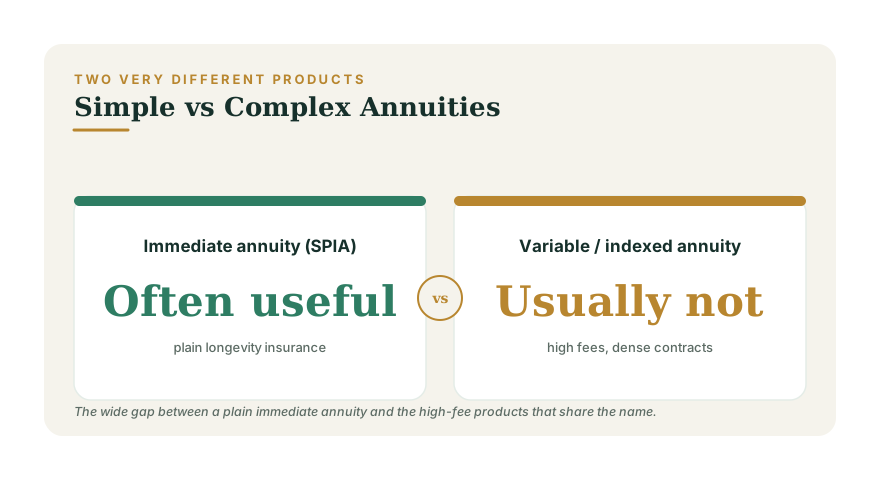
The version worth taking seriously is the single-premium immediate annuity (SPIA). You pay a lump sum and the insurer pays you a fixed income for life, starting right away. It is plain, transparent, and solves a real problem that no investment portfolio can fully solve: longevity risk, the danger of outliving your money.
Here is the logic. No matter how carefully you draw down a portfolio, you cannot know if you will live to 80 or 100, so you either underspend out of fear or risk running out. A SPIA outsources that uncertainty. The insurer pools many people together; those who die early effectively subsidize those who live long, and everyone gets a higher guaranteed payment than they could safely take alone. For a retiree worried about the back end of a very long life, using a slice of savings to buy a floor of guaranteed income, on top of Social Security, can be a genuinely smart move. A related product, the deferred-income or longevity annuity, does the same thing but starts payments late in life, which can be an efficient way to insure specifically against extreme old age.
The bad use cases: variable and indexed annuities
Now the products that earn the category its bad reputation:
- Variable annuities invest your money in subaccounts that resemble mutual funds, wrapped in an insurance shell. They typically carry layered fees, mortality and expense charges, fund fees, and rider costs, that can quietly consume a large share of returns. They are often pitched as tax-deferred growth, but for most people a plain retirement account or taxable index fund achieves similar goals at a fraction of the cost.
- Indexed annuities promise market-linked gains with downside protection, which sounds ideal. In practice the upside is throttled by caps, participation rates, and spreads that the insurer can sometimes change, and surrender charges can lock your money up for years. The contracts are dense by design, and complexity favors the seller.
None of this means these products are fraud, but their costs and complexity make them a poor fit for the typical investor, and the heavy commissions create an obvious conflict of interest in how they are sold.
Questions to ask before signing anything
If someone is steering you toward an annuity, slow down and ask:
- What exactly is this product, and is it a simple immediate annuity or something with subaccounts and riders?
- What are all the fees, stated as an annual percentage, including any rider charges?
- What is the surrender period, and what does it cost me to get my money out early?
- How is the person selling this paid, and how big is their commission?
- What problem is this solving that a low-cost portfolio plus Social Security cannot?
- How financially strong is the insurer, since the guarantee is only as good as the company behind it?
If the answers are vague, evasive, or buried in a contract you cannot follow, that is your answer.
The balanced verdict
Annuities are neither a miracle nor a scam. A simple immediate annuity used in moderation is legitimate longevity insurance, the right tool for a retiree who wants a guaranteed income floor and peace of mind about a long life. The complex, high-fee variable and indexed products are usually solving the seller's problem, not yours. The deciding factors are cost, transparency, and whether the product fills a real gap your existing plan cannot. If you are weighing how guaranteed income fits alongside drawing down a portfolio, start with our guide to a sensible retirement drawdown strategy and our breakdown of why permanent life insurance is so often oversold.