The reason most people abandon a budget is not laziness — it is friction. Manually logging every coffee and categorizing every charge is tedious, and the moment life gets busy, the spreadsheet goes stale. The promise of AI-powered budgeting apps in 2026 is to remove that friction entirely: connect your accounts, and the app categorizes everything, predicts your upcoming bills, spots subscriptions you forgot, and nudges you when you are drifting. The features are genuinely useful. Whether they change your financial life depends on something the app cannot supply.
What the AI features actually do
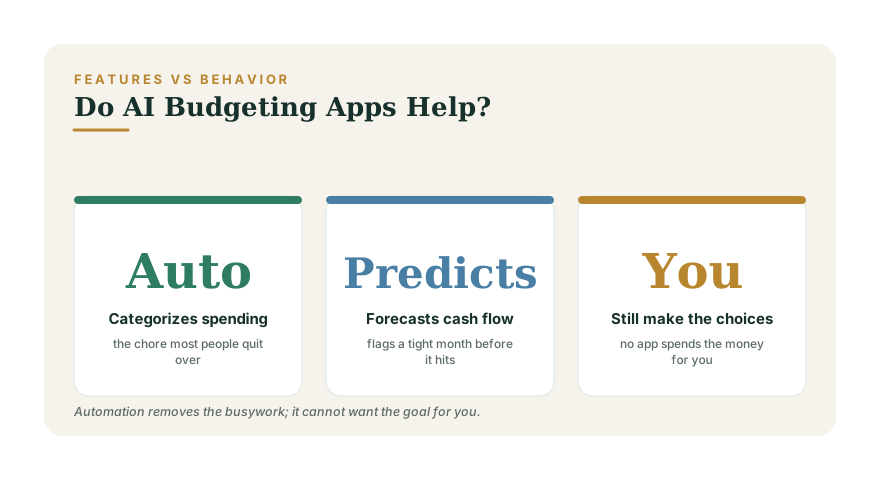
- Automatic categorization. The app reads each transaction and sorts it into groceries, dining, transport, and so on — killing the single most tedious part of budgeting.
- Cash-flow forecasting. By learning your recurring income and bills, it can predict a tight week before it arrives and warn you.
- Subscription detection. It flags recurring charges you may have forgotten — the exact problem tackled in The Subscription Creep Audit.
- Personalized nudges. Gentle prompts when you are outpacing a category, framed to feel like a helpful friend rather than a scolding.
Where they genuinely help
For people who quit budgeting because of the manual grind, automation is transformative — it makes tracking effortless enough to actually stick, which is the whole point of How to Track Your Spending. Seeing categorized spending appear without any effort creates awareness, and awareness alone often trims wasteful spending. The forecasting can also prevent overdraft fees by warning you before an account runs dry. If the app is the difference between having a budget and having none, it is worth it.
Where the AI falls short
- Miscategorization. AI guesses, and it guesses wrong — a business expense tagged personal, a one-off lumped as recurring. You still have to review, or your "insights" are built on bad data.
- Awareness is not action. An app can show you that you spend $600 a month on takeout; it cannot make you cook. The behavior change is still yours.
- It optimizes tracking, not goals. A beautiful dashboard is not a plan. You still have to decide what the money is for — a topic in How to Set Financial Goals.
Watch the cost and the data trade
Many of these apps now charge a monthly subscription — a small irony for a tool meant to cut spending. Do the math: a $15-a-month app needs to save you more than $180 a year to pay for itself. Just as important is the data: budgeting apps connect to your bank and see everything you buy. Understand what the company does with that data, and be as cautious with these tools as you would be with any AI service — the same privacy caution raised in Using AI Chatbots for Financial Advice. The Consumer Financial Protection Bureau maintains guidance on how financial apps use and share the data they collect.
Do you even need the app?
An app is a means, not the goal. Some people thrive with a simple percentage split they never touch — see The 50/30/20 Rule — and never need software at all. The right question is not "which AI app is best" but "what will I actually keep doing." If automation is what keeps you engaged, pick one and use it. If it becomes another dashboard you admire but ignore, it is a $15 monthly subscription doing nothing.
The bottom line
AI budgeting apps are excellent at removing the tedium that kills budgets, and that alone makes them worth it for many people. But they automate the tracking, not the discipline — the choices, the goals, and the follow-through are still yours. Use the app to see clearly, then act. Turn awareness into a real plan with the Budget Analyzer and find out where your money leaks with the Financial Wellness assessment, then set your targets at the planning hub.