Walk into any financial firm today and someone will tell you they are a fiduciary. It is the most reassuring word in the industry, which is exactly why it has been stretched until it means almost nothing. The honest truth is that the legal duty an advisor owes you can switch on and off during the same meeting, and most clients never find out until it costs them money.
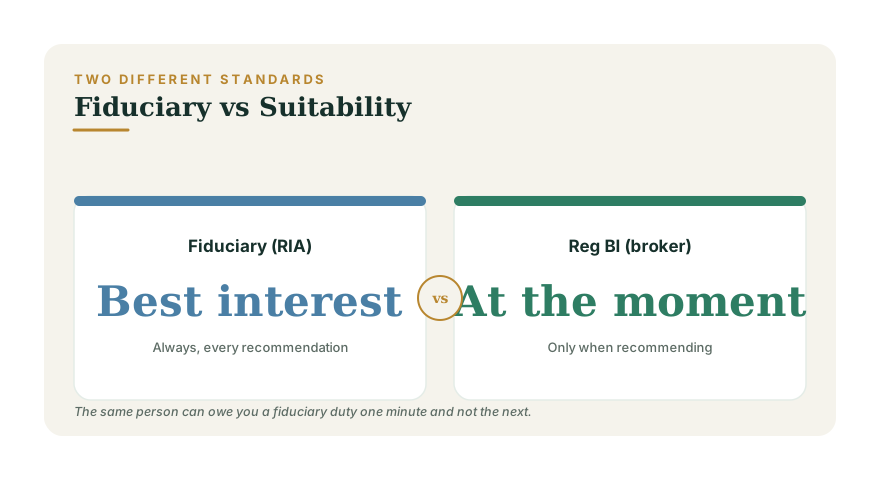
A genuine fiduciary is legally required to put your interests ahead of their own at all times. That sounds obvious. It is not the standard most people who manage money actually operate under.
The Two Standards, In Plain English
There are two different legal frameworks, and the difference between them is where your money quietly leaks out.
The fiduciary standard. Registered Investment Advisers, or RIAs, are regulated under the Investment Advisers Act of 1940. By law they owe you a fiduciary duty of care and loyalty. That duty is continuous. It applies to every recommendation, the ongoing management of your account, and the disclosure of any conflict of interest. If a cheaper, better option exists for you, a true fiduciary is supposed to tell you, even when it earns them less.
The broker standard. Brokers, often called registered representatives, are regulated differently. Since 2020 they operate under Regulation Best Interest, known as Reg BI, which replaced the old "suitability" rule. Reg BI sounds strong, but it has a critical limitation: it applies only at the moment a recommendation is made. There is no ongoing duty. Once the product is sold, the obligation effectively ends. And "best interest" under Reg BI does not require the lowest cost or the best available product. It requires a product that is reasonable for you, which is a much lower bar.
Why the Industry Profits From the Confusion
Here is the part the brochures leave out. Many advisors are dually registered. They hold both a fiduciary RIA license and a broker license at the same time. This lets them wear whichever hat pays better for any given transaction.
When they charge you an ongoing advisory fee, they may act as a fiduciary. But the moment they pitch you a commission product, an annuity, a non-traded REIT, or a high-fee mutual fund with a sales load, they can quietly switch to their broker hat. In that moment they are a salesperson, not your fiduciary, even though nothing about the conversation looks any different to you. Same office, same person, same friendly tone, completely different legal duty.
This is not a loophole someone forgot to close. The dual-registration model exists because it is enormously profitable. Commission products can pay 1 to 7 percent or more upfront, plus ongoing trail commissions. An advisor acting purely as a fiduciary, recommending a low-cost index fund, earns none of that. Follow the money and the incentive to switch hats becomes obvious.
What This Costs You
Consider a simple example. You roll over a 250,000 dollar 401(k) and your advisor recommends a variable annuity that pays a 5 percent commission. That is 12,500 dollars to the salesperson, baked into a product with annual costs that can run 2 to 3 percent a year. Over time those internal fees can quietly drain tens of thousands of dollars from your balance.
Run the math on the fee drag alone. On a 250,000 dollar account, the difference between a 0.25 percent index portfolio and a 2.5 percent annuity is about 5,600 dollars in year one. Compounded over 25 years at a 7 percent gross return, that gap can erase well over 200,000 dollars of ending wealth. A true fiduciary, obligated to consider cost, would struggle to justify the annuity. A broker operating under Reg BI at the point of sale often can.
How to Protect Yourself
You do not need to memorize securities law. You need to ask one direct question and get the answer in writing.
Ask: "Will you act as a fiduciary on every recommendation you make to me, in writing, at all times?" Then watch what happens. A fee-only RIA will say yes without hesitation and sign it. A dually registered advisor will start qualifying the answer, talking about "depending on the product" or "when we are in an advisory capacity." That hedging is your answer.
You can also verify their registration yourself. Look them up on the SEC Investment Adviser Public Disclosure site and FINRA BrokerCheck, both free. These records show whether they are an RIA, a broker, or both, and they list any disciplinary history.
Your Fiduciary Checklist
- Ask, in writing, whether they act as a fiduciary on ALL recommendations, ALL the time. Get a signed statement, not a verbal promise.
- Find out if they are dually registered as both an adviser and a broker. If yes, ask exactly when the fiduciary duty does and does not apply.
- Ask how they are paid: a flat fee, a percentage of assets, commissions, or some combination. Commissions are a flashing warning light.
- Check SEC IAPD and FINRA BrokerCheck before you sign anything.
- If they cannot or will not put the always-on fiduciary commitment in writing, walk away.
An Honest Recommendation
If you want advice you can trust without decoding which hat someone is wearing, look for a fee-only registered investment adviser who is a fiduciary at all times and earns nothing from product commissions. For many people, a low-cost robo-advisor or a simple index-fund portfolio removes the conflict entirely, because there is no salesperson in the room. The cleanest way to avoid a conflicted recommendation is to remove the commission incentive before it ever reaches you.
The word fiduciary is supposed to mean someone is legally on your side. Make them prove it on paper. If you want to see how much advisor fees and product costs are quietly draining from your own plan, run the numbers with our free tools and build a clear picture in your plan before your next meeting.