The Affordable Care Act marketplace is where people without employer or government coverage buy their own insurance, and the premium tax credit is what makes it affordable for most of them. That subsidy has been unusually generous in recent years because of temporary enhancements layered on top of the original law. Whether and how those enhancements continue is the story of marketplace coverage in 2026, and it directly affects what you pay.
How the subsidy works at all
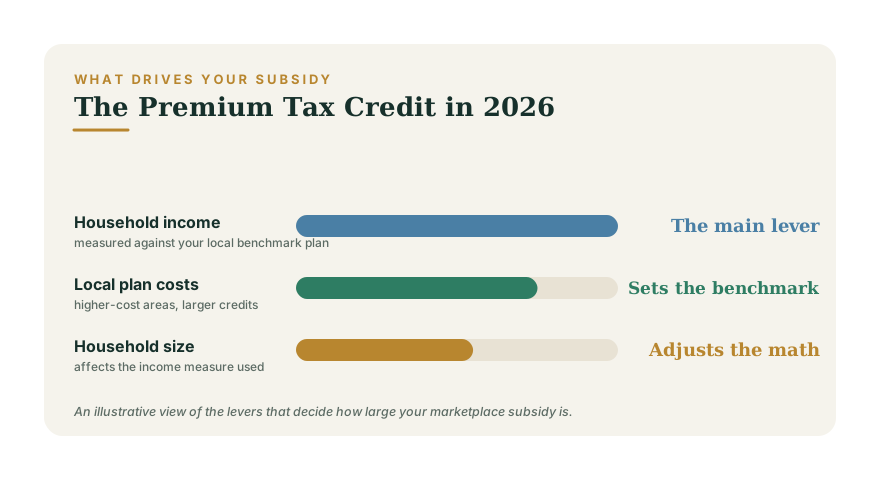
The premium tax credit caps what you pay for a benchmark plan at a percentage of your household income. The government covers the rest, paid straight to the insurer so your monthly premium is lower. The lower your income relative to the cost of coverage in your area, the larger the credit. This is the mechanism the marketplace is built on, explained from the ground up in ACA Marketplace Health Insurance. If health insurance itself still feels like a foreign language, start with How Health Insurance Works.
The temporary enhancements — and the cliff
Two enhancements reshaped the subsidy in recent years. First, the caps on what people pay were lowered across the board, so credits grew even for middle earners. Second, the old "subsidy cliff" — where earning even a dollar over a hard income line erased the entire credit — was replaced by a smoother phase-out that kept help flowing to households above the traditional threshold. These changes were temporary by design, which is why every open-enrollment season now carries uncertainty about whether they persist. Policy shifts, so confirm the current rules for your plan year at healthcare.gov rather than assuming last year's numbers hold.
Why income estimates matter so much
The credit is based on your estimated income for the coverage year, then reconciled against your actual income when you file taxes. Estimate too low and you may have to repay part of the subsidy; estimate too high and you leave money on the table all year. For anyone with variable income — freelancers, commission earners, small-business owners — this is the part that bites. Keep your marketplace income estimate updated when your situation changes, and understand that the figure the marketplace uses is your modified adjusted gross income, not your take-home pay. The interplay of income and marketplace math is detailed at healthcare.gov.
Levers you actually control
Because the subsidy tracks income, ordinary tax moves can raise your credit:
- Pre-tax retirement contributions. Money into a traditional 401(k) or IRA lowers the income the marketplace measures, which can enlarge your credit.
- HSA contributions. If you pick a qualifying high-deductible plan, HSA contributions also reduce that income figure — one more reason to understand the strategy in Maximizing an HSA as a Stealth Retirement Account.
- Timing income. Self-employed people with control over when they invoice or realize gains can smooth income across years to stay in a more favorable subsidy range.
You can model how these moves change your taxable income with the Tax Strategies tool.
Picking the plan, not just the subsidy
A large credit is not the same as a good plan. The benchmark used to size your subsidy is a mid-tier "silver" plan, but you can apply the credit to any metal tier. Many people find a bronze plan with the credit costs little each month but carries a very high deductible — which only works if you can absorb that deductible in a bad year. Weighing a low premium against a high deductible is exactly the calculation in High-Deductible Health Plans: When the Math Works.
Check your numbers every year
Marketplace subsidies are a moving target, and 2026 is a year to verify rather than assume. Update your income estimate honestly, use pre-tax accounts to shape the income the credit is based on, and re-shop your plan every open enrollment because the benchmark shifts. Confirm the rules that apply to you at healthcare.gov, then fit the premium into your wider budget with the Budget Analyzer and review your overall coverage with the Financial Resilience assessment.