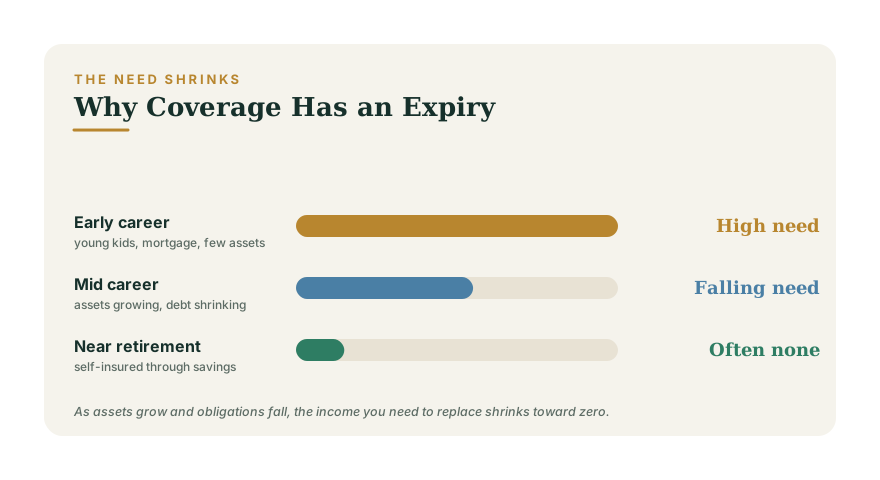
Life insurance has a clear and specific job: if you die, it replaces the income or financial support that the people who depend on you would lose. That job is enormous when you are young, carry a mortgage, and have small children. But it is not a permanent feature of life. For most people, the need to insure their life rises, peaks, and then falls away entirely — and continuing to pay premiums after the need is gone is simply wasted money.
The whole point is replacing income
Strip away the marketing and life insurance does one thing: it provides a lump sum to replace the financial contribution you make to others. If no one relies on your income or care, there is nothing to replace. This is why a single person with no dependents and no co-signed debt usually needs little or no life insurance, while a sole earner supporting a spouse and three kids needs a great deal. The article Do You Actually Need Life Insurance? walks through who genuinely needs coverage in the first place.
What "self-insurance" means
You are self-insured when your own assets are large enough to do the job the policy was doing. Picture the original reason you bought coverage: to pay off the mortgage, cover years of living expenses, and fund the kids' education if you were gone. Now imagine you have accumulated enough in retirement accounts, a paid-down home, and investments that those same needs could be met from your assets directly. At that point the insurance company's payout would be redundant — you have effectively become your own insurer. This is the same principle that applies to other coverage, explained in self-insuring: when it makes sense.
The signs you can safely drop it
You are likely ready to let a policy lapse when several of these are true:
- Your dependents are independent. The kids have finished school and support themselves.
- Your debts are gone or manageable. The mortgage is paid off or small enough that your surviving partner could handle it from assets.
- Your partner could live on what remains. Between retirement savings, Social Security, a pension, and investments, the survivor would be financially secure without your future earnings.
- You have hit your wealth target. Your portfolio is large enough to cover the household's needs. A quick way to gauge this is your FI number — the asset level at which work, and the income it provides, becomes optional.
When most of these line up, the premium is buying protection against a loss you can already absorb.
Term laddering: matching coverage to the need
The cleanest way to avoid paying for insurance you no longer need is to plan for it from the start with term laddering. Instead of one large policy, you buy several term policies of different lengths, each sized to a need that expires on its own schedule. For example, a larger 15-year term to cover the years until the kids are grown, stacked with a 30-year term to cover the mortgage. As each need disappears, the matching layer expires and your premium automatically drops. It is far cheaper than carrying one oversized policy for decades. How to size each layer is covered in Term Life Insurance: How Much Do You Actually Need?
Why you may not need it forever
This is precisely why term insurance is the right tool for most families and permanent insurance usually is not. Permanent policies are sold on the premise that you will need coverage for your entire life — but for the typical household, the need has a natural end date. Building wealth is, in effect, a slow process of self-insuring against life's risks. The healthier your finances become, the less outside insurance they require.
Before you cancel
Do not drop a policy on a hunch. Confirm the genuine remaining need first: would your survivors truly be fine, accounting for lost Social Security survivor benefits, any pension that does not continue, and final expenses? If you are within a term you are still paying for, you can simply stop renewing when it ends rather than canceling early. And if your health has changed, weigh whether you would be able to re-qualify later, in the small chance your circumstances reverse.
Life insurance is a bridge, not a destination — it carries your family across the years when your income is irreplaceable. Run the numbers on whether your assets have already finished the job with the insurance needs calculator, and revisit the question during a full financial wellness check.