Insurance feels like a virtue — more coverage must mean more safety. But every policy is a trade: you hand an insurer a steady premium, and on average they keep more than they pay out, because that margin is their business. That does not make insurance a bad deal. It makes it a tool with a specific, narrow purpose — and using it for the wrong jobs quietly drains money you could keep.
The single principle that organizes every coverage decision is this: insure only what you cannot afford to lose. Master that one idea and most insurance questions answer themselves.
What "self-insuring" actually means
Self-insuring is not going uncovered and hoping for the best. It means deciding that a particular risk is small enough that you will absorb it yourself — usually from savings — rather than paying someone to absorb it for you. Your emergency fund is, in effect, your self-insurance reserve. The stronger that reserve, the more small risks you can rationally choose to carry, keeping the premiums you would have spent.
This is why building a solid emergency fund is the foundation. Without it, you cannot self-insure anything; with it, you gain the freedom to stop over-insuring.
Insure the catastrophic, absorb the trivial
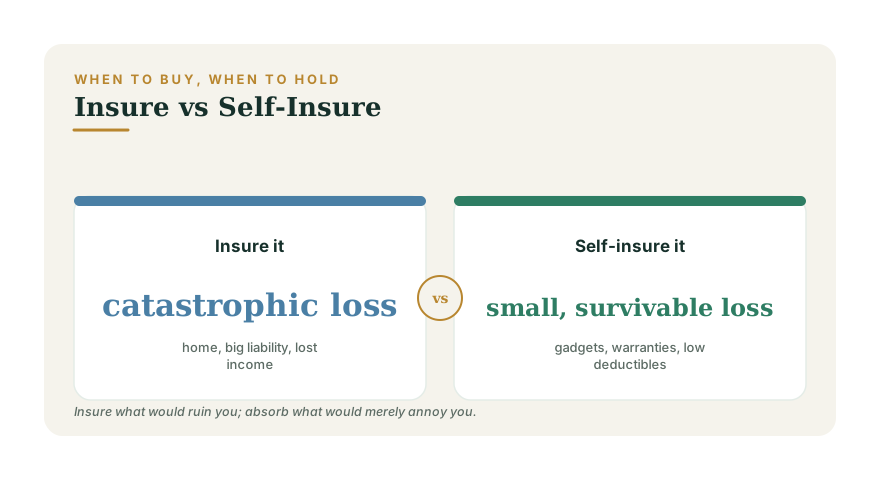
Picture losses on a scale from trivial to ruinous. The right strategy depends entirely on where a loss sits:
- Ruinous losses — your house burning down, a lawsuit, a disability that wipes out your income, a major health event. You could never absorb these from savings, so you must transfer them to an insurer. This is what insurance is for.
- Small, survivable losses — a cracked phone screen, a broken appliance, a $500 repair. Annoying, but not life-altering. Paying a premium to cover these is usually a losing trade, because the insurer prices in their profit and you would be insuring a cost you can simply pay.
The error most people make is backwards: they over-insure the small stuff with warranties and add-ons while under-insuring the catastrophic stuff like liability and disability.
Why extended warranties usually lose
Extended warranties on phones, laptops, appliances, and electronics are among the most reliably bad insurance buys. They are profit centers for retailers — a large share of the price is commission and margin, which is why cashiers push them so hard. The covered item is usually cheap enough to replace from savings, manufacturer defects are already covered by the standard warranty, and the most common failures (you dropped it) are often excluded anyway.
The honest alternative: decline the warranty and mentally bank the money. Across all the gadgets you own over a lifetime, self-insuring this category wins for the vast majority of people. The same logic applies to pet insurance for a healthy pet — for predictable, survivable costs, a savings bucket beats a premium.
Small-deductible add-ons: a hidden version of the same trap
The deductible you choose on your auto and home policies is a self-insurance decision in disguise. Picking a very low deductible means paying a higher premium to insure small claims you could easily cover yourself — and filing those small claims can raise your rates anyway. Raising your deductible to an amount you could comfortably pay out of pocket lowers your premium and reserves insurance for the losses that genuinely hurt. That is self-insuring done deliberately, and the trade-offs are spelled out in How to Choose Your Home Insurance Deductible.
The same pattern shows up everywhere: rental-car damage waivers, mortgage life insurance, credit-card payment protection, "accidental death" riders. Each insures a narrow, often-survivable scenario at a marked-up price.
When self-insuring is the wrong call
Self-insuring is powerful but not universal. Do not self-insure when:
- The potential loss is larger than your savings could absorb — that is precisely what real insurance is for.
- You do not actually have the reserve. Self-insuring only works if the money exists; otherwise you are just uninsured.
- The law or a lender requires coverage, as with auto liability or a mortgage.
- The peace of mind genuinely matters to you more than the premium — that is a legitimate reason to buy, just make it a conscious choice rather than a default.
Run the rule across your whole policy lineup
Take an afternoon and list every premium you pay. For each, ask: could I absorb this loss from savings without real harm? Where the answer is yes, consider dropping the coverage or raising the deductible and redirecting the premium into your reserve. Where the answer is no, keep it — and make sure it is sized correctly. The money you free up from over-insuring the small stuff is exactly what funds proper protection against the big stuff.
To find that line for your own finances, size your real exposures with the Insurance Needs Calculator, then confirm your savings can actually take the hits you have chosen to carry with the Financial Resilience Assessment.