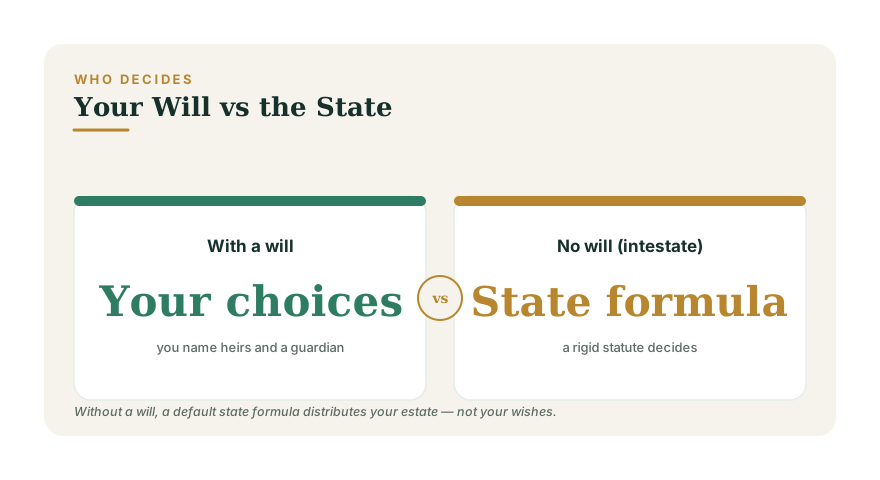
Most adults do not have a will. The common assumption is that without one, your spouse simply gets everything, or that your family will "sort it out." Neither is reliably true. When you die without a valid will — what the law calls dying intestate — you do not get to skip estate planning. You just hand the job to your state, which applies a one-size-fits-all formula that may look nothing like what you would have chosen.
Intestacy: the will the state writes for you
Every state has an intestate succession statute — a default order of who inherits when there is no will. These laws follow bloodlines and marriage in a fixed sequence: typically a surviving spouse and children first, then parents, then siblings, then more distant relatives. The exact split varies a lot by state. In many places a surviving spouse does not automatically receive the entire estate; they share it with the deceased's children or parents under a formula you never agreed to.
The rules are blunt by design. They cannot account for the stepchild you raised but never adopted, the partner you never legally married, the sibling you are estranged from, the friend you wanted to remember, or the charity you cared about. Intestacy recognizes legal relationships, not real ones. Anyone outside the bloodline-and-marriage chart — an unmarried partner, a close friend, a beloved cause — generally receives nothing.
The default distribution can surprise everyone
A few examples of how the formula can diverge from intent:
- A married person with children from a prior relationship may have their estate split between the current spouse and those children, leaving the spouse with far less than expected.
- An unmarried couple — no matter how long together — may find the survivor inherits nothing, with assets flowing to the deceased's parents or siblings instead.
- If no eligible relatives can be found, the estate can ultimately escheat to the state.
None of this reflects malice; it reflects a default rule doing exactly what it was written to do. A will exists precisely to override that default with your own instructions.
Who raises your children?
For parents of minor children, this is the part that matters most. A will is where you name a guardian for your kids. Without one, the court decides who raises them, choosing among relatives who step forward — possibly not the person you would have picked, and sometimes after a painful family dispute. No spreadsheet of assets outranks getting this single decision in writing.
Probate still happens — and it gets slower
A frequent myth is that skipping a will avoids probate. The opposite is closer to the truth. Probate is the court-supervised process of validating a will, paying debts, and distributing what remains. With no will, the estate still goes through probate; it just runs under the intestacy rules and usually takes longer, because the court must first appoint an administrator and may have to track down and verify heirs.
That administrator — the person who settles your affairs — is chosen by the court rather than by you, and they typically must post a bond. The process can stretch on for months or more, during which assets may be frozen and your family is left waiting. If you want to understand the machinery and how some assets sidestep it entirely, read How Probate Works and How to Avoid It.
What a will does not control
One important nuance: certain assets pass outside your will entirely, by beneficiary designation. Retirement accounts, life insurance, and many bank or brokerage accounts go to whoever is named on the account form, regardless of what any will says. That makes keeping those forms current at least as important as the will itself — a stale designation can send money to an ex-spouse. The mechanics are covered in Beneficiary Designations Override Your Will.
Even simple estates need a will
"My estate is simple, so I do not need a will" is the most common rationalization, and it misses the point. A will is not only about dividing wealth. It is where you name a guardian for your children, choose the executor who will wind up your affairs, and spare your family the cost, delay, and uncertainty of the state's default. The simpler your estate, the cheaper and faster the will is to write — there is little excuse to skip it.
Where to start
A basic will, paired with up-to-date beneficiary designations and a couple of healthcare documents, covers most people well. Begin with the foundations in Estate Planning Basics Everyone Needs, then gauge your own gaps with the Estate Readiness assessment. An afternoon of planning now is a gift to the people you would otherwise leave to navigate the default rules alone.