Open enrollment hands you a menu of plans labeled with cryptic acronyms — HMO, PPO, EPO, POS — and most people pick based on the premium alone. But the letters describe something that matters just as much as price: how the plan handles its network of doctors and whether you need referrals to see specialists. Get the plan type wrong for how you actually use care, and you can end up either overpaying or stuck with surprise bills.
The two questions that define every plan
All four plan types are really answers to two questions:
- Does the plan cover out-of-network care? A network is the set of doctors and hospitals that have agreed to the insurer's negotiated rates. Some plans pay nothing outside it; others pay a reduced share.
- Do you need a referral to see a specialist? Some plans require you to go through a primary care physician (PCP) who acts as a gatekeeper; others let you book a specialist directly.
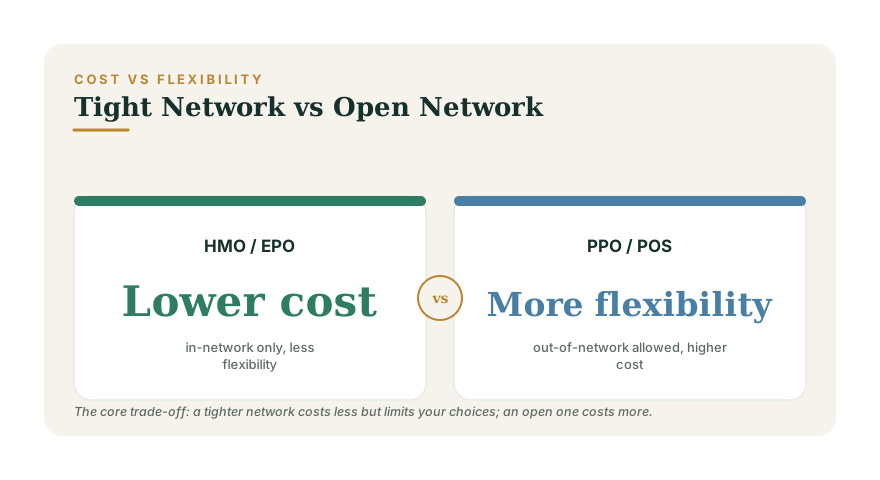
The general rule: the more a plan restricts you, the cheaper it is. Flexibility costs money. Here is how each type answers the two questions.
HMO: lowest cost, tightest rules
A Health Maintenance Organization plan keeps costs down by being strict. You pick a primary care physician, and you generally need a referral from them to see a specialist. Coverage is in-network only — go outside the network for non-emergency care and you typically pay the full bill yourself. In exchange, HMOs usually have the lowest premiums and predictable copays. They suit people who do not mind a gatekeeper and whose preferred doctors are already in-network.
PPO: most flexible, highest cost
A Preferred Provider Organization plan is the opposite end. No referrals are required — you can book a specialist directly — and the plan covers out-of-network care, just at a higher cost share than in-network. That flexibility comes with higher premiums and often a higher deductible. PPOs fit people who want maximum choice, see specialists frequently, travel often, or have established relationships with doctors who may not all be in one network.
EPO: in-network only, but no referrals
An Exclusive Provider Organization is a middle ground that borrows from both. Like an HMO, it covers in-network care only — no out-of-network coverage except emergencies. But like a PPO, it usually does not require referrals, so you can go straight to an in-network specialist. EPOs often land between HMO and PPO on price, and they work well if you are comfortable staying in-network but want to skip the referral hassle.
POS: a hybrid of HMO and PPO
A Point of Service plan mixes the two classic models. Like an HMO, you typically pick a PCP and need referrals for specialists. But like a PPO, it offers some out-of-network coverage at a higher cost. POS plans are less common and can be the most confusing, but they appeal to people who want a low in-network cost structure with an out-of-network safety valve.
Matching the plan to how you use care
The right choice depends less on which plan is "best" and more on how you actually use the health system:
- Young, healthy, rarely see a doctor? A tighter HMO or EPO with lower premiums often makes sense — you are unlikely to bump into the network limits.
- Manage a chronic condition or see specialists often? The referral-free access and broader networks of a PPO or EPO can be worth the higher premium.
- Have specific doctors you refuse to give up? Check which networks include them before anything else, then pick the cheapest plan that keeps them in-network.
- Travel a lot or split time between regions? Out-of-network coverage from a PPO or POS adds real protection.
Whatever you choose, always confirm your doctors and nearby hospitals are in the network before enrolling, and remember that staying in-network is the biggest lever on your bills — the topic of how health insurance works. The plan type interacts with deductibles and copays too, so weigh the whole structure, not just the network letters.
Coverage is the start, not the end
Choosing a plan type is only the first decision; you still have to use it well — staying in-network, getting referrals when required, and handling claims and bills when they come. Pairing the right network with the rest of your family's protection, including coverage for a non-earning parent, rounds out the picture. Run the cost trade-offs through the Financial Wellness assessment to see how your health coverage fits your overall plan.