Life insurance conversations almost always center on the breadwinner, and the stay-at-home parent gets skipped with a reasonable-sounding logic: they earn no income, so there is no income to replace. That logic is wrong, and the mistake can be expensive. A non-earning parent performs a large amount of work that has very real economic value — work the surviving family would suddenly have to pay strangers to do.
Why a non-earning parent still needs coverage
Life insurance is not really about replacing a salary; it is about replacing the financial contribution someone makes to a household. A stay-at-home parent's contribution shows up not as income but as costs the family avoids — childcare, household management, transportation, and more. If that parent dies, those costs do not disappear; they land on the surviving parent all at once, often at the same moment that parent must keep working a demanding job.
Picture the practical reality: a working spouse now has to arrange full-time childcare, after-school care, summer coverage, housekeeping, and all the daily logistics that one person used to handle for free. That is tens of thousands of dollars a year of new expense, on top of grieving and parenting alone. Life insurance exists precisely to keep a tragedy from also becoming a financial collapse — the same protective instinct behind sizing your liability and property coverage correctly.
Valuing the unpaid labor
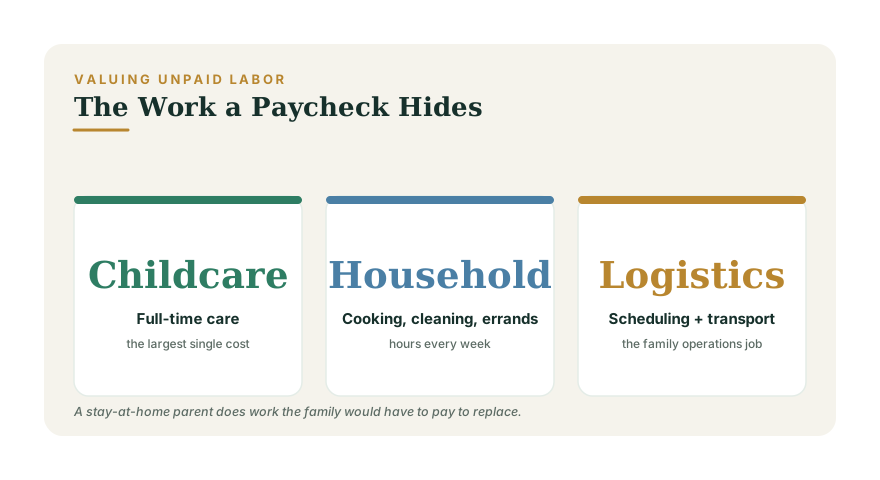
To decide how much coverage to buy, put a rough dollar figure on the work being done. Think in terms of what it would cost to hire it out:
- Childcare — usually the largest cost. Full-time care for one child is significant; for multiple young children it can rival a full salary.
- Household work — cooking, cleaning, laundry, grocery shopping, and errands add up to many hours a week that someone would have to be paid to cover.
- Family logistics — scheduling appointments, managing the household calendar, transporting kids, handling the hundred small tasks that keep a family running.
Add these up at local hourly rates and the annual value of a stay-at-home parent commonly lands in the tens of thousands of dollars. That figure, projected over the years until the kids are independent, is roughly the financial hole their loss would create.
How much coverage to carry
You do not need to replicate a breadwinner-sized policy, but you need enough to fund the services the surviving parent would have to buy. A practical approach is to estimate the annual replacement cost and multiply it by the number of years until the children are grown and self-sufficient, then add a cushion for one-time needs.
Coverage should be enough to pay for childcare and household help through the dependent years, cover any debts the family carries, and ideally leave room to give the surviving parent some flexibility — to work less, or take time off, during the hardest stretch. The same how-much framework used for an earner applies here; it is walked through in how much term life insurance you need.
Term insurance is almost always the answer
For this need, term life insurance is the right tool. Term policies cover a set period — say 15 or 20 years — for a low, level premium, which is ideal because the need itself is temporary: it ends when the children are grown. You are insuring a specific window of vulnerability, not your whole life.
Avoid being upsold expensive permanent or whole-life policies for this purpose. They cost many times more for the same death benefit, and the extra money is far better invested separately. A healthy adult can often buy a substantial term policy for a modest monthly premium — frequently less than a streaming-and-takeout habit. Both parents should be covered: if the working parent dies, the family loses income; if the stay-at-home parent dies, the family gains enormous new costs. Both are real risks.
Build it into the family plan
Covering a stay-at-home parent is one of the highest-value, lowest-cost protective moves a young family can make, and it pairs naturally with sorting out health coverage and an emergency fund. Map out how much your family would actually need with the insurance calculator, then fit the premium into your broader strategy at the planning hub.