One of the most disorienting parts of moving to the United States is discovering that your financial reputation does not travel with you. You may have paid every bill on time for twenty years in another country, but to American lenders you arrive as a blank page. This is the "thin file" or "no file" problem, and it shapes everything from renting an apartment to financing a car.
The good news is that no credit history is very different from bad credit history. You are not digging out of a hole; you are starting fresh, and a fresh start can become a solid score faster than most newcomers expect.
Why Your Foreign Credit Does Not Count
The three US credit bureaus build their files around a Social Security number (SSN) or an Individual Taxpayer Identification Number (ITIN). Foreign credit reports are not connected to these systems, so even an excellent record abroad does not transfer. A few large international banks let existing customers carry some history when they open a US account, and a handful of services try to translate foreign credit data for lenders, but you should not count on either. Plan to build from scratch.
Step 1: Get an SSN or ITIN and Open a Bank Account
If you are authorized to work, apply for an SSN. If you are not eligible for one but still file US taxes, you can apply for an ITIN. Either number lets you open accounts and start building a file. Open a checking and savings account at a bank or credit union as soon as you can. The accounts themselves do not build credit, but they establish a banking relationship that can lead to a first card.
Step 2: Open a Secured Credit Card
A secured card is the workhorse of newcomer credit building. You put down a refundable deposit, often a few hundred dollars, and that deposit becomes your credit limit. You use the card like any other, and the issuer reports your payments to the bureaus. After several months of on-time payments, many issuers refund the deposit and convert the account to a regular card.
- Look for no annual fee and confirmation that the issuer reports to all three bureaus.
- Charge a small recurring bill and pay it in full every month.
- Keep your usage low — ideally under about 30 percent of the limit, and lower is better.
Step 3: Add a Credit-Builder Product
Some banks and credit unions offer credit-builder loans, where the amount you borrow sits in a locked savings account while you make monthly payments. When the loan is paid off, you receive the money and you have a record of on-time installment payments. A mix of a revolving account (the card) and an installment account (the loan) can help your score mature.
Step 4: Consider Banks That Weigh Foreign History
A small number of lenders, often those focused on students, new arrivals, or specific immigrant communities, will look at factors beyond a traditional score — your income, education, or banking relationship abroad. These can be a useful bridge to a first unsecured card. Read the terms carefully and watch for high fees.
What to Avoid
Do not chase store cards or high-fee subprime cards that promise easy approval. Do not apply for many accounts at once, since each application is a hard inquiry. And be skeptical of anyone who offers to sell you a credit history or add you as an "authorized user" on a stranger's account for a fee — that is a common scam.
A Realistic Timeline
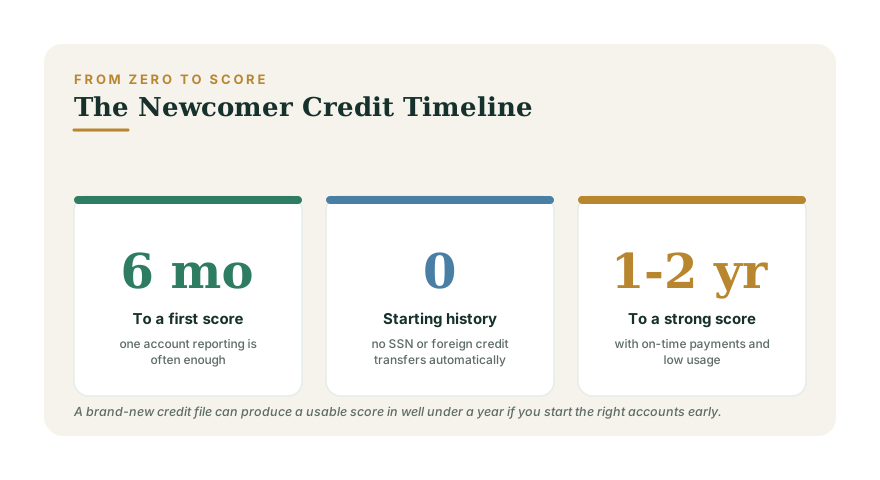
With one well-managed account, you can generate a score in roughly six months. After a year or two of perfect payments and low balances, that score can reach the range that unlocks good apartments, car loans, and rewards cards. The mechanics are the same for everyone, which we cover in depth in how to build credit from scratch and in our H-1B financial guide.