For years, one fear kept parents from fully funding a 529 college-savings account: what if the child gets a scholarship, skips college, or simply does not use it all? Leftover money could be withdrawn, but the earnings would face income tax plus a penalty if not used for education. SECURE 2.0 added a genuinely useful escape hatch — the ability to roll unused 529 funds into a Roth IRA for the account's beneficiary.
What the provision actually allows
Money that has been sitting in a 529 can be moved, tax-free and penalty-free, into a Roth IRA owned by the beneficiary of the 529 — typically the child. It turns unused education savings into a head start on retirement, which removes much of the risk of overfunding a college account. The full mechanics of 529s themselves are in 529 Plans, Explained. The IRS is the authority on the conditions, published on its retirement plans pages, and details are still being clarified — so confirm current guidance before acting.
The rules that gate it
This is not a loophole to shovel money into a Roth. The guardrails are strict:
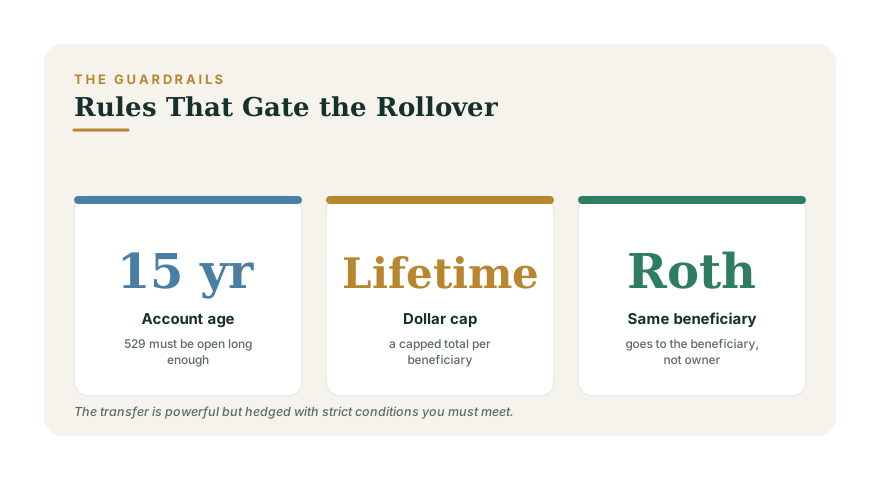
- Account age. The 529 generally must have been open for at least 15 years before you can roll funds out to a Roth.
- Seasoning of contributions. Contributions (and their earnings) made in the last several years typically cannot be rolled — only older money qualifies.
- Same beneficiary. The Roth IRA must belong to the 529's beneficiary, not the account owner. The money follows the child.
- Annual limit. Each year's rollover counts against that person's normal Roth IRA contribution limit, so it moves over in yearly slices, not all at once.
- Earned income required. The beneficiary must have earned income at least equal to the amount rolled in a given year, just like any Roth contribution.
- Lifetime cap. There is a capped lifetime total that can ever be rolled from a 529 to a Roth for one beneficiary.
Why the yearly limit matters most
Because each transfer eats into the beneficiary's annual Roth contribution limit, you cannot empty a large leftover balance in one move. It takes several years of rollovers to reach the lifetime cap, and in any year the beneficiary uses the rollover, they have less room for their own direct Roth contributions. For a young adult just starting to work, that is usually a fine trade — but it is a real constraint to plan around. The value of a Roth for a young person is enormous; see Roth vs Traditional IRA.
Who benefits most
This provision rewards families who saved diligently and ended up with a surplus — a scholarship recipient, a child who chose a cheaper school, or grandparents who overfunded out of caution. It also makes funding a 529 feel less like a gamble, because worst case, unused money becomes retirement seed capital for the child rather than a taxed-and-penalized withdrawal. Model your college funding with the College Planner to see whether you are likely to over- or underfund.
Do not overcorrect
- The rollover is a safety net, not a reason to deliberately overfund a 529 as a backdoor Roth strategy — the caps and timing rules make that inefficient.
- Keep records of when the 529 was opened and when contributions were made; the 15-year and seasoning rules depend on dates.
- Coordinate with the beneficiary's own earned income and Roth contributions each year.
Plan the education-to-retirement bridge
The 529-to-Roth rollover is one of the friendlier parts of recent tax law: it lowers the stakes of saving for college and quietly boosts a child's retirement. Weigh it alongside your broader plan, check your college-savings readiness with the College Readiness assessment, and map the full strategy at the planning hub.