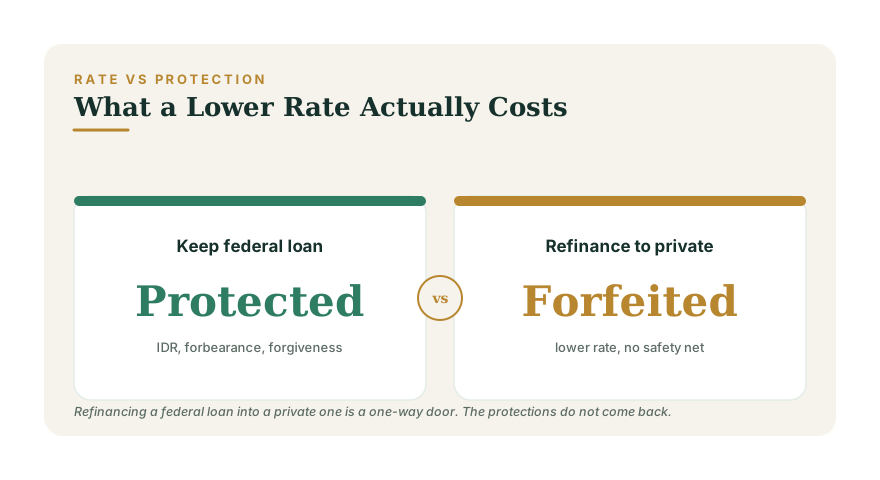
A refinancing pitch is simple and it sounds like a no-brainer: you are paying 6.5% on your student loans, a lender will give you 5%, and you save money every month. What the pitch leaves out is that when you refinance a federal student loan, you are not lowering your rate on the same loan. You are paying off a federal loan with a brand-new private one, and the moment that happens, every federal protection attached to the old loan is gone forever. There is no undo button.
The honest truth: you are trading a safety net for a discount
Federal student loans come bundled with benefits that have nothing to do with the interest rate, and those benefits are the entire reason the federal program exists. When you refinance with a private lender, you give up all of them at once:
- Income-driven repayment (IDR). Federal plans can cap your monthly payment at a percentage of your discretionary income. If you lose your job or your income drops, your payment can fall to a manageable number, sometimes near zero. Private lenders do not offer this. Your payment is your payment.
- Forbearance and deferment. Federal loans let you pause payments during hardship, unemployment, or a return to school. Private lenders may offer a short, discretionary pause if you are lucky, but it is not a right and it is rarely generous.
- Forgiveness programs. Public Service Loan Forgiveness (PSLF) can wipe out the remaining balance after 120 qualifying payments for people in government and nonprofit jobs. IDR plans forgive remaining balances after 20-25 years. Private loans qualify for none of this.
- Death and disability discharge. Federal loans are discharged if the borrower dies or becomes permanently disabled. Many private loans are not, which can leave a co-signer on the hook.
Follow the money
Refinancing lenders make money on the spread between what they pay for capital and the rate they charge you, multiplied across years of payments. The lower rate is real, but it is also the bait. They advertise the headline number because it is the one thing they can beat the government on, and they stay quiet about protections because protections are exactly what they cannot match. The borrowers they most want are the ones with high balances and stable, high incomes, because those borrowers are the least likely to ever need the safety net they are signing away, and the most profitable to lend to. The pitch is engineered to feel like a smart-money move precisely for the people who can least imagine needing help.
Now the math
Say you owe 60,000 dollars at 6.5% on a 10-year term. A refinance to 5% lowers your payment from about 681 dollars to about 636 dollars, saving roughly 45 dollars a month, or about 5,400 dollars in interest over the full term. That is a real number and it is not nothing.
Now weigh it against what you gave up. Suppose two years in, you lose your job for eight months. On the federal loan, IDR could have dropped your payment to near zero while you recovered, with no late marks and no default. On the private loan, you owe 636 dollars a month regardless. Miss a few and you are looking at late fees, a damaged credit score, and possible default. The 5,400 dollars you saved in interest evaporates against a single bad year, and the credit damage can cost you far more on your next mortgage or car loan. The federal protection is essentially free insurance, and refinancing cancels the policy to save a few thousand dollars over a decade.
For someone pursuing PSLF the math is even starker. If you are a nurse, teacher, or public defender on track to have a 40,000 dollar balance forgiven after 10 years, refinancing to save a point of interest throws away a 40,000 dollar benefit to chase a few thousand in savings. That is not a discount. That is setting money on fire.
When refinancing is actually fine
The trap is specific to federal loans. If your loans are already private, refinancing carries no protection downside because private loans never had federal protections to lose. Shopping a private loan to a lower rate is just smart comparison shopping. The decision changes entirely based on what you are starting with.
A decision framework by borrower type
- You have private loans only. Refinance freely whenever you can get a meaningfully lower rate and a stable income to support fixed payments. Nothing to lose here.
- You have federal loans and a rock-solid, high income. Refinancing can make sense only if you are certain you will never need IDR, forbearance, or forgiveness. Be honest about how certain anyone can really be about that.
- You are pursuing PSLF or any forgiveness. Never refinance the federal loans in the program. You would be canceling the forgiveness to save pennies on the dollar.
- Your income is variable, early-career, or uncertain. Keep your federal loans. The protections are worth far more than a rate cut when your financial life is still volatile.
- You have a mix. Refinance only the private portion if you want a better rate, and leave the federal loans alone.
The honest recommendation
Treat federal student loan protections as paid-up insurance you already own. Do not cancel that policy for a rate cut unless you are genuinely certain you will never file a claim, and most people cannot be that certain. The rule is simple: never refinance federal loans you might one day need protections on. Private loans are fair game; federal loans almost never are.
Before you sign anything, run both scenarios. Compare the interest you would actually save against the realistic chance you will need a payment pause or forgiveness in the next decade. Map out your full debt picture in your plan, pressure-test it with the tools, and read more on related debt traps in our articles before you make a move you cannot reverse.