Where you owe state income tax feels like it should be obvious: you live somewhere, so you pay tax there. In reality, states use two distinct tests to decide whether they can tax you as a resident, and it is entirely possible to trip both — or to think you have escaped a high-tax state when, in the eyes of that state, you never left. With more people working remotely and moving to no-income-tax states, these questions have become one of the most litigated corners of personal tax.
The stakes are real. A state that considers you a resident can tax your entire income — including investment gains and out-of-state earnings — not just what you made within its borders. Getting the move right is worth serious attention, and getting it wrong can surface as an audit years later.
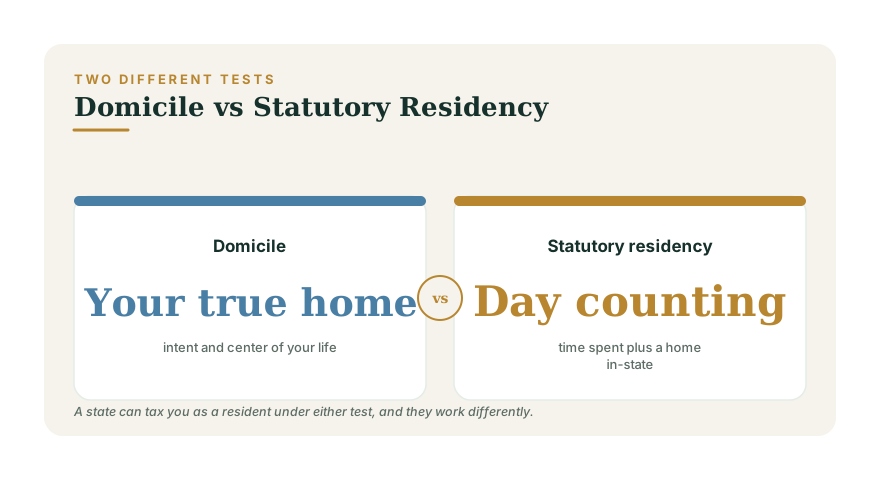
Domicile: your one true home
Domicile is the deeper of the two concepts. It is the single place you consider your permanent home — the place you intend to return to. You can have many residences but only one domicile, and it does not change just because you spend time elsewhere. To shift your domicile from one state to another, you generally must both leave the old state and establish genuine roots in the new one, with the intent to stay. Because intent is subjective, states look at objective evidence: where you register to vote, where your driver's license and car registration are, where your family and doctors are, where you spend holidays, and where your most valued possessions live. A half-hearted move leaves your old domicile intact.
Statutory residency: the day-count trap
Even if you successfully change your domicile, a state can still tax you as a statutory resident under a separate, mechanical test. Many states treat you as a full-year resident if you maintain a home there and spend more than a set number of days in the state during the year — often around half the year. This is where snowbirds and commuters get caught: someone who "moved" to a no-tax state but kept an apartment in the old state and spent a lot of days there can be taxed as a resident of both the new state (by domicile) and the old one (by statutory residency). The day count is unforgiving, and even a partial day in the state can count. The general mechanics of a cross-state move are covered in State Taxes When You Move.
Why high-tax states fight to keep you
States with high income taxes have strong incentives to challenge departures, and their revenue departments run sophisticated residency audits. They will examine cell-phone location data, credit-card and toll records, and social-media posts to reconstruct where you actually spent your days, and they scrutinize whether your "move" was real or cosmetic. The burden often falls on you to prove you genuinely relinquished your old domicile. This is not a reason to avoid moving — it is a reason to make the move clean and well-documented.
How to make a move stick
If you are relocating to change your tax home, treat it as a deliberate project rather than a formality:
- Sever ties with the old state. Sell or genuinely give up your old home, or at least stop treating it as your base. Change your voter registration, driver's license, and vehicle registration to the new state promptly.
- Build ties in the new state. Move your primary bank accounts, doctors, dentist, place of worship, clubs, and professional relationships. Update your estate documents to the new state.
- Count your days carefully. Keep a contemporaneous log of where you are each day, with evidence, and stay well under any statutory-residency threshold in the old state.
- Move what matters to you. Auditors ask where your "near and dear" items are — family photos, heirlooms, pets, the things that signal where your life really is.
- Mind remote-work rules. Some states tax income earned for an in-state employer even when you work from elsewhere, so a remote job can create a filing obligation you did not expect. A job relocation deserves a look at these rules before you accept.
Two states, and how not to be double-taxed
In a year you move, you will often file a part-year return in each state. If two states both claim you as a resident, or if you work in one state and live in another, you can face overlapping tax — but a credit for taxes paid to another state usually prevents true double taxation on the same income. The rules are intricate and vary by state pairing, so a year with a move is often worth professional help. Remember, too, that new untaxed income in your new state may require quarterly estimated payments if there is no withholding.
The bottom line
Changing states to lower your tax is legitimate and common, but it is a change of your whole life on paper, not a change of address. Establish a real domicile in the new state, sever ties with the old one, watch the day-count trap, and keep records that would satisfy an auditor. When a move is on the horizon, run the numbers with the Tax Strategies tool and the Lifetime Wealth simulator, and pressure-test the plan with the Tax Health assessment and the planning hub.