Federal income tax is the same no matter where in the country you live, but state income tax is a patchwork — different rates, different rules, and a handful of states with no income tax at all. Most of the time this is invisible, because you live and work in one state all year. The moment you move, or take a remote job for a company in another state, the picture gets complicated fast, and the surprises usually arrive at tax time, long after you can change anything.
Residency is the foundation of everything
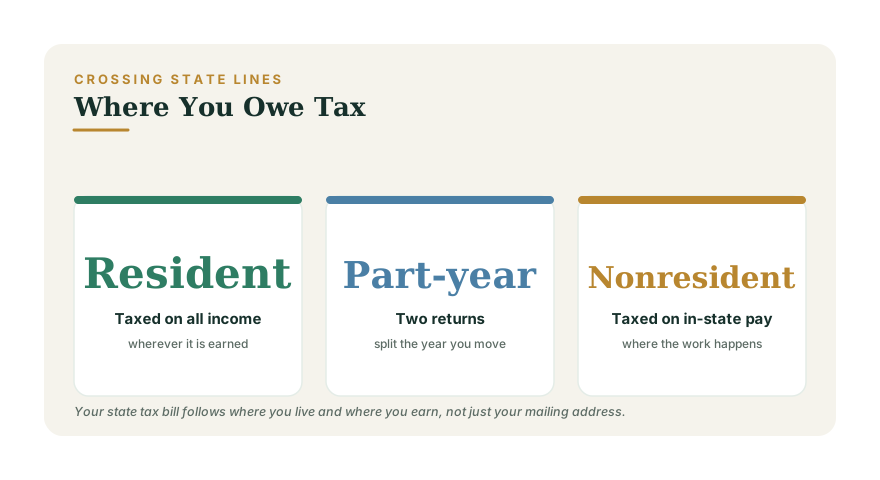
State taxation starts with residency. The state you are a resident of generally taxes you on all of your income, from every source, no matter where you earned it. So the first question whenever you relocate is: which state am I actually a resident of? It is not always where your mail goes.
States look at where your true home is — where you spend your time, where your family and belongings are, where you are registered to vote and licensed to drive, and where you bank and work. Many states also apply a day-count test (for example, treating you as a resident if you spend more than a certain number of days there). To establish residency in a new state and end it in the old one, you generally need to genuinely move your life: change your driver's license and voter registration, update accounts and your mailing address, and spend the bulk of your time in the new state.
The exit-state problem
Some high-tax states are aggressive about not letting you go. If you move away but keep a home, keep significant ties, or spend a lot of days in the old state, it may argue you are still a resident and still owe full state tax there. People who move to a no-tax state but keep one foot in their old high-tax state are the classic target of a residency audit. Cleanly cutting ties — not just changing your address — is what protects you.
Part-year returns: the year you move
In the calendar year you relocate, you typically were a resident of two states at different points. That usually means filing a part-year resident return in each: you report the income you earned while living in State A to State A, and the income earned after the move to State B. The two returns together should cover your whole year without overlapping. It feels like extra paperwork, but the logic is clean — each state taxes the slice of the year you lived there.
No-income-tax states
A small group of states levy no state income tax at all. Living in one can be a real saving, which is part of why they are popular destinations for movers and remote workers. Two cautions, though. First, those states still raise revenue somehow — often through higher property or sales taxes — so "no income tax" does not always mean "low total taxes." Second, moving to a no-tax state only helps if you genuinely establish residency there and sever ties with your former state; a sloppy move can leave you taxed by the old state anyway.
Remote work and the double-taxation trap
Remote work is where people get blindsided. If you live in one state and work remotely for an employer based in another, which state taxes your wages? Usually your home state (where you physically do the work) has the primary claim. But complications pile up quickly:
- Nonresident filing. If you travel to work in another state, or your employer's state asserts a claim, you may have to file a nonresident return there in addition to your home-state return.
- The "convenience of the employer" rule. A few states tax remote workers of in-state companies as if they worked in that state, even when the employee never sets foot there — a notorious trap for people who move away but keep the same employer.
- Double taxation risk. When two states both claim the same income, you can be taxed twice on the same dollars.
The main relief is the credit for taxes paid to another state: your home state usually lets you offset the tax you paid to the other state, so you are not fully double-taxed. It is not automatic, though — you have to file in both states and claim the credit correctly, and it does not always erase the difference if the two states' rates differ.
What to do before and after you move
- Document the move. Keep records of when you changed your license, registration, and address, and roughly how many days you spent in each state. This is your defense in a residency dispute.
- Tell your employer. Your withholding needs to match your new state, or you will face a mismatch at filing time. (For a refresher on how withholding flows through your paycheck, see how tax brackets really work.)
- Expect multiple returns in transition years. Budget time and possibly a tax professional for the year you move or change work states.
- Mind deductions across states. State rules on what you can deduct differ; our note on standard versus itemized deductions is a useful starting point, though each state has its own twists.
Plan the move, not just the box of belongings
A state move is a financial event, not only a logistical one. The difference between a clean residency change and a sloppy one can be thousands of dollars and an audit you would rather avoid. Before a relocation or a remote-work arrangement, fold the tax picture into your wider plan at the planning hub, and run the Tax Health assessment to surface the questions you should be asking. A little planning up front beats untangling two states' returns after the fact.