One of the most powerful estate-planning tools costs nothing and takes about five minutes: naming a beneficiary on your bank and brokerage accounts. With a simple form, you can arrange for an account to pass directly to the people you choose the moment you die — skipping probate, the often slow and public court process for settling an estate. The labels are POD for bank accounts and TOD for investment accounts, and the idea behind both is the same.
What POD and TOD mean
POD — payable on death — is the designation used on bank accounts: checking, savings, and CDs. You name one or more people to receive the balance when you pass away. TOD — transfer on death — is the equivalent for brokerage and investment accounts, naming who inherits the securities and cash inside. Functionally they are the same tool with different names for different account types.
The key feature of both: the beneficiary has no access and no rights while you are alive. You remain the sole owner, can spend or move the money freely, and can change or remove the beneficiary anytime. The designation only takes effect at death. That makes POD/TOD very different from a joint account, where the co-owner has full access immediately — a distinction explained in joint bank accounts explained.
How it avoids probate
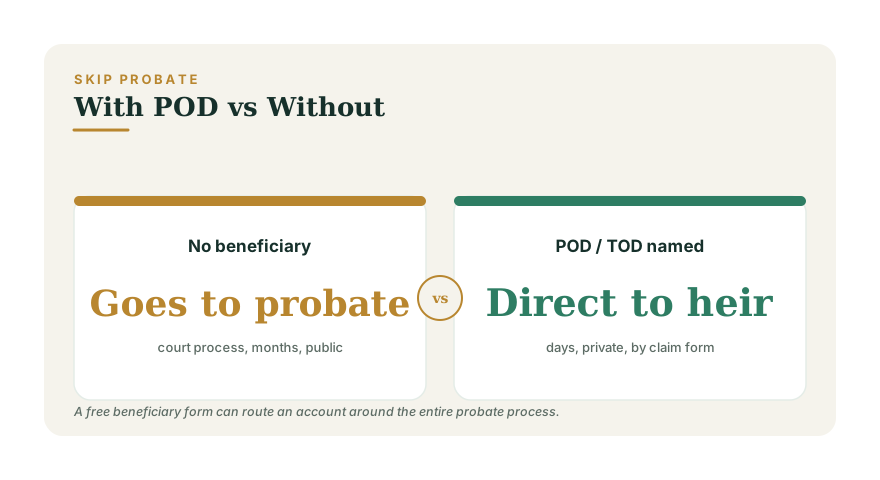
When someone dies, assets that pass through their will normally go through probate — a court-supervised process to validate the will, pay debts, and distribute what is left. Probate can take months, costs money, and becomes part of the public record. Accounts with a valid POD or TOD beneficiary skip all of that. The money is not part of the probate estate; the named beneficiary simply contacts the institution, shows a death certificate and ID, and the funds are released, often within days. For the bigger picture on sidestepping the court process, see how probate works and how to avoid it.
Beneficiary forms override your will
This is the part that trips people up. A POD or TOD designation beats whatever your will says. If your will leaves everything to your spouse but a savings account names your sibling as POD beneficiary, your sibling gets that account — full stop. Beneficiary forms are not overridden by a will; they sit above it. This means a stale beneficiary form can quietly undo your intentions, which is why review matters. The full warning is in beneficiary designations override your will.
Where POD and TOD fit — and where they fall short
These designations are ideal for the straightforward case: you want a specific account to go to a specific person quickly and privately. They are simple, free, and revocable. But they are not a substitute for a full estate plan:
- They only cover the accounts you put them on. Anything without a beneficiary still goes through probate.
- They pass money outright, with no strings. If a beneficiary is a minor, has special needs, or is bad with money, an outright transfer can cause problems a trust would have handled.
- If a beneficiary dies before you and you named no backup, the account can fall back into probate. Naming a contingent (backup) beneficiary prevents this.
- They do not address what happens if you become incapacitated — that requires a power of attorney, not a death beneficiary.
For most people, POD/TOD designations complement a will and trust rather than replace them. They handle the liquid accounts cleanly so cash reaches your heirs fast, while the will and any trust handle everything else.
How to set them up
The process is genuinely easy:
- Ask your bank or brokerage for the beneficiary designation form — most let you do it online in a few minutes, or in a branch.
- Provide each beneficiary's full legal name and, often, their date of birth or Social Security number.
- Name a contingent beneficiary as a backup in case the primary predeceases you.
- If naming several people, specify the percentages so there is no ambiguity.
- Keep a record of which accounts have designations and review them after any major life event — a marriage, divorce, birth, or death.
Make it part of a plan
Set a reminder to revisit your beneficiary forms whenever your life changes, because an outdated form is one of the most common and avoidable estate mistakes. To see where POD and TOD fit alongside wills, trusts, and powers of attorney, gauge your readiness with the estate readiness assessment, then organize the next steps through the planning hub. A few minutes of paperwork now can save your family months of court later.