When cash runs out before payday, a storefront or app offering a few hundred dollars "until your next check" can feel like a lifeline. The fee looks modest — fifteen or twenty dollars per hundred borrowed, due in two weeks. The problem is what that small fee becomes when you cannot repay on time, and how rarely a single payday loan stays a single payday loan. This is one of the few financial products designed so that the difficult outcome is the most common one.
How a payday loan works
A payday loan is a small, short-term, high-cost loan, typically due in full on your next payday. You borrow, say, $300 and agree to repay $345 in two weeks — a $45 fee, or $15 per $100. To get it, you usually give the lender a post-dated check or authorization to debit your bank account on the due date. There is little or no credit check, which is exactly why people in a bind turn to it. The catch is that the entire balance plus fee is due in a lump sum, very soon — and if you were short on cash this paycheck, you are very likely to be short again on the next one.
Why the APR is triple-digit
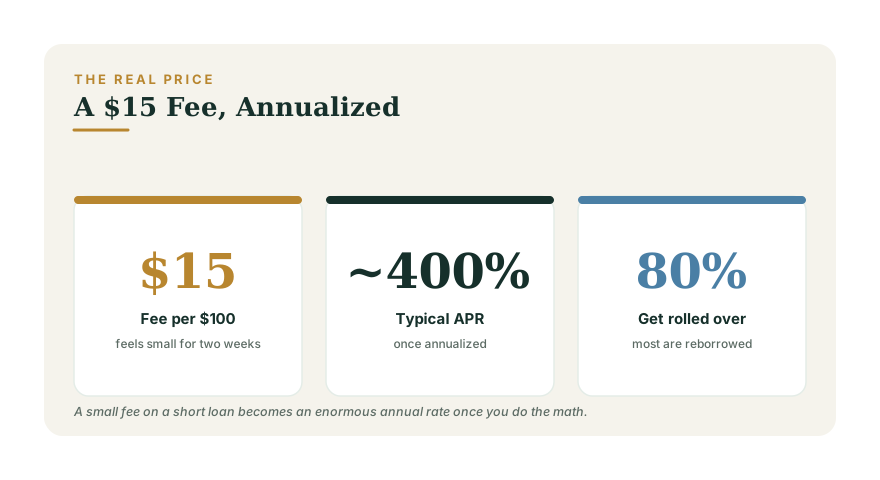
That $15-per-$100 fee sounds reasonable for a two-week loan. But annual percentage rate exists precisely to let you compare borrowing costs on equal footing, and once you annualize a two-week fee, the number is staggering. A $15 fee on $100 for 14 days works out to an APR of roughly 400%. A credit card at 24% — which feels expensive — is a fraction of that cost. The fee is small in dollars only because the term is tiny; as a rate of interest, payday lending is among the most expensive borrowing available to ordinary consumers. Understanding APR is the single best defense, the same way it cuts through the fine print on the offers in Personal Loans: When They Make Sense.
The rollover cycle
Here is the mechanism that turns a one-time loan into a trap. When the loan comes due and you cannot pay the full $345, the lender offers to "roll it over": pay just the $45 fee to extend the loan another two weeks. You hand over $45, your $300 principal is untouched, and two weeks later you face the exact same choice. Pay another fee, roll again. After a few months of this, you have paid more in fees than you originally borrowed — and you still owe the full $300.
This is not a rare misstep; it is the core of the business. A large share of payday loans are reborrowed rather than repaid on schedule, and a majority of the industry's revenue comes from borrowers stuck in repeat cycles. The product works best for the lender when the borrower cannot escape, which is why it is widely described as a debt trap rather than an emergency tool.
Other predatory lending to recognize
Payday loans have cousins that share the same DNA — high cost, structured for repeat borrowing:
- Auto title loans use your car as collateral. The APRs rival payday loans, and missing a payment can cost you the vehicle you need to get to work.
- Some "no credit check" installment loans and high-cost lines marketed to people with thin credit carry rates well into the triple digits.
- Refund-anticipation products and certain cash-advance apps can carry steep effective costs once you account for fees and "tips" against a short term.
Safer options when cash is short
Almost anything is cheaper than a payday loan. Before resorting to one, work down this list:
- Ask the biller for time. Utilities, medical providers, and landlords often have hardship or payment-plan options if you ask before the due date.
- Negotiate with existing creditors for a short reprieve rather than borrowing new money — see How to Negotiate With Creditors and Collectors.
- A credit-card cash advance is costly, but its APR is still a fraction of a payday loan's.
- A small loan from a credit union — many offer "payday alternative loans" with capped, far lower fees.
- An advance from your employer or a no-fee earned-wage-access benefit, if available.
- Local assistance — nonprofits, community funds, and religious organizations often help with rent or utilities in a crunch.
The real fix is upstream
Payday loans thrive on the gap between paychecks. The durable escape is a small cash buffer that absorbs the shocks that would otherwise send you to a lender — even a few hundred dollars changes everything. Start building one with the guidance in The Emergency Fund Guide, work on closing the monthly gap using How to Stop Living Paycheck to Paycheck, and size your target buffer with the Emergency Fund Calculator. The goal is simple: never be in the position where a 400% loan looks like your best option.