On the surface, a credit union and a bank do the same things: they hold your checking and savings, issue debit cards, make loans, and let you pay bills. The real difference is structural — who owns the institution and who it ultimately works for. That single difference quietly shapes the rates you earn, the fees you pay, and the service you get.
The ownership difference
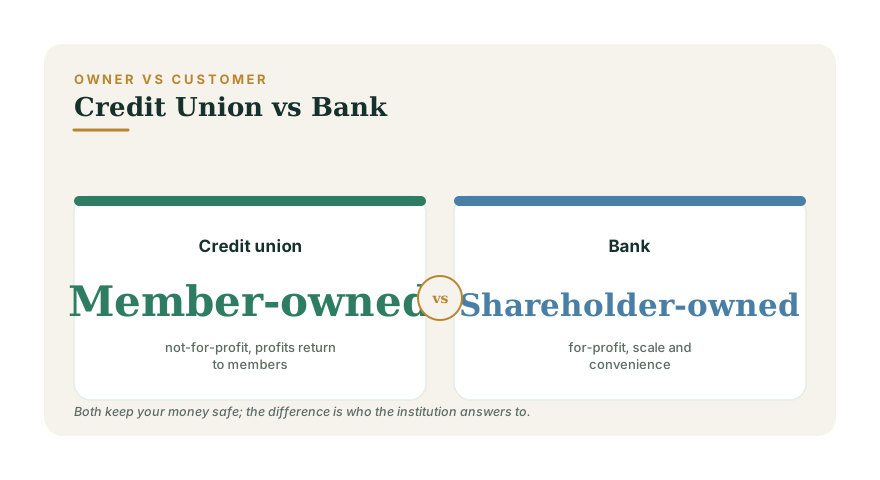
A bank is a for-profit company owned by shareholders. Its job is to earn a return for those owners, and the fees and rates it sets serve that goal. A credit union is a not-for-profit cooperative owned by its members — the people who bank there. When you open an account at a credit union, you become a part-owner with a vote, not just a customer.
Because a credit union has no outside shareholders to pay, any surplus it earns is returned to members in the form of better rates, lower fees, and sometimes a year-end dividend. This is not charity; it is just a different math. The institution is built to break even for its members rather than to profit from them.
Rates and fees: where credit unions usually win
That structure tends to show up in the numbers. On average, credit unions pay higher interest on savings and charge lower interest on loans — car loans and credit cards especially — than comparable banks. They also tend to charge fewer and smaller account fees, including lower overdraft charges. None of this is guaranteed for every product at every institution, so you still compare, but the averages lean toward the credit union.
The fees worth watching are the same at both: monthly maintenance, overdraft, and out-of-network ATM charges. The good news is that credit unions often belong to shared ATM networks that give you thousands of surcharge-free machines despite having few branches. For the full menu of avoidable charges, see the bank fees quietly draining your checking account and the deeper look at overdraft and NSF fees.
Membership: the catch, and why it is smaller than it sounds
To join a credit union you must be eligible for membership. Historically this meant a shared "field of membership" — working for a certain employer, living in a certain county, or belonging to a particular group. That sounds restrictive, but in practice most people can find a credit union they qualify for. Many are open to anyone who lives or works in a region, and some let you join simply by becoming a member of an associated nonprofit. Joining usually requires a small one-time deposit (often five to twenty-five dollars) into a share account, which represents your ownership stake.
Where each one wins
Banks tend to win on scale and technology. Large national banks have branches and ATMs in most cities, polished mobile apps, 24/7 support, and a wide range of products — useful if you travel often, want everything under one roof, or need specialized business or wealth services. Big banks also tend to roll out new digital features first.
Credit unions tend to win on cost and service. If your priority is paying less to borrow, earning more on deposits, and dealing with an institution that treats you as an owner, a credit union is hard to beat — particularly for an auto loan or a first credit card. The trade-off is usually a smaller branch footprint and occasionally slower technology, though shared networks and improving apps have narrowed that gap considerably.
Your money is equally safe either way
A common worry is whether a credit union is as safe as a bank. It is. Bank deposits are insured by the FDIC; credit union deposits are insured by the NCUA, a separate federal agency that provides the same standard coverage limit per depositor, per institution. As long as your institution carries that insurance — virtually all do — your money is protected to the same degree. The choice between them is about cost, convenience, and service, not safety.
How to decide
You do not have to pick just one. A popular approach is to keep your everyday checking wherever it is most convenient, then use a credit union for the products where its lower rates matter most — a car loan, a credit card, or savings. Many people who already split their banking between an online bank and a brick-and-mortar institution, as described in online banks vs traditional banks, simply slot a credit union into that mix.
Before you move anything, get clear on what your current accounts actually cost you in fees and lost interest. Run your monthly numbers through the budget analyzer to see where a lower-fee, higher-yield institution would change the picture — sometimes a single switch is worth a few hundred dollars a year.