When prices climb, a raise that merely matches last year's salary is quietly a pay cut. If everything you buy costs more and your paycheck stands still, your buying power shrinks. So the goal is not just a bigger number on your offer letter — it is a raise that outpaces the cost of living, giving you a real increase in what your money can do. That takes a little more preparation than walking in and asking.
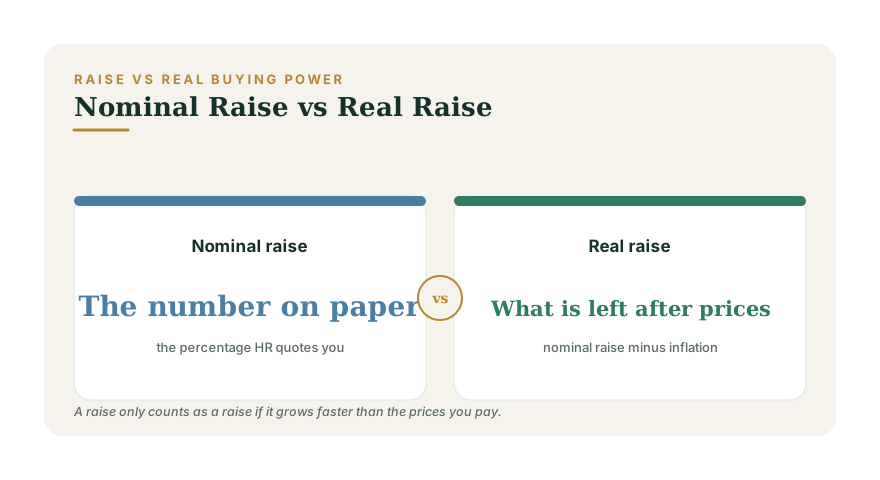
The distinction that matters is between a nominal raise (the percentage your employer quotes) and a real raise (that percentage minus inflation). If inflation ran a few percent over the past year and you get a raise of the same size, your real raise is roughly zero. Beating inflation means aiming higher and knowing your number before you speak.
Anchor to inflation, not to last year's salary
Start with the cost-of-living reality. The Bureau of Labor Statistics publishes the Consumer Price Index (CPI), the standard measure of how much a typical basket of goods and services has risen in price. You do not need to quote a decimal in the meeting, but you should know roughly how much prices have moved so you can frame your ask above it. If a cost-of-living adjustment merely keeps pace with CPI, it holds your buying power flat — a real raise has to clear that bar. Anchoring to the price level rather than to your old salary reframes the conversation from "I want more" to "my compensation needs to keep up with the cost of doing my job and living my life."
Do the market research that justifies the number
Inflation sets the floor; the market sets the ceiling. Before you ask, gather evidence for what your role pays now, not what it paid when you were hired:
- Salary data for your title, level, and metro. Reputable salary surveys and job postings for equivalent roles show the going rate. Pay compression is common — new hires often earn more than loyal staff — and that gap is legitimate leverage.
- Your own results. Keep a running list of what you shipped, saved, or grew. Concrete outcomes beat "I have been here three years" every time.
- The cost of replacing you. Turnover is expensive. Being reliably strong at a role you already know is worth a premium to a manager who does not want to backfill it.
Time the ask
Timing changes your odds more than most people realize. Budgets are usually set on a cycle, so the best moment is often before those numbers are locked, not after raises have already been allocated. Right after a visible win — a successful launch, a retained client, a solved crisis — your value is top of mind. Avoid asking during a hiring freeze or a rough quarter. The broader mechanics of framing and delivering the ask are covered in How to Ask for a Raise.
Negotiate the whole package, not just base pay
If base salary is capped by policy, other levers still add real value and are sometimes easier to grant: a one-time bonus, more equity or a faster vesting schedule, a title bump that repositions you for the next role, extra paid time off, a remote or hybrid arrangement that cuts your commuting costs, or a professional-development budget. Many of these move your total compensation without touching the salary band your manager is fighting. The same toolkit applies when you are weighing an offer elsewhere, as laid out in Negotiating a Job Offer.
Make the case, then be quiet
In the meeting, state a specific number or range grounded in your research, connect it to your results and to the rising cost of living, and then stop talking. Silence is uncomfortable, which is exactly why it works — let your manager respond. If the answer is not yet, ask what specific, measurable goals would earn the raise and by when, and get that in writing. A soft "maybe later" with no criteria is a polite no; a concrete plan is a real path.
Protect the raise once you get it
A raise that beats inflation only builds wealth if the extra money does not evaporate into higher spending. The moment a raise lands is the highest-leverage time to increase what you save, before lifestyle creep absorbs it. Route part of the increase straight into savings and investments so inflation does not claw it back — the defensive side of this is in Protecting Your Savings From Inflation. See how a higher contribution compounds over a career with the Lifetime Wealth Calculator, and weigh trade-offs with the Opportunity Cost Calculator.
Turn one raise into a habit
Beating inflation is not a one-time event; it is a yearly discipline of knowing your market value, tracking your wins, and asking with evidence. Do it well once and it becomes routine. Map how rising income fits your larger goals at the planning hub, and pressure-test whether your finances can absorb shocks with the Financial Resilience assessment.