Mental health care has never been more in demand, and the financial side of getting it is often confusing. On paper, your insurance is supposed to cover therapy and psychiatry much like any other medical care. In practice, finding an in-network provider who is taking new patients can be surprisingly hard, and the costs are not always obvious. Knowing how the system actually works helps you get care without overpaying.
Parity: the rule on paper
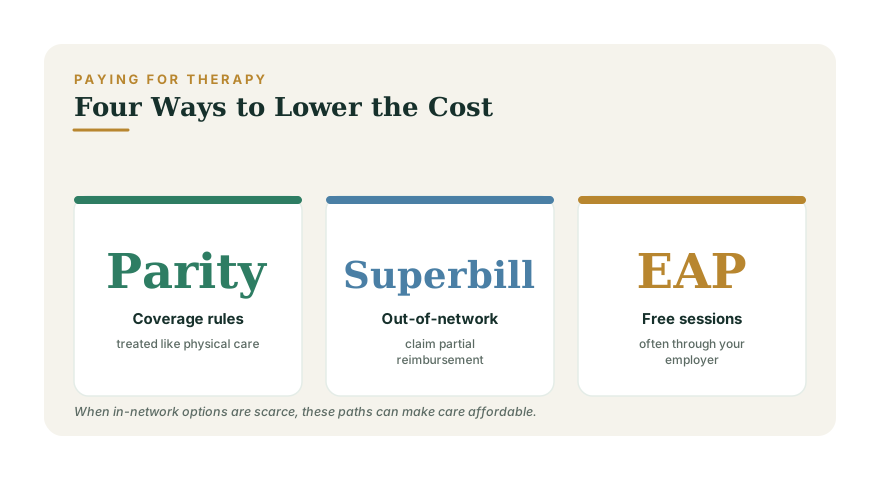
Federal mental health parity law requires most insurance plans that cover mental health and substance-use treatment to do so on terms no more restrictive than they apply to physical health. That means copays, deductibles, and visit limits for therapy generally cannot be harsher than those for, say, seeing a cardiologist. Parity was a real advance, and it is worth knowing your rights — if a plan imposes obviously stricter limits on mental health, that may violate the law.
The in-network shortage
Parity on paper runs into a practical wall: many therapists and psychiatrists do not accept insurance at all, or only contract with a few plans. Reimbursement rates from insurers are often low and paperwork-heavy, so a large share of mental health providers operate cash-only. The result is a network adequacy problem — your plan technically covers therapy, but the in-network directory is short, outdated, or full of providers not accepting patients. Before assuming you are stuck, call your insurer and ask for a current list of in-network providers taking new clients; understanding the in-network vs out-of-network distinction is essential here.
Superbills and out-of-network reimbursement
If the therapist you want is out of network, you are not necessarily paying full price forever. Many plans include out-of-network benefits that reimburse a portion of what you pay once you meet a separate out-of-network deductible. The mechanism is a superbill — an itemized receipt the therapist gives you with the diagnosis and procedure codes. You submit it to your insurer, and if your plan has out-of-network coverage, you get reimbursed for part of the cost.
Before committing to an out-of-network provider, call your insurer and ask three questions: Do I have out-of-network outpatient mental health benefits? What is my out-of-network deductible? What percentage do you reimburse after it is met? The answers tell you your real cost. Keep copies of every superbill and claim, and track them the way you would any health insurance claim.
EAPs: free sessions you may already have
Many employers offer an Employee Assistance Program that includes a handful of free counseling sessions per year — often three to eight — completely separate from your health insurance. EAP sessions are confidential, do not require a diagnosis, and cost nothing. They are an excellent first step for short-term issues or for getting a referral. Check your benefits portal or ask HR; a surprising number of people have an EAP and never use it.
Sliding-scale and lower-cost options
If insurance and EAPs do not cover what you need, several routes lower the cash price:
- Sliding-scale fees. Many therapists and community clinics adjust their rate based on your income. It is normal and appropriate to ask, "Do you offer a sliding scale?"
- Training clinics. University and graduate-program clinics offer therapy from supervised trainees at sharply reduced rates.
- Community mental health centers. These provide low-cost or free care, often on an income basis.
- Group therapy and online platforms. Group sessions cost less than individual ones, and some telehealth services offer lower monthly rates than weekly in-person visits.
- HSA and FSA dollars. Therapy and psychiatry are qualified medical expenses, so paying with pre-tax money lowers the effective cost.
Watch for billing surprises
Mental health billing has its own traps. Confirm in advance whether a provider is in or out of network, because an unexpected out-of-network bill can be steep. If you receive a charge you did not expect — especially for emergency or inpatient care — you may have protections worth understanding in Surprise Medical Bills and Your Rights.
Getting care without overpaying
Start with what is free or cheapest — your EAP and any in-network providers — then weigh out-of-network care with superbill reimbursement against sliding-scale and community options. Call your insurer before your first appointment so you know your real cost up front, and use pre-tax dollars when you can. Care is more affordable than it first looks once you know the paths, and fitting therapy into a realistic monthly budget is easy with the Budget Analyzer and a Financial Wellness check-in.