Money is consistently named as one of the top sources of conflict in relationships, and it rarely comes down to arithmetic. Two people bring different incomes, different spending habits, and different money stories into one shared life, and the friction shows up in the mundane logistics: whose account pays the rent, whether one person feels policed, whether the arrangement quietly punishes the lower earner. The account structure you choose matters, but agreeing on what fair means matters more.
Three account structures
Almost every couple lands on one of three models, and none of them is universally right:
- Fully joint. All income flows into shared accounts and all spending comes out of them. Maximum transparency and simplicity, and it treats the money as genuinely "ours." The cost is a loss of personal autonomy — some people feel every coffee is now a committee decision. The mechanics of shared accounts are in Joint Bank Accounts, Explained.
- Fully separate. Each partner keeps their own accounts and divides shared bills somehow. Preserves independence, but it can make big shared goals harder to coordinate and can quietly entrench inequality if one person earns far more.
- The hybrid ("yours, mine, and ours"). A joint account funds shared expenses and goals; each partner keeps a personal account for no-questions-asked spending. This is where most couples end up, because it balances teamwork with autonomy.
The real question: what does fair mean?
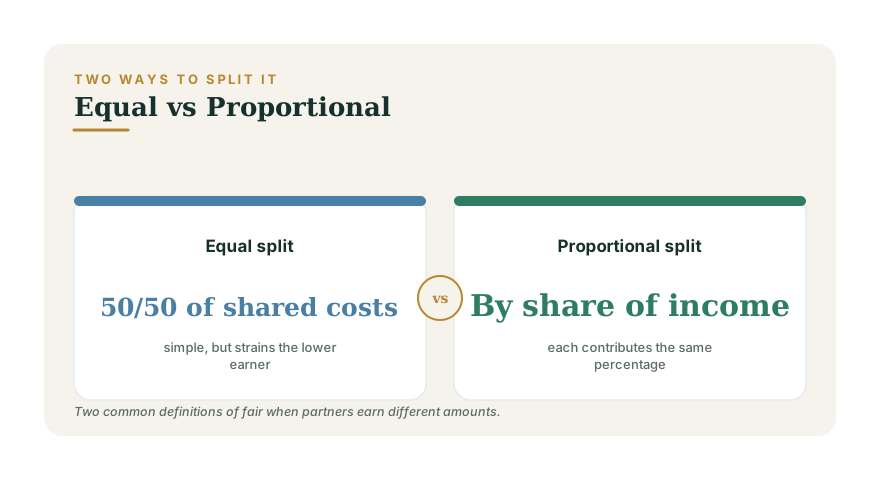
The structure is easy compared with defining fairness when incomes differ. Two honest definitions compete:
- Equal split. Each person pays half of shared costs. Clean and simple — but if one partner earns much less, an equal dollar split can leave them with almost nothing while the other has plenty. Fifty percent of a shared budget is a very different burden on two different incomes.
- Proportional split. Each person contributes the same percentage of their income toward shared costs. The higher earner pays more in dollars but both feel the same proportional pinch, and both have similar breathing room afterward. Many couples find this the fairest once incomes diverge.
There is no objectively correct answer; there is only the answer you both agree feels fair. Writing it down prevents the slow resentment that builds when one person silently thinks the deal is lopsided.
Keep some autonomy on purpose
Even couples who pool most of their money benefit from each partner having a personal allowance — a fixed amount, equal for both regardless of who earns it, that either can spend without justifying. It sounds small, but it removes a huge share of day-to-day friction. Autonomy is not the enemy of partnership; secrecy is. The difference between healthy privacy and financial infidelity is transparency about the system, not surveillance of every purchase.
Run one budget together
Whatever the account structure, a couple needs a shared view of the whole picture: total income, shared bills, joint goals, and each person's contribution. This is the heart of How to Budget as a Couple. Hold a short recurring money date — even fifteen minutes a month — to review spending and adjust. Coordinate joint goals like a home down payment, a shared emergency fund, and retirement so you are not unknowingly working against each other.
When two lives become one
If you are newly married or moving in together, the transition deserves its own conversation about debts, credit, and expectations — covered in Combining Finances When You Marry. Talk about the money you are each bringing, including debt, before you merge anything. The Opportunity Cost Calculator can turn abstract disagreements ("is this worth it?") into concrete numbers you can decide on together.
The system that lasts
The couples who fight least about money are not the ones who earn the most — they are the ones who agreed on a system and revisit it. Pick a structure, define fair in a way you both endorse, protect a little autonomy, and review together regularly. Use the Budget Analyzer to build the shared budget, and map your joint goals at the planning hub. If you want a checkpoint, the Financial Resilience assessment works well for two.