"Is college worth it?" is the wrong question, because the honest answer is "it depends entirely on what you study, what you pay, and how much you borrow." A degree raises lifetime earnings on average — but averages blend a computer-science graduate with no debt and a fine-arts graduate with six figures of loans, and almost no one is the average. The useful move is to run the numbers for your specific plan.
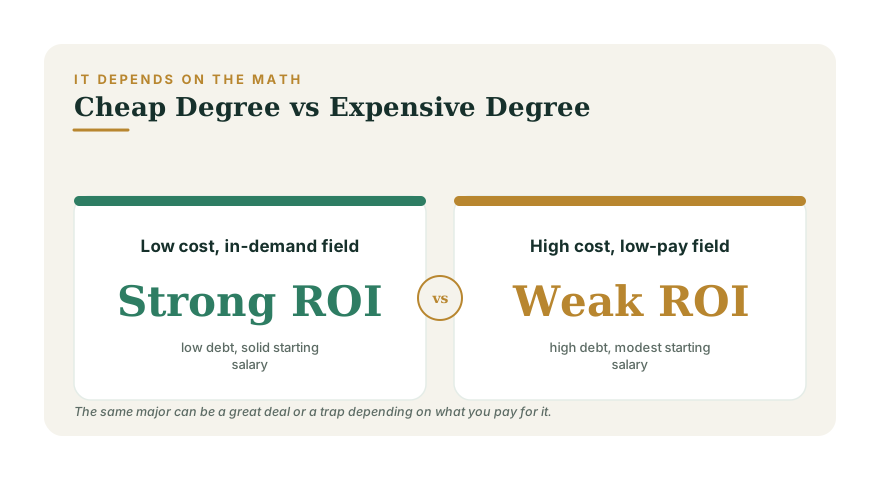
ROI depends on two numbers, not one
Return on investment is just the payoff divided by the cost. For college, the payoff is the extra lifetime earnings the degree unlocks, and the cost is tuition plus the wages you gave up while studying. Both numbers swing wildly:
- Major drives the payoff. Engineering, nursing, computer science, and many applied fields tend to produce strong, durable salary premiums. Some other fields produce a smaller premium that takes many years to show up.
- School cost drives the denominator. The same major at a low-cost in-state public university and at a high-cost private school can produce nearly identical careers — but very different debt.
A great ROI usually comes from pairing a field with real labor-market demand with a school you can attend without crushing debt. A poor ROI comes from paying a premium price for a degree that does not command a premium salary.
The debt-to-starting-salary rule of thumb
One of the most useful sanity checks is to compare total student debt at graduation to expected first-year salary. A widely cited guideline: try to keep total borrowing at or below what you expect to earn in your first year out. Stay near that line and standard repayment is manageable; blow far past it and the loan payment starts crowding out rent, saving, and life for a decade or more.
This is why two students with the same major can have wildly different outcomes. One borrows $20,000 against a $60,000 starting salary; the other borrows $120,000 against the same salary. Same degree, completely different financial life. If you are weighing how repayment would actually feel, Student Loan Repayment Plans Explained walks through the options.
Don't forget opportunity cost
Tuition is the visible cost; the wages you forgo for four years are the hidden one, and they are often larger. Four years out of the full-time workforce is four years of salary, raises, and retirement contributions you did not earn. That does not mean skip college — for most fields the lifetime earnings gain far outweighs it — but it does mean that taking six years instead of four, or dropping out with debt and no degree, is enormously expensive. The cheapest degree is the one you finish on time.
The alternatives are real
College is not the only path to a good income, and pretending otherwise does young people a disservice. Skilled trades, apprenticeships, community-college certificates, coding bootcamps, and military service can all lead to solid careers with little or no debt. The right comparison is not "college vs nothing" but "this specific degree at this specific price vs the best realistic alternative for this person." For some students an apprenticeship that pays from day one beats a pricey degree in a low-demand field.
How to make college worth it
If you do choose college, you control most of the levers that determine the ROI:
- Choose a field with genuine demand, or pair a passion major with a marketable minor or skills.
- Keep the price down — in-state public schools, community-college transfer, and merit aid all move the needle. The full playbook is in Strategies to Graduate With Less Debt.
- Borrow only what you need, and never more than your expected first-year salary.
- Finish on time. Internships and a clear major shorten the path and strengthen the payoff.
Run your own numbers
The headline statistics cannot tell you whether your plan pencils out — only your major, your school's price, and your borrowing can. And if graduate study is on the horizon, fold that in too with The Financial Case for (and Against) Grad School. To see the long-term trade-off in dollars, the Opportunity Cost calculator and the College Planner let you compare paths side by side before you commit.