Graduate school occupies a strange place in personal finance. For some people it is the best investment they ever make; for others it is years of lost income and a pile of debt for a credential that barely moves their salary. The difference is almost never about how much you love the subject. It comes down to cold math: opportunity cost, the expected salary bump, and — above all — who is paying for it.
Opportunity cost is the hidden tuition
Tuition is the obvious cost of grad school. The bigger, invisible one is the income you give up while enrolled. Two years out of a full-time career is not just two years of forgone salary — it is the raises, promotions, and retirement contributions that would have compounded on top. For a program that requires you to quit a $70,000 job for two years, the real cost includes roughly $140,000 of lost earnings before a dollar of tuition. This is the same logic that governs the undergraduate decision in Is College Worth It? Running the Numbers — only the stakes are higher because you are giving up a real salary, not a hypothetical one.
The expected salary bump has to clear a high bar
For grad school to pay, the lifetime increase in earnings has to exceed the tuition plus the opportunity cost — and then some, to compensate for the years of waiting. The honest question is: how much will this specific degree raise my income, and how reliably?
- Some credentials carry a large, dependable premium — many medical, law (at strong schools and outcomes), engineering, and certain technical or healthcare master's degrees clearly lift earning power.
- Others offer a modest bump that takes many years to repay the cost, or open doors that experience alone might have opened anyway.
Research realistic post-graduation salaries for your field and program, not the marketing brochure's best case. If the degree adds $8,000 a year but costs $120,000 plus two years of lost income, the math is brutal.
Funding changes everything
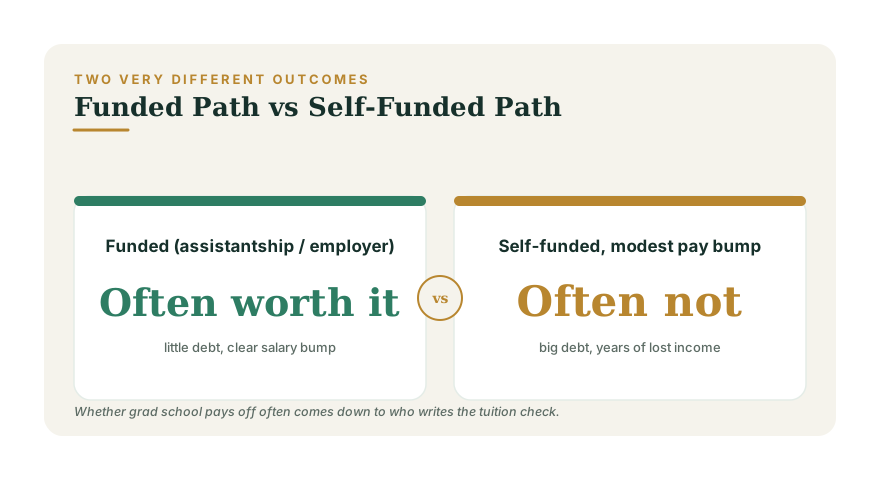
Here is the factor that flips the entire calculation: who pays. Many graduate programs — especially funded PhDs and some master's programs in the sciences — come with assistantships that waive tuition and pay a stipend in exchange for teaching or research. A funded program turns grad school from a six-figure expense into a low-cost or even break-even path. The same degree can be a terrible deal self-funded and a fine deal fully funded. Before applying, find out which programs fund students and how generously; it can matter more than the program's ranking.
When the employer should pay
Many companies offer tuition assistance or reimbursement, particularly for degrees relevant to your job — a part-time MBA, a technical master's, professional certifications. If your employer will foot some or all of the bill, the financial case improves enormously, because you keep your salary and avoid the debt. A few things to weigh:
- Reimbursement programs often require you to stay with the company for a period afterward, or repay the benefit if you leave early. Read the terms.
- Part-time or evening study lets you keep working, which eliminates most of the opportunity cost — the single biggest expense.
- Even partial employer support can tip a marginal decision into a clear yes.
If your employer does not advertise tuition help, it can be worth asking — the same way you would negotiate any part of your compensation. The approach in How to Ask for a Raise applies directly to negotiating education benefits.
The case against
Grad school is sometimes a way to delay a hard decision — avoiding the job market, postponing a career you are unsure about, or chasing prestige that the market does not reward. Borrowing heavily for a degree with a weak or uncertain salary payoff is one of the most damaging financial moves a young professional can make, because the debt outlives the enthusiasm. If you would not pay for the degree out of your own pocket given the expected return, be very skeptical about borrowing for it. And if debt is already in the picture, the discipline from Strategies to Graduate With Less Debt applies just as much in grad school as in undergrad.
Run the decision like an investment
Grad school is an investment, so evaluate it like one: estimate the all-in cost (tuition plus lost income), estimate the realistic salary increase, factor in any funding or employer support, and see whether the payoff clears the cost with room to spare. The Opportunity Cost calculator makes the lost-income side concrete, and the planning hub helps you see how the decision ripples through the rest of your financial life.