Two students can earn the exact same degree and walk away with completely different debt — one with $20,000, the other with $120,000. The difference is rarely luck. It is a series of choices made before and during college, most of which are fully within a family's control. Here are the moves that actually shrink the bill, roughly in order of impact.
Start at community college, then transfer
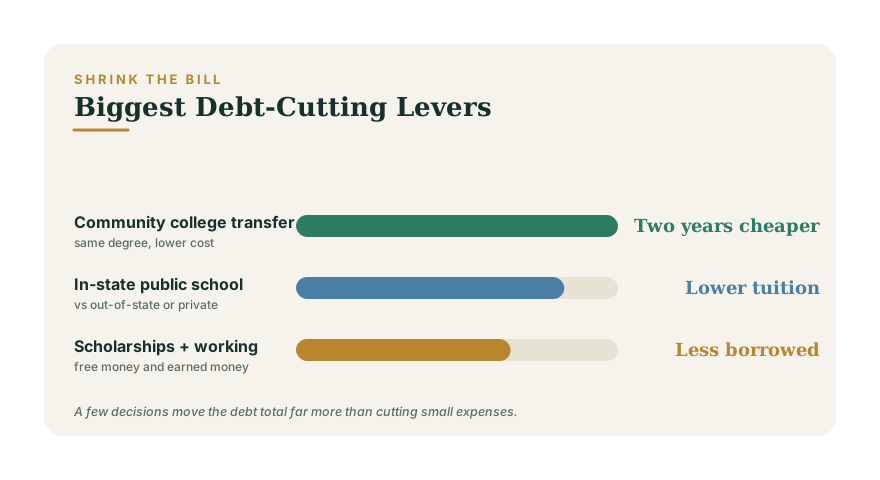
One of the most powerful and underused strategies is to complete your first two years of general-education credits at a community college, then transfer to a four-year school to finish the degree. The diploma comes from the school you graduate from — it does not mention where you took introductory courses. Done deliberately, this can cut the cost of a degree dramatically. The key is to plan it carefully: confirm in advance which credits transfer (many states have guaranteed transfer agreements between community colleges and public universities) so you do not lose credits and time.
Favor in-state public schools
Sticker prices vary enormously, and the biggest swing is in-state public vs out-of-state or private. In-state tuition at a public university is often a fraction of the alternatives, and for most fields the career outcome is similar. Paying a large premium for a private or out-of-state school can be worth it in specific cases — but it should be a deliberate decision with the extra cost weighed against the extra benefit, not a default. The framework for that judgment is in Is College Worth It? Running the Numbers.
Chase free money relentlessly
Scholarships and grants are the best dollars in college finance because you never pay them back. Two streams matter:
- Need-based and institutional aid flows through the FAFSA — which is exactly why you file it every year, even if you think you won't qualify. See Financial Aid and the FAFSA, Explained.
- Merit and private scholarships come from schools, employers, community groups, and foundations. Many smaller local scholarships go unclaimed because few students apply. Treating scholarship applications like a part-time job during senior year of high school can pay extraordinarily well per hour.
Work — strategically
A part-time job, work-study position, or paid summer internship reduces how much you need to borrow and often strengthens your résumé. The trick is balance: enough hours to meaningfully cut borrowing, not so many that grades slip and you take an extra semester (which is its own expensive form of debt). Co-op programs that alternate study and paid work can be especially powerful for graduating with both experience and lower debt.
Save ahead of time with the right account
If college is years away, money saved and invested early does heavy lifting. A 529 plan grows tax-free for education and is a natural home for college savings. Even modest, consistent contributions compound into real money over a childhood — and every dollar saved is a dollar not borrowed at interest.
Borrow only what you need
Here is the discipline that protects you even after every other move: just because you are offered a loan amount does not mean you should take all of it. Loan offers are often padded to cover a generous estimate of living costs. Borrow the minimum that covers your actual, budgeted needs — not the maximum on the form. And when you must borrow, exhaust federal student loans before private ones, because federal loans carry repayment protections and income-driven options that private loans usually lack. How those repayment options work is covered in Student Loan Repayment Plans Explained.
Finish on time
Every extra semester is more tuition and more delayed income. Declaring a major early, mapping your required courses, meeting with an advisor, and avoiding credit-losing transfers all shorten the path. The four-year degree that takes six years is one of the quietest ways students overpay.
Put the plan together
No single move does it alone, but stacked together — transfer credits, in-state tuition, scholarships, working, saving early, and borrowing lean — they routinely cut a degree's debt by more than half. Map your own version with the College Planner, and check that the whole plan holds together with the College Readiness assessment.