Most people think of life insurance as tax-free, and for the beneficiary the death benefit generally is income-tax-free. But there is a second tax that catches larger estates by surprise: if you personally own the policy when you die, the entire death benefit is counted in your taxable estate. For families near the estate-tax threshold, that can mean a big chunk of the payout going to tax. An irrevocable life insurance trust, or ILIT, is the classic tool for keeping the payout out of your estate — at the price of giving up control of the policy for good.
The problem an ILIT solves
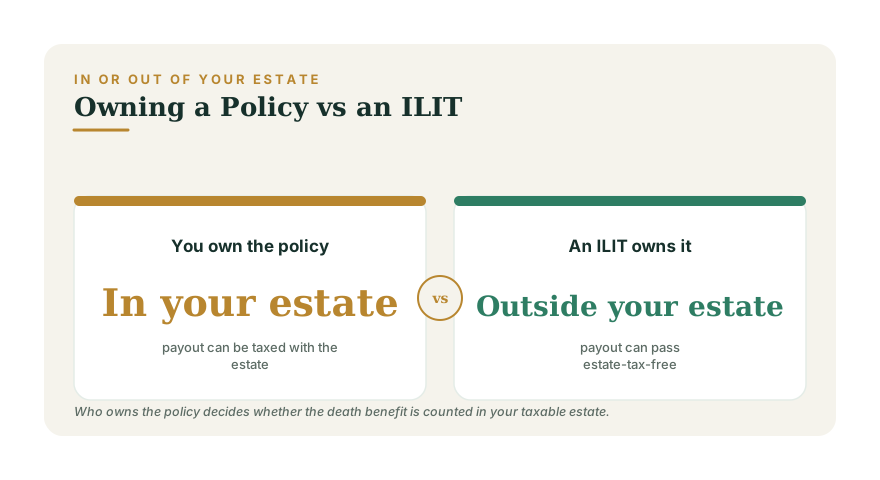
The federal estate tax applies only above a high exemption amount that the IRS sets and adjusts over time, and several states impose their own estate taxes at much lower thresholds. Because a life insurance death benefit is often large, it can push an otherwise-modest estate over the line. When you own the policy, the IRS treats the death benefit as part of what you owned at death. Move ownership to a properly structured ILIT, and the proceeds generally fall outside your estate — so the full payout can reach your heirs untaxed by estate tax. The estate-tax mechanics behind this are covered in Estate Tax and Gift Tax Basics.
How an ILIT works
An ILIT is an irrevocable trust created specifically to own a life insurance policy. In practice:
- You establish the trust and name a trustee (not yourself) to manage it and beneficiaries to receive the proceeds.
- The trust owns the policy and is its beneficiary. You either transfer an existing policy into it or, more cleanly, have the trust buy a new one.
- You fund the premiums by making gifts of cash to the trust, and the trustee pays the insurer from those funds.
- At your death, the insurer pays the trust, and the trustee distributes the money to your beneficiaries under the terms you wrote.
Because the trust — not you — owns and controls the policy, the death benefit sits outside your estate. This is one of the more advanced structures discussed in Trusts Beyond the Basics.
The price of "irrevocable"
The word irrevocable is not decoration. To keep the proceeds out of your estate, you must genuinely give up ownership — you cannot be the trustee, cannot change beneficiaries later, cannot borrow against the policy, and generally cannot undo the trust. That permanence is the whole point, and also the main risk: if your family circumstances change, your options are limited. There are also two technical traps to respect:
- The three-year rule. If you transfer an existing policy into an ILIT and die within three years, the IRS pulls the proceeds back into your estate. Having the trust buy a new policy from the start avoids this.
- Crummey notices. For premium gifts to qualify for the annual gift-tax exclusion, beneficiaries usually must receive formal withdrawal-right notices each time — a paperwork discipline the trustee has to maintain year after year.
The control benefit, beyond taxes
Even families who are nowhere near the estate-tax threshold sometimes use an ILIT for control rather than tax. A raw life insurance payout goes to the named beneficiary in one lump sum, immediately — which can be a problem for minor children, heirs who are not ready to manage money, or a beneficiary with special needs. An ILIT lets you dictate how and when the money is distributed: staggered over years, held until a certain age, or managed for a dependent's benefit. This is why coordinating the policy with your trust matters, and why beneficiary designations override your will is such an important companion idea.
Who should actually consider one
ILITs are powerful but not for everyone. They earn their complexity when you have a taxable estate (federal or state) that life insurance would enlarge, or when you specifically want to control a large payout rather than hand it over outright. For most households below the exemption with straightforward heirs, a simple beneficiary designation is enough and an ILIT is overkill. Because the structure is irrevocable and the tax rules are unforgiving, this is a job for an estate attorney, not a DIY template. Estimate whether your estate is even in range with the Net Worth Tracker and the Insurance Needs Calculator.
A precise tool for a specific problem
An ILIT is a scalpel, not a Swiss Army knife: it keeps a life insurance payout out of your taxable estate and lets you control how heirs receive it, in exchange for permanently giving up control of the policy. If you have a potential estate-tax exposure or a reason to manage a large payout, it is worth a serious conversation with an estate-planning attorney. Gauge whether it applies to you with the Estate Readiness and Financial Resilience assessments, then organize the rest of your plan at the planning hub.