Inheriting money is one of the strangest financial moments a person can have. It usually arrives wrapped in grief, and it often involves more money than you have ever managed at once. That combination — high emotion, high stakes, and no experience with these specific rules — is exactly how good people make expensive mistakes. The single most valuable thing to know up front is that the assets you inherit follow different tax rules than the money you earn, and a few of those rules can save or cost you a great deal.
First, do nothing — on purpose
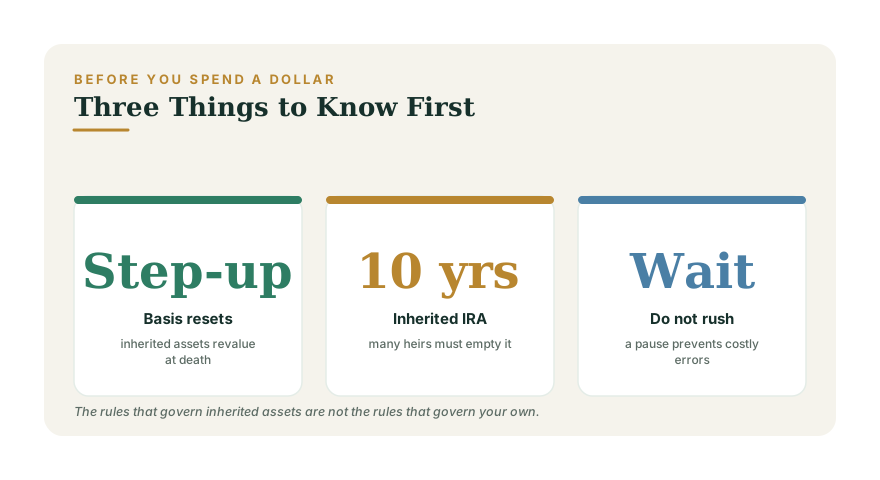
The most powerful move is a deliberate pause. There is no deadline that forces you to invest, gift, or spend an inheritance immediately, and the worst decisions tend to come in the first emotional weeks. Park cash somewhere safe — a high-yield savings account — and give yourself a cooling-off period of weeks or months. Resist the urge to make a big purchase, lend to relatives who suddenly appear, or hand the money to the first advisor who calls. A windfall that took someone a lifetime to build deserves more than a snap decision.
Understand the step-up in basis
This is the rule that surprises most heirs, pleasantly. When you inherit an appreciated asset — stocks, a home, a mutual fund — its cost basis generally resets to its fair market value on the date of death. This is the step-up in basis, and it can erase decades of taxable gains.
Suppose a parent bought stock for $20,000 that is worth $120,000 when they die. If they had sold it, they would owe tax on a $100,000 gain. But you inherit it with a stepped-up basis of $120,000 — so if you sell it soon after for $120,000, your taxable gain is roughly zero. You only owe capital-gains tax on appreciation after the date of death. Knowing this often makes selling an inherited asset far cheaper than selling one you have held for years; the broader mechanics are in The Capital Gains Tax Guide.
The inherited-IRA 10-year rule
Retirement accounts are the big exception, and the rules changed in recent years. If you inherit a traditional IRA or 401(k) and you are not the spouse, you generally cannot stretch withdrawals over your lifetime anymore. Most non-spouse beneficiaries must empty the entire account within 10 years of the original owner's death.
That matters because every dollar withdrawn from a traditional inherited IRA is taxable income to you. Empty it all in year one and you could pile a huge sum on top of your salary, vaulting yourself into a high tax bracket. Often the smarter play is to spread withdrawals across the full 10 years to smooth out the tax hit — and in some cases annual withdrawals are required along the way, echoing the logic of required minimum distributions. A spouse who inherits has more generous options, including treating the account as their own. An inherited Roth IRA also follows the 10-year rule, but withdrawals are generally tax-free. The rules here are genuinely tricky, and a misstep can trigger penalties — this is a place to get advice before you touch the account.
Know how it reached you
How an asset comes to you shapes what you can do with it. Money that passed by beneficiary designation — retirement accounts, life insurance — skipped the will entirely and may already be in your name. Assets that went through probate or a trust may take longer to distribute. Life-insurance proceeds are generally income-tax-free; an inherited traditional IRA is fully taxable as you withdraw it. Sorting your inheritance by type is the first practical step, because each type has its own playbook.
Assemble a team before you act
A meaningful inheritance is the right time to get professional help, ideally before you make any moves. Two people are worth their fee:
- A tax professional (CPA) to map out the inherited-IRA withdrawal strategy and confirm your step-up basis.
- A fee-only fiduciary advisor — one paid by you, not by commissions — to help fit the money into your life. (Why the payment model matters is covered in Fee-Only vs Commission Advisors.)
Be wary of anyone who finds you the moment money changes hands; the good advisors are the ones who tell you to slow down.
Then put it to work, in order
Once the dust settles, an inheritance is best used to strengthen your own foundation before anything flashy: shore up your emergency fund, clear high-interest debt, then invest the rest toward your long-term goals rather than letting it sit idle or evaporate on lifestyle. Run the numbers through the Retirement Planner to see what the inheritance does for your future, and use the planning hub to fold it into the bigger picture. Handled with patience, an inheritance can quietly change your trajectory; rushed, it can vanish without a trace.