Deductible, copay, coinsurance. Three words on every insurance card, and the three reasons your bill is rarely what you expected. They are not interchangeable — each is a different way you and the insurer split a cost — and a single doctor visit can involve more than one. Once you can tell them apart, you can predict what care will cost before you walk in.
The deductible: your annual entry fee
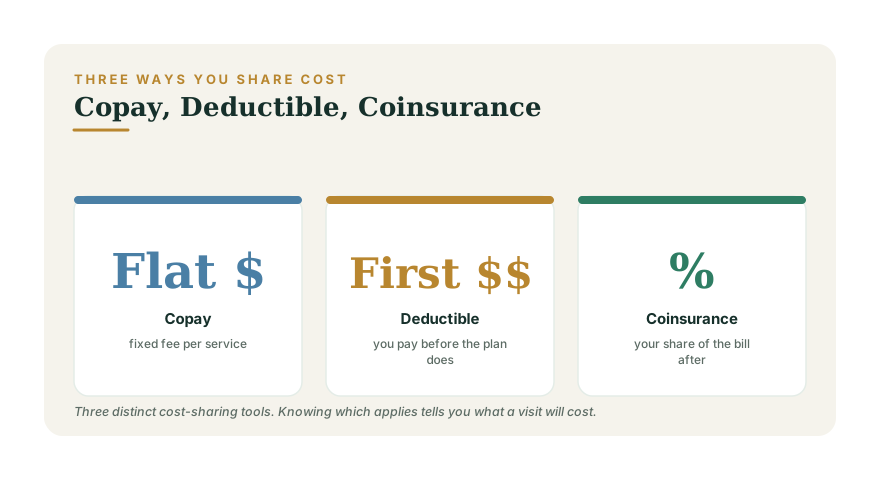
The deductible is the amount you pay yourself, each year, before the plan starts sharing most costs. With a $1,500 deductible, the first $1,500 of covered care is fully on you. It resets every year. Think of it as the threshold you have to cross before the insurer joins in.
The copay: a flat fee per service
A copay is a fixed dollar amount for a specific service — $25 to see your primary doctor, $60 for a specialist, $15 for a generic prescription. Copays are predictable, which is their whole appeal: you know the number before you go. Importantly, many plans charge copays for routine visits even before you have met your deductible, which is why a checkup can cost a flat $25 in January while a procedure costs full price.
The coinsurance: a percentage after the deductible
Coinsurance is your share expressed as a percentage, and it usually kicks in only after the deductible is met. A "20% coinsurance" plan means once you have crossed the deductible, you pay 20% of each covered bill and the insurer pays 80%. Unlike a copay, the dollar amount scales with the size of the bill — 20% of a $200 visit is $40, but 20% of a $40,000 surgery is $8,000 (capped by your out-of-pocket max). The relationship between all of these and that yearly ceiling is mapped out in How Health Insurance Actually Works.
Worked example 1: a single doctor visit
Say your plan has a $20 copay for primary-care visits, a $1,500 deductible you have not met, and 20% coinsurance after that.
- You see your doctor for a sore throat. Because the visit has a defined copay, you pay $20 at the desk. Simple.
- The doctor orders a lab test that is not covered by a copay. That cost falls under the deductible, so you pay the full negotiated price for the test — say $80 — because you have not met your deductible yet.
- Your total for the visit: $20 + $80 = $100, and that $80 also counts toward chipping away at your deductible.
The lesson: a single appointment can mix a copay (the visit) with deductible spending (the lab). The bill is not one number with one rule.
Worked example 2: a hospital stay
Now a bigger event. Same plan: $1,500 deductible, 20% coinsurance, and a $6,000 out-of-pocket maximum. You have a $40,000 hospital stay and have spent nothing yet this year.
- First, the deductible: you pay the first $1,500 yourself.
- Then coinsurance: on the remaining $38,500, your 20% share would be $7,700.
- But the out-of-pocket max stops you. Your deductible ($1,500) plus coinsurance can never push your total past $6,000. So you pay $1,500 + $4,500 = $6,000, and the plan covers the rest — even though your 20% share would otherwise have been far more.
This is exactly what the out-of-pocket maximum is for: it turns a $40,000 event into a known $6,000. After hitting it, the rest of the year's covered, in-network care costs you nothing. It is also why staying in-network matters so much during a big event — an out-of-network hospital can fall under a separate, far higher maximum, or none at all, which quietly undoes the whole protection.
Notice, too, how the order of operations works in your favor here. You do not pay the deductible and then 20% of the entire bill on top — the deductible counts toward the ceiling. Every dollar you spend, whether it is deductible or coinsurance, climbs the same staircase toward that out-of-pocket cap. Once people see that the deductible is not an extra charge stacked on top but part of the same running total, the dread around a large bill eases considerably.
Why this matters when you pick a plan
Plans trade these levers against the premium. A low-premium plan often carries a high deductible and coinsurance, betting you stay healthy; a higher-premium plan softens the deductible with more copays. Neither is "better" in the abstract — it depends on how much care you expect. Compare them in HDHP vs PPO: Choosing a Health Plan That Fits, and estimate your real exposure with the Insurance Calculator.
Once you can read these three numbers, an insurance card stops being a mystery and becomes a price list. Bring that same clarity to every policy you own — start with the Financial Resilience assessment to see whether your coverage truly protects your budget.