Medical debt is unlike almost any other debt you will face. The prices are wildly inconsistent, the bills are frequently wrong, providers rarely charge interest, and hospitals routinely accept far less than they invoice. That combination makes medical debt the most negotiable debt most people ever encounter — yet millions pay the full sticker price simply because they assume the number is final. It usually is not.
First, do not pay immediately
The instinct to clear a scary bill fast is exactly what works against you. Once you pay, your leverage is gone. Medical providers generally do not charge interest the way credit cards do, so a bill sitting unpaid for a few weeks while you work it down costs you little. Take a breath, gather your paperwork, and treat the first invoice as an opening offer, not a demand.
Demand an itemized bill and hunt for errors
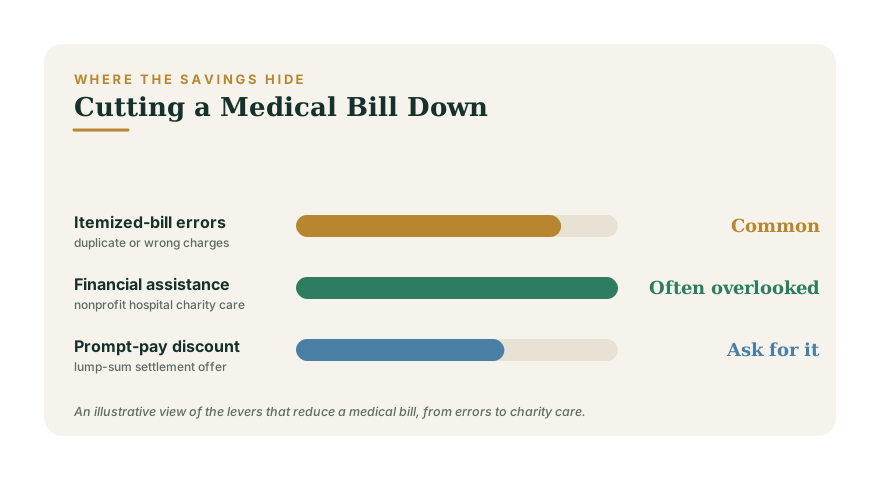
The summary bill you receive shows lump sums, not the line-by-line charges. Call and request a fully itemized bill with billing codes. Medical billing error rates are notoriously high, and the mistakes almost always favor the provider: duplicate charges, services you never received, a routine supply billed at absurd markup, or a procedure coded incorrectly so your insurer denied it. Cross-check the itemized bill against your insurer's Explanation of Benefits. Any discrepancy is a charge you can dispute — and correcting a miscoded claim can flip a denial into a covered service. The mechanics of reading these documents are in How to Lower Your Medical Bills.
Ask about financial assistance and charity care
This is the most underused lever of all. Nonprofit hospitals are required to offer financial assistance programs — often called charity care — and many will reduce or entirely forgive bills for patients under certain income levels. Crucially, the thresholds are often higher than people assume, reaching well into middle-income territory, and you can frequently apply even after receiving care. Ask the billing department directly for the financial assistance application, and do not disqualify yourself before you check the criteria. The Consumer Financial Protection Bureau notes that patients have strong rights around medical billing and collections and encourages asking about assistance and disputing errors (consumerfinance.gov).
Negotiate the price directly
If the bill survives error-checking and you do not qualify for charity care, negotiate the number itself. Providers accept discounts routinely because a partial payment beats sending the account to collections for pennies. Effective approaches:
- Cite the fair price. Compare the charge to what Medicare or a fair-price database pays for the same procedure in your area, and ask them to meet closer to that benchmark.
- Offer a prompt-pay lump sum. Providers often knock off a meaningful percentage for an immediate one-time payment. Ask plainly: "If I pay this today, what discount can you offer?"
- Request an interest-free payment plan. If you cannot pay a lump sum, most hospitals will set up a no-interest monthly plan. Insist it stays interest-free and out of collections.
Get every agreement in writing
Verbal promises evaporate when the account moves between departments or to a collector. Before you pay a negotiated amount, get written confirmation that the payment settles the account in full and that the balance will not be reported to a bureau. Note the recent changes limiting how and when medical debt appears on credit reports, which have shifted leverage toward patients. If a bill has already gone to collections, the playbook shifts — that is covered in Medical Debt: What to Do.
Know when negotiation is not enough
Sometimes the number is simply beyond what negotiation can fix. If your medical debt is one piece of a larger crisis, weigh it against other options rather than draining a retirement account to pay a bill you might have settled for a fraction — see Debt Settlement vs Bankruptcy. Never let a medical bill push you into liquidating protected retirement savings without advice.
The bottom line
Medical debt bends more than any other. Slow down, get the itemized bill, dispute the errors, apply for financial assistance, negotiate the price, and lock every agreement in writing. To fit a reduced balance into a realistic payoff, use the Debt Payoff Planner, and check where medical debt sits in your broader picture with the Financial Resilience assessment. Then build the wider plan at the planning hub.