Every January, gym memberships spike and savings apps see a flood of new sign-ups. By February, most of it has quietly evaporated. Financial resolutions fail at roughly the same rate as every other kind, and for the same reasons. The failure is not a lack of sincerity — people genuinely want to do better with money. The failure is in how the resolutions are built. Fix the design, and a resolution can actually outlast the season that birthed it.
Tiny specific goals beat big vague ones
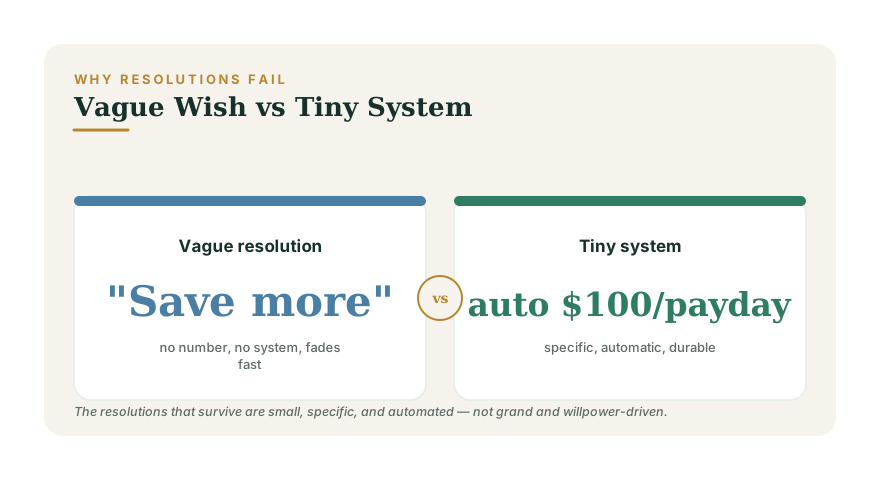
"Save more money" and "get out of debt" feel like resolutions, but they are wishes. They have no number, no deadline, and no obvious first step, so on any given day there is nothing concrete to actually do. A resolution you cannot act on today is a resolution you will not keep.
Replace the wish with a target that is small and specific enough to start this week. Not "save more" but "move $100 to savings every payday." Not "pay off my cards" but "put an extra $150 toward the highest-rate card each month." The smaller and more concrete the goal, the more likely it is to survive contact with real life. You can always scale up once the habit is sticking — but you cannot scale up a habit that never started. For a fuller framework on shaping these, see how to set financial goals.
Systems beat willpower
Here is the uncomfortable truth: willpower is a terrible long-term strategy. It is a limited resource that drains over a day and over a year, and resolutions that depend on "I'll just be more disciplined" are quietly counting on a tank that always runs dry. The people who keep their resolutions are not more disciplined — they have simply removed the need for discipline.
The way to do that is to convert each goal into a system that runs on its own. Want to save more? Set up an automatic transfer so it happens without a decision. Want to invest? Automate the contribution. Want to stop overspending? Delete saved cards and unsubscribe from retailer emails so temptation never reaches you. A good system makes the desired behavior the default and the undesired behavior the effortful one. This is the whole idea behind automating your finances, and it is why the same forces that make saving feel hard can be designed around rather than overpowered.
Track it, but keep tracking easy
A resolution you do not measure is a resolution you will drift away from without noticing. You need some way to see whether the system is working — a labeled savings bucket whose balance you can watch climb, a debt total you check monthly, or a net-worth figure you glance at each quarter. Seeing progress is itself motivating; watching a number move in the right direction gives your brain a small, immediate reward that helps offset the slow, delayed payoff of good money habits.
But keep the tracking light. If checking in becomes a daily chore, you will abandon it, and then you will abandon the resolution. Once a month is plenty for most goals. The point is awareness, not obsession.
The slip-up recovery plan
This is the part that separates resolutions that last from resolutions that die: plan for the slip in advance. You will have a month where you overspend, skip a savings transfer, or blow the budget on an unexpected expense. That is not a question of if, but when. The danger is not the slip itself — one missed transfer barely matters over a year. The danger is the story you tell yourself about it.
Most resolutions die not from a single failure but from the "well, I already broke it, so what's the point" spiral that follows. One slip becomes permission to quit. The antidote is to decide ahead of time that a slip is a normal, expected event with a simple response: acknowledge it, skip the guilt, and resume the very next day. Missing one transfer and missing the next thirty are completely different outcomes, and the only thing standing between them is whether you treat the first one as a verdict or a blip. Aim for consistency over perfection — a habit kept 90% of the time is a wild success, not a failure.
Make this year's resolution the one that sticks
Pick one or two small, specific goals. Turn each into an automatic system so it does not depend on willpower. Track it lightly. And decide now that a slip is just a slip, not the end. To turn your resolution into a concrete monthly number — and a system you can set and forget — start with the Budget Analyzer or take the Financial Wellness assessment to see exactly where one small change would do the most good.