Few pieces of mail spike your heart rate like an envelope from the IRS. But the first thing to know is that most notices are routine, automated, and narrowly focused — and a meaningful share of them are simply wrong. The IRS sends millions of letters a year for everything from a math error to a friendly reminder. Panicking, or worse, ignoring it, are the two reactions that turn a small matter into a real one. Here is how to handle one calmly.
First, don't panic — and don't ignore it
A notice is not an audit, and it is not an accusation. It is a specific, usually computer-generated message about one item on one return. The IRS does not start with phone calls, texts, or emails demanding immediate payment — those are scams. Real contact begins with a letter by mail. So the correct emotional setting is neither dread nor avoidance; it is steady attention. Open it, read it twice, and find out what it actually wants before you do anything else.
Read the notice number
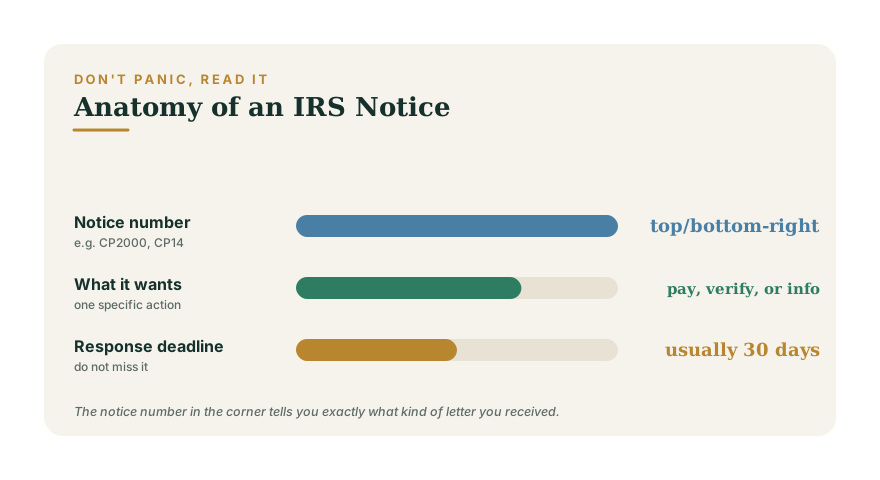
Every IRS notice carries a notice or letter number, printed in the upper-right or lower-right corner — things like CP14, CP2000, CP05, or LTR followed by digits. That code is the key to everything: it tells you what category of issue this is and what response is expected. You can look the exact number up on the IRS website to see a plain-English explanation of that specific notice. Always work from the number, not from your imagination of what might be wrong.
The common notices, decoded
- CP14 — "You owe a balance." This is the first bill for unpaid tax. If it is correct, the path forward is in What to Do If You Owe the IRS.
- CP2000 — the big one most people see. This is an underreporter notice: the income reported to the IRS by employers, banks, and brokerages (on W-2s and 1099s) does not match what your return reported. The IRS proposes additional tax. Crucially, a CP2000 is a proposal, not a final bill — and it is frequently wrong, because the automated match misses context like cost basis on stock sales.
- CP05 / CP05A — "We are reviewing your return," often delaying a refund. Usually no action is needed beyond patience, unless it asks for documents.
- Letter 5071C / verify-your-identity letters — the IRS wants to confirm you really filed, to stop refund fraud. Verify promptly so your refund is released.
How to respond — and respond on time
Each notice states a deadline, commonly 30 days, and a specific action: pay, agree, disagree, or send documents. Your job is to do exactly that, by that date.
- If you agree (you really did owe it), follow the payment or sign-and-return instructions.
- If you disagree — very common with a CP2000 — respond in writing by the deadline, check the "I disagree" box, and attach copies (never originals) of the documents that prove your position, such as the brokerage statement showing your real cost basis. Many proposed balances vanish once you supply the missing context.
- Keep records. Photocopy everything you send, note the date, and use certified mail or the IRS upload tool so you can prove you responded.
If a CP2000 was triggered by a misread 1099, it helps to understand those forms — see Understanding 1099 Forms — and many notices stem from avoidable slip-ups covered in Common Tax Filing Mistakes.
When to get help — and when not to
For a simple, correct CP14 or an identity-verification letter, you can almost always handle it yourself. For a large or complicated CP2000, or anything you genuinely do not understand, a tax professional is worth the fee. Be wary of firms that respond to any IRS letter with a pitch for expensive "resolution" services before you have even read what the notice asks.
Stay ahead of next year's mail
Most notices trace back to a mismatch, a missed form, or under-withholding — all preventable. A yearly review catches these before the IRS does. Take the Tax Health assessment to surface weak spots, and keep your documents organized so that if a letter does arrive, your proof is already at hand.