A company announces a stock split, the financial press treats it like news, and the share price often pops in the days around it. New investors understandably wonder whether they should buy in or whether they just got wealthier. The honest answer is that a stock split, by itself, changes almost nothing about the value of what you own. It is one of the most over-hyped events in investing.
The mechanics of a split
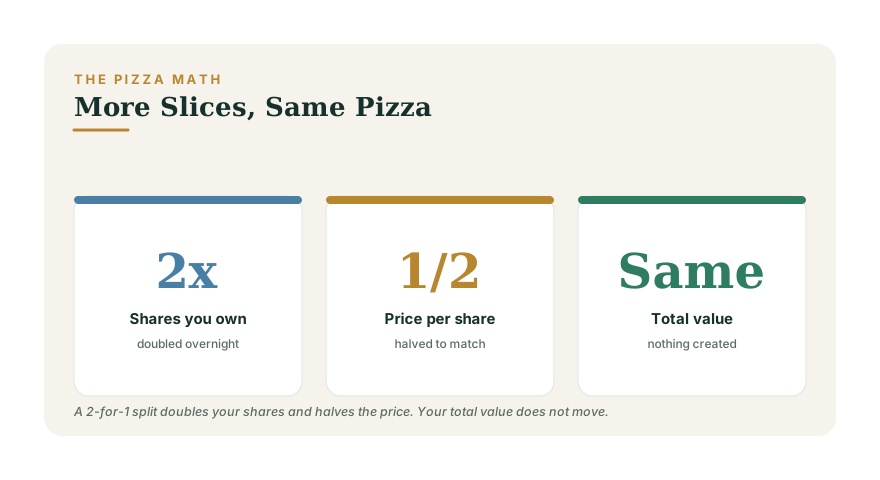
In a stock split, a company increases its number of shares while proportionally lowering the price of each. In a 2-for-1 split, every share you own becomes two, and the price of each is cut in half. Own 10 shares at $200, and after the split you own 20 shares at $100. A 3-for-1 split triples your share count and divides the price by three. The ratio can be anything — 4-for-1, 10-for-1, and so on.
The best analogy is a pizza. Slicing a pizza into eight pieces instead of four does not give you more pizza — just more, smaller slices of the same pie. A split slices your existing ownership more finely; it does not add anything to the pie.
Why your wealth does not change
Before a 2-for-1 split: 10 shares at $200 equals $2,000. After: 20 shares at $100 equals $2,000. Your slice of the company — and your dollars — are identical. Nothing has been created. The percentage of the company you own is exactly the same; it is simply divided into more, cheaper certificates.
This is why the excitement is misplaced. A split does not improve the company's revenue, profit, or prospects. If a stock was overpriced before a split, it is still overpriced after; if it was a poor business, it is still a poor business. Splits change the packaging, not the contents — the same skepticism in how to spot a bad investment still applies.
So why do companies split at all?
Historically, the main reason was psychological and practical. When shares had to be bought in whole units, a very high price — say, several thousand dollars per share — put a single share out of reach for small investors. Splitting brought the per-share price down to a more approachable level, widening the pool of potential buyers. There can be a modest sentiment bump too: a split is often read as a sign that management is confident the price will keep climbing, which sometimes nudges the stock up briefly. But that is sentiment, not substance.
The reverse split — and why it is a warning sign
A reverse split runs the other way: it reduces your share count and raises the price per share. In a 1-for-10 reverse split, 100 shares at $1 become 10 shares at $10. Again your total value is unchanged. But the reason companies do this matters. Reverse splits are often used to lift a beaten-down stock back above a minimum price — for instance, to avoid being delisted from an exchange for trading too low. A reverse split does not fix the underlying problems that drove the price down; it just changes the optics. Treat one as a yellow flag worth investigating, not a fresh start.
Fractional shares made splits mostly cosmetic
The original rationale for splits has largely evaporated. Most brokerages now let you buy fractional shares — you can invest $50 in a company whose shares trade at $3,000 and own a sliver of one share. Because a high share price no longer locks anyone out, the accessibility argument for splitting is mostly gone. Splits today are largely cosmetic, and you should not change your investment decisions because of one.
What it means for your taxes and cost basis
A split is not a taxable event — you have not sold anything. But it does adjust your per-share cost basis. If you paid $200 for one share and it splits 2-for-1, your basis becomes $100 per share across your two shares. Your total basis is unchanged; brokerages handle this automatically, but it is good to understand why the per-share figure moved.
The takeaway: a split is a non-event for your wealth, and a reverse split is worth a closer look. If you are just getting started picking and holding investments, ground yourself first in how to start investing and sketch a long-term mix with the portfolio builder.