A missed payment or a debt in collections can feel like a permanent stain. It is not. Credit reporting runs on timers, and almost every negative mark eventually falls off on its own. Just as important, the damage a mark does shrinks steadily long before it disappears. Knowing these timelines turns a vague dread into a countdown you can plan around.
The seven-year rule
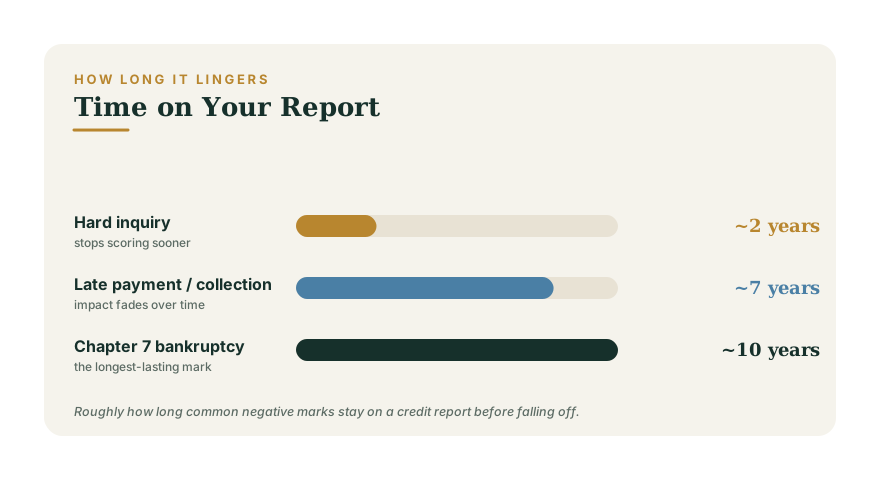
The federal Fair Credit Reporting Act caps how long most negative information can stay on your report, and for the great majority of marks that limit is about seven years. This covers late payments, accounts sent to collections, charge-offs, repossessions, and most foreclosures. The clock generally starts from the date of the original missed payment that led to the trouble — not the date a collector bought the debt — so a collector cannot reset the timer by reselling an old account.
This is the single most important fact to know: a paid or unpaid late payment from years ago is on a fixed schedule to disappear, and there is nothing a debt collector can legally do to extend it.
Bankruptcy timelines
Bankruptcy is the longest-lasting mark. A Chapter 7 bankruptcy can remain on your report for about ten years from the filing date. A Chapter 13, which involves a repayment plan, typically falls off after about seven years. Severe as that sounds, people routinely rebuild usable credit within a couple of years of a bankruptcy by adding positive history on top of it — the mark is still there, but its weight keeps shrinking. The myths around this are unpacked in The Things That Actually Hurt Your Credit Score.
Why the impact fades long before the mark is gone
Here is the part that gives people the most relief: scoring models weigh recent behavior far more heavily than old behavior. A 30-day late payment from last month hurts a great deal; the same late payment from four years ago, surrounded by years of on-time payments since, barely registers. The mark sits on your report for the full seven years, but its drag on your score diminishes month after month.
This is why the best response to a derogatory mark is not panic but patience plus new positive history. Every on-time payment you add dilutes the old damage. The recovery playbook is in How to Improve Your Credit Score, Step by Step.
What you can and cannot remove
People desperately want to erase negative marks, which is exactly why a whole industry preys on that wish. The honest breakdown:
- Accurate, negative marks generally cannot be removed early. If you genuinely paid late or had a debt go to collections, that information is allowed to stay for its full term. No legitimate service can force its removal.
- Inaccurate marks can and should be disputed. If a mark is wrong — not your account, a payment that was actually on time, a debt you already paid — you have the right to dispute it for free, and the bureau must investigate. The steps are in How to Check Your Credit Report for Errors.
- Paying a collection is still worth it even though it may not vanish, because newer scoring models treat a paid collection more favorably than an unpaid one, and you stop the collector's contact.
Avoid the "credit repair" trap
If a company promises to remove accurate, negative information or to give you a "fresh start," be skeptical. They cannot do anything you cannot do yourself for free, and the legitimate-sounding ones simply file the same disputes you could file at no cost. The full warning is in Why Credit Repair Companies Are Mostly a Scam.
The takeaway
Negative marks are on timers — about seven years for most, up to ten for a Chapter 7 bankruptcy — and their bite fades steadily the whole time. You cannot erase accurate marks early, but you can dispute errors for free and, more powerfully, bury old damage under new on-time payments. Track the climb with the Credit Score Simulator and keep credit in view alongside the rest of your finances with the Financial Wellness Score.