Most American families will never owe federal estate tax — the exemption is very high, and it shields the vast majority of estates. But for families whose wealth approaches or exceeds the threshold (and in states with their own lower estate or inheritance taxes), giving assets away during life can shrink the taxable estate, move appreciation out of it, and help people while you are around to see it. Used well, lifetime gifting is generosity and tax planning at the same time.
The mechanics matter, because doing it wrong can waste your lifetime exemption or trigger paperwork you did not expect. Here are the core strategies, in plain terms.
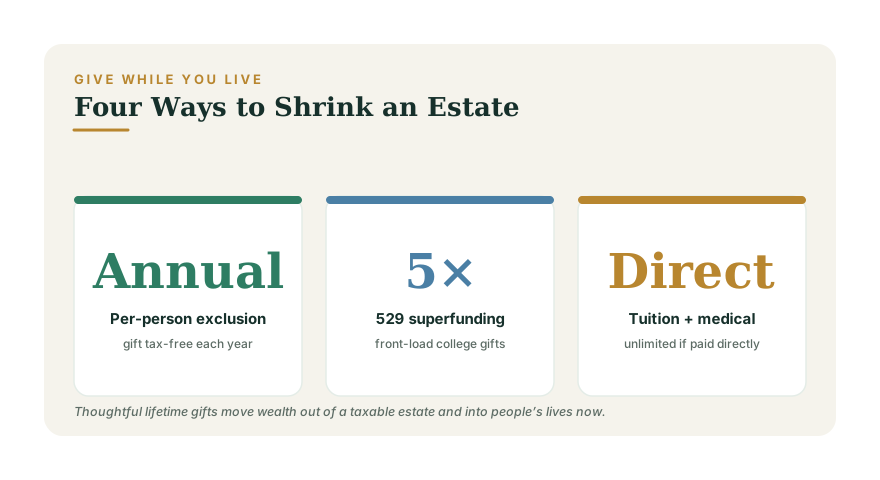
The annual gift tax exclusion: the workhorse
Each year you can give a set amount to any number of people without filing a gift-tax return or touching your lifetime exemption. The per-recipient limit is adjusted for inflation periodically, so treat it as a moving number rather than memorizing a figure. Two points make it powerful:
- It is per recipient. A couple with three children and several grandchildren can move a large sum out of their estate every single year, entirely tax-free.
- A married couple can double it by "gift splitting," each giving up to the limit to the same person.
Done consistently over many years, the annual exclusion alone can shift a substantial fortune out of a taxable estate without any complex structures.
529 superfunding: front-loading college gifts
A special rule lets you "superfund" a 529 college savings plan: you can contribute up to five years' worth of annual exclusions to one beneficiary at once and elect to spread it across five years for gift-tax purposes. For grandparents, this is a favorite move — a large lump sum gets out of the estate immediately, then grows tax-free for a grandchild's education. The trade-off is that you cannot make additional exclusion gifts to that same person for the five-year window. The mechanics of the account itself are in 529 Plans Explained, and you can model the college numbers with the College Planner.
Direct tuition and medical payments: the unlimited gift
This is the most underused strategy, and it is remarkably generous. Payments you make directly to a school for tuition or directly to a medical provider for someone's care are completely exempt from gift tax — no dollar limit, and they do not count against your annual exclusion or lifetime exemption at all.
The catch is the word directly. You must pay the institution itself, not hand the money to the student or patient. A grandparent can pay a grandchild's full college tuition straight to the university and still give that grandchild the full annual exclusion in cash the same year. For families with both wealth to move and relatives in school or facing medical bills, this is one of the cleanest ways to help.
Charitable gifts: doing good and shrinking the estate
Gifts to qualified charities are removed from your estate and, when made during life, can generate an income-tax deduction too. For larger or more deliberate giving, families use vehicles such as donor-advised funds (a simple way to claim a deduction now and direct grants over time) or charitable trusts. Even straightforward annual giving to causes you care about reduces a taxable estate while supporting your values.
Gifting trade-offs to weigh
Lifetime gifting is not free of downsides, and it is not for everyone:
- Don't give away your own security. Never gift assets you may need for your own retirement or care. Run your own plan first — see Estate Planning for Young Families for the foundation, and the Retirement Planner to confirm you have enough to give.
- Cost basis matters. Gifted assets keep your original cost basis, while inherited assets generally get a "stepped-up" basis at death. For highly appreciated assets, holding until death can actually save more in capital-gains tax than gifting saves in estate tax. This deserves real analysis.
- Watch state rules. Several states impose estate or inheritance taxes at much lower thresholds than the federal one.
Where to start
For most families, the foundation — a will, guardians, powers of attorney, current beneficiaries, and avoiding probate — matters far more than estate-tax gifting. Gifting strategies are the next layer, for those whose wealth makes them relevant, and they reward both careful timing and professional advice. Begin by mapping what you have with the Estate Readiness assessment, then bring a tax advisor into any large or recurring gifting plan.