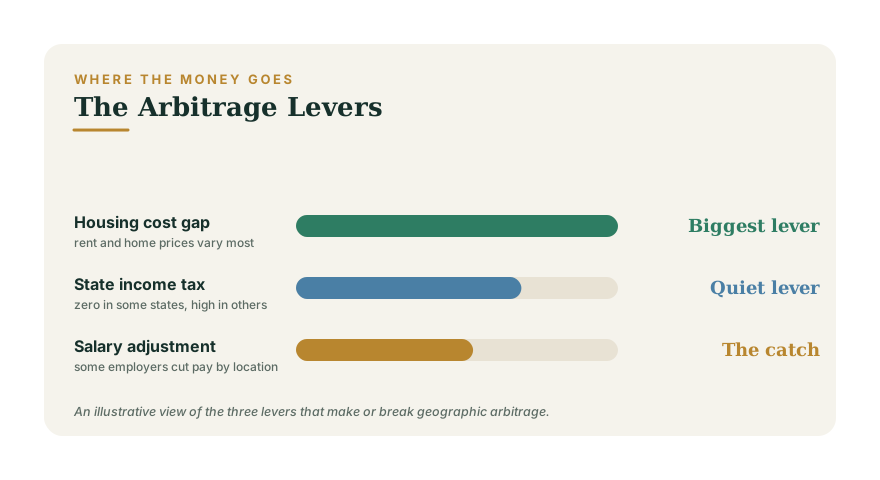
Geographic arbitrage is the idea that if you can earn a salary set by an expensive city while living somewhere with a lower cost of living, you keep the difference. Remote and hybrid work made this newly practical for millions of people. The headline savings are usually about housing, but there is a second lever that is easy to overlook and can swing thousands of dollars a year: state income tax.
The state-tax lever
State income tax rates vary enormously. A handful of states levy no personal income tax at all, while others take a meaningful slice of every paycheck. Moving from a high-tax state to a no-tax state can lift your take-home pay by a noticeable margin at the same salary — on top of any savings on rent. That is the part of geographic arbitrage that does not show up in a cost-of-living calculator but lands in your bank account every pay period. The general rules for what happens to your taxes when you relocate are covered in State Taxes When You Move.
Residency is not just where you sleep
Here is where remote workers get tripped up. Your state tax obligation follows your residency and, in some cases, where the work is physically performed — not simply your mailing address. States that want their revenue apply detailed residency tests: how many days you spent there, where your home and family are, where your car is registered, where you vote. If you keep a foot in your old high-tax state, it may still consider you a resident and expect its cut. Establishing residency in a new state usually means genuinely moving your life there, not just forwarding your mail.
Two states can both want a piece
The messiest scenarios involve two states with competing claims:
- You live in one state and your employer is in another. Depending on each state's rules, you may owe tax to the state where you live, and sometimes the state where the company or the work is sourced. A credit for taxes paid to another state usually prevents true double taxation, but you can still end up filing two returns.
- The "convenience of the employer" rule. A few states tax remote employees of in-state companies as if they worked in-state, even when the employee never sets foot there, unless the remote arrangement is required rather than chosen. This can erase the tax savings you moved for.
- Part-year moves. If you relocate mid-year, you typically file part-year returns in both states, splitting your income by when you lived where.
None of this is a reason to abandon arbitrage — it is a reason to check the specific state pair before you move, ideally with a tax professional.
Do not forget the salary adjustment
Some employers now set pay by your location and will cut your salary if you move to a cheaper area. That does not automatically kill the deal — a smaller salary in a low-cost, no-tax state can still leave you further ahead — but you have to run the full comparison rather than assuming the same paycheck follows you. Model both the pay change and the tax change together before committing, and treat any relocation as the financial project it is, as described in Financial Planning for a Job Relocation.
Run the real numbers
Geographic arbitrage works, but only when you account for every moving part: housing, state income tax, sales and property taxes, any salary adjustment, and the one-time cost of moving itself. A no-income-tax state sometimes recoups revenue through higher property or sales taxes, so compare the whole picture. Estimate your federal and state tax exposure with the Tax Strategies tool, and use the Budget Analyzer to see how the cost-of-living shift changes your monthly cash flow.
Bank the difference, do not spend it
The whole point of arbitrage is to convert a cost-of-living gap into savings and investments, not into a nicer lifestyle that eats the gain. If you pull off a move that lifts your take-home pay, direct the surplus toward your goals before it disappears — and build the kind of flexible budget described in Building a Recession-Resistant Budget. Map the move against your bigger plan at the planning hub, and check your standing with the Tax Health assessment before you file in a new state.