Estate planning is hard enough with one set of relationships. Add a second marriage, stepchildren, and children from a prior relationship, and the standard "leave everything to my spouse" plan can quietly produce an outcome no one intended: your own children disinherited.
The trouble is that the simple defaults most people rely on assume a simple family. In a blended family, those same defaults pit the people you love against one another. The good news is that a few well-known tools — used deliberately — can protect everyone. Here is what to watch for.
The core conflict: spouse versus children
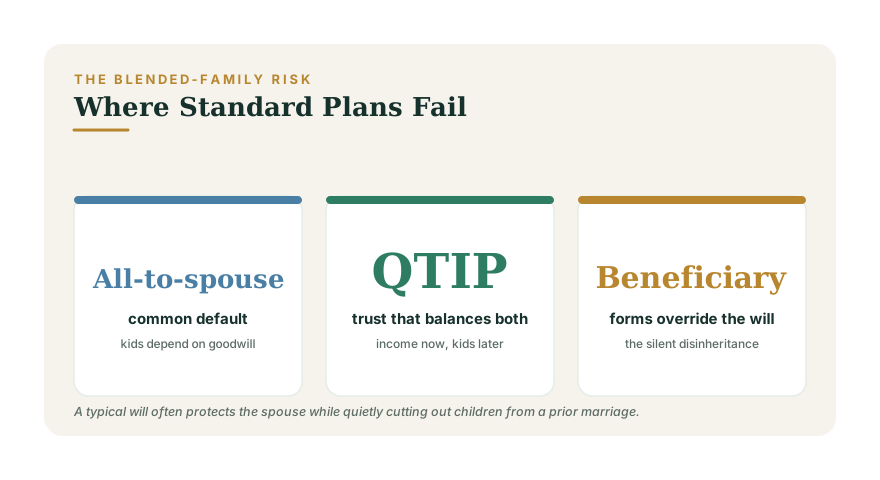
The central tension in a blended family is timing. You want to provide for your current spouse for the rest of their life, and you want your own children to eventually inherit. The simple solution — leave everything to your spouse and trust them to pass it to your kids later — is where things go wrong.
Once your spouse owns the assets outright, they are theirs to do with as they please. They can spend them, leave them to their children, or remarry and leave them to a new spouse. None of that is bad faith; life simply moves on. But your children's inheritance now rests entirely on someone else's future choices. The "all to spouse" default does not balance the two sides — it hands one side everything and hopes for the best.
The QTIP trust: a tool built for exactly this
The classic solution is a QTIP trust (qualified terminable interest property trust). It threads the needle elegantly:
- While your surviving spouse is alive, the trust pays them income — and often access to principal for health and living needs — so they are fully provided for.
- When your spouse dies, whatever remains in the trust goes to the beneficiaries you named when you created it — typically your own children.
The key feature is that your spouse cannot redirect the remainder to someone else. You decide, up front, where the assets ultimately land. A QTIP gives your spouse lifetime security and your children a guaranteed eventual inheritance, defusing the central conflict. It lives inside a trust, so it pairs naturally with the structure described in Setting Up a Living Trust, Step by Step.
The titling trap
How you own property can quietly override your entire estate plan. The most common surprise is joint ownership with right of survivorship. If you own your home or an account jointly with your new spouse this way, it passes to them automatically at your death — outside your will, outside any trust, regardless of what those documents say.
That can be exactly the disinheritance you were trying to avoid. In blended families, titling deserves deliberate thought: which assets should be joint, which should be individually owned and directed through a will or trust, and which should flow into a QTIP. Getting the titles wrong can silently undo even a carefully drafted plan.
Beneficiary forms: the silent overrides
This one catches almost everyone. Beneficiary designations on retirement accounts, life insurance, and payable-on-death accounts override your will completely. If your 401(k) still names your ex-spouse — a stunningly common oversight after a divorce — that is who inherits it, no matter what your new will says.
The reverse problem also bites. If you name your current spouse as sole beneficiary of a large retirement account "to keep it simple," that asset bypasses your trust and your children entirely. In a blended family, every beneficiary form is a tiny estate plan of its own, and they must all be coordinated with your will and trust. The most frequent mistakes are catalogued in Beneficiary Mistakes to Avoid.
Don't forget the prenup and the kids' guardians
If you signed a prenuptial or postnuptial agreement, it may dictate or constrain parts of your estate plan; your documents need to agree with it. And if minor children are involved on either side, your plan should name guardians and, ideally, set up trusts to manage any inheritance until the children are old enough — you generally do not want a teenager receiving a lump sum outright.
Communicate, then document
The single most underrated step is talking. Blended-family inheritance disputes are often less about money than about surprise and the feeling of being cut out. Letting your spouse and children understand the plan — that the spouse is provided for and the children will inherit — prevents the resentment that fuels lawsuits. The broader foundation for all of this is in Estate Planning Basics Everyone Needs.
Blended families have more moving parts, which means more ways for a plan to go quietly wrong — and more value in getting it right. Start by mapping your situation with the Estate Readiness assessment, then work with a professional to put the right structures in place.