Most people think their will controls who inherits everything. For your biggest accounts, it often does not. Retirement accounts, life insurance, and many bank and brokerage accounts pass by beneficiary designation — the form you filled out (and probably forgot) when you opened them. That form is a contract, and it overrides whatever your will says. A perfect will and a stale beneficiary form means the form wins.
Because these designations move so much money so quietly, the mistakes on them are some of the most consequential — and most preventable — in all of estate planning.
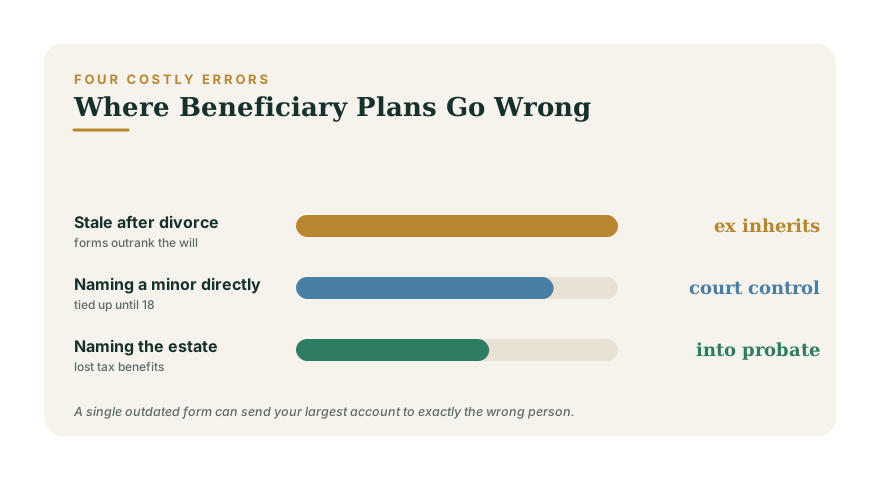
Mistake 1: stale designations after a divorce or death
This is the classic, and it is brutal. Someone names a spouse as beneficiary, divorces, never updates the form, and dies years later. The ex-spouse inherits the 401(k) — even if the current spouse and children were meant to. Courts have repeatedly enforced the form as written, regardless of the divorce decree or the will. The same happens when a named beneficiary dies and no contingent was listed.
The fix is simple and free: after every major life event — marriage, divorce, a birth, a death — review and update every beneficiary form. This is the core lesson of Beneficiary Designations Override Your Will, and it is the single highest-leverage hour in estate planning.
Mistake 2: naming a minor child directly
It feels natural to name your young child as beneficiary. Legally, it backfires. Minors cannot control significant assets, so naming one directly forces the court to appoint a conservator, supervise the money until the child turns 18, and then hand the entire balance over outright. A teenager receiving a six-figure lump sum is rarely the outcome you intended.
Instead, name a trust created for the child's benefit, or set up a custodial arrangement, so a responsible adult manages the money and releases it at sensible ages. This is exactly why guardianship and trusts belong together — see Naming a Guardian for Your Children.
Mistake 3: naming your estate as the beneficiary
Listing "my estate" as the beneficiary — or leaving the form blank, which defaults to the estate — drags the asset into probate: slower, public, and sometimes costly. Worse, for an inherited IRA, routing it through the estate can collapse valuable tax-deferral options that a named human or qualifying trust would have kept. The whole point of a beneficiary designation is to pass the asset outside probate; naming the estate throws that advantage away. Name actual people or a properly drafted trust instead.
Mistake 4: misunderstanding per stirpes vs per capita
This small phrase decides what happens when a beneficiary dies before you, and most people never notice the option on the form. Suppose you name your three children equally, and one child predeceases you leaving two kids of their own:
- Per stirpes ("by branch") — that child's one-third passes down to their children. Each branch of the family keeps its share. Your grandchildren split their late parent's third.
- Per capita ("by head") — the deceased child's share is redistributed among the surviving named beneficiaries. The two surviving children each get half; the grandchildren get nothing.
Neither is automatically right — but the default may not be what you want, and the difference can disinherit a whole branch of your family. Choose it deliberately on each form.
A few more quiet traps
- No contingent beneficiary. If your primary beneficiary dies with you and no backup is named, the asset falls into probate. Always name a contingent.
- Forgetting old accounts. A 401(k) from a job three employers ago still has whatever beneficiary you named then. Track it down.
- Special situations. A beneficiary with a disability who receives means-tested benefits, or one with creditor problems, usually needs a trust rather than a direct designation.
The ten-minute audit
Pull up every retirement account, life insurance policy, and account that allows a beneficiary. Confirm the primary and contingent names are current, that no minor is named directly, that your estate is not the beneficiary, and that per stirpes or per capita reflects your wishes. Do this whenever your family changes. It is one of the cheapest, fastest, and most important moves in your plan — fold it into the broader checklist in Estate Planning for Young Families.
Not sure whether your designations line up with the rest of your plan? The Estate Readiness assessment highlights the gaps before they become your heirs' problem.