If you want to start investing on behalf of a child, custodial accounts are the main vehicle. They let an adult manage money for a minor until the child reaches adulthood, at which point the account legally becomes the child's. That last detail surprises a lot of parents, so it is worth understanding the whole picture before you open one.
How a custodial account works
A custodial account is opened in a child's name but controlled by an adult custodian — usually a parent or grandparent. The custodian makes the investment decisions and manages withdrawals, which must be for the benefit of the child. The money is an irrevocable gift: once it goes in, it legally belongs to the child, even though the adult runs it for now.
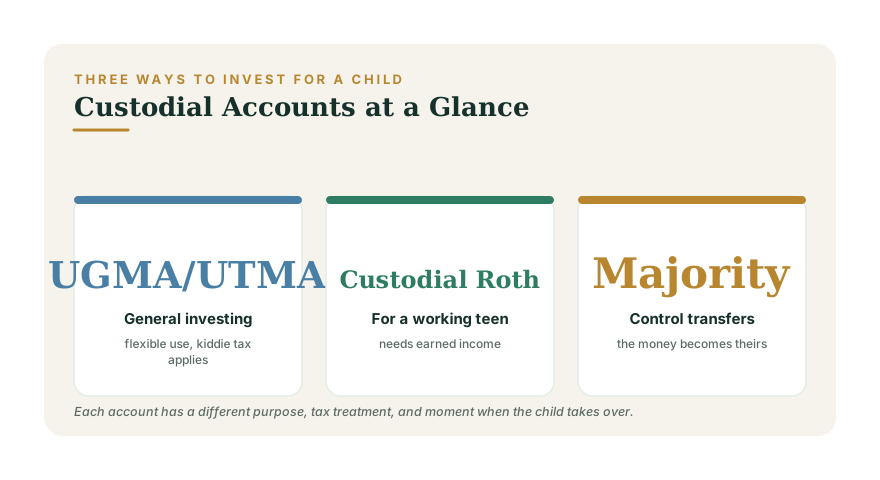
The two common flavors are the UGMA (Uniform Gifts to Minors Act) and the UTMA (Uniform Transfers to Minors Act). They are very similar; UTMA is the more modern version and can hold a slightly broader range of assets. Both can hold ordinary investments like stocks, bonds, and funds, and the money can be used for almost anything that benefits the child — not just college.
The kiddie tax: why this is not a tax shelter
It is tempting to think of a custodial account as a clever way to shift investment gains to a child's lower tax rate. The kiddie tax exists precisely to limit that. In broad terms, a child's investment income up to a small annual threshold is tax-free, the next slice is taxed at the child's low rate, and income above a second threshold is taxed at the parents' rate. The exact figures change yearly, so treat them qualitatively, but the principle is steady: you cannot park large investment gains in a child's name to dodge taxes.
Custodial accounts also have a real downside for families chasing financial aid: because the assets count as the student's, they can weigh more heavily against aid eligibility than money held in a parent-owned account. For dedicated college saving, a 529 plan is usually the more tax-efficient and aid-friendly choice.
The custodial Roth IRA: a quiet powerhouse for a working teen
There is one custodial account that can be genuinely extraordinary: a custodial Roth IRA. The catch is that the child must have earned income — money from an actual job, whether a summer gig, babysitting, or a part-time role. The contribution cannot exceed what the child earned (up to the annual IRA limit).
Why is it so powerful? A teenager has decades of compounding ahead, and Roth contributions grow tax-free. A few hundred dollars invested at 16 has half a century to grow before retirement. It also doubles as a teaching tool — a tangible lesson in how investing and compound interest work. Many parents offer to match a working teen's contributions to make the deal more appealing. If you are weighing Roth versus traditional treatment generally, the trade-offs are in Roth vs traditional IRA, but for a low-earning teen the Roth is almost always the answer.
Control transfers at the age of majority
Here is the part that catches people off guard. When the child reaches the age of majority set by your state — often 18 or 21 — the custodial relationship ends and the account becomes fully theirs to do with as they please. You cannot impose conditions or claw it back. If a young adult decides to spend a sizable UTMA balance on something you would not have chosen, that is legally their right.
This is the central trade-off of UGMA/UTMA accounts: flexibility now in exchange for handing over control later, with no strings. For some families that is fine; for others, a 529 plan (which the parent continues to control) or a trust is a better fit. The custodial Roth is a happier story here, since retirement money is unlikely to be raided for a sports car, and the structure itself nudges toward long-term thinking.
Choosing the right account
Match the account to the goal. If the money is earmarked for college, lean toward a 529. If you want maximum flexibility for general purposes and are comfortable handing over control at adulthood, a UGMA/UTMA fits. If your child has a job, a custodial Roth IRA is one of the best gifts you can give. Many families use a combination, and pairing any of these with real conversations about money — see teaching kids about money — is what makes the dollars stick.
Whatever you choose, the earlier you start, the more time does the heavy lifting. To see how small, regular contributions for a child can grow over a long horizon, run the numbers through the Lifetime Wealth Simulator.