Imagine you bought a stock fund in a taxable account, never sold a single share, and your investment is actually down for the year. Then in December you get a tax form telling you that you owe capital gains tax anyway. It feels like a mistake, but it is not — it is a capital gains distribution, and it surprises new investors every year.
Understanding why it happens, and how to avoid it, can save you an unwelcome and entirely unnecessary tax bill.
Why a fund hands you a tax bill
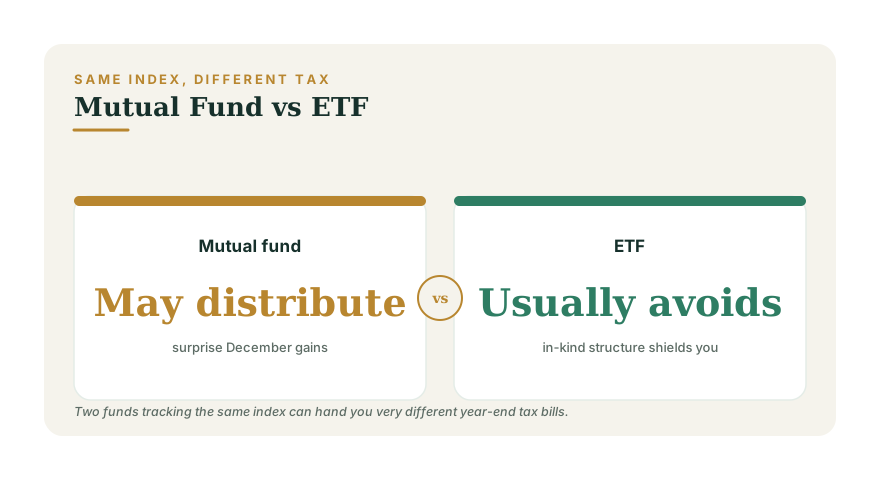
A mutual fund is a pooled basket of investments. When the fund's manager sells holdings inside the fund at a profit — to rebalance, to meet redemptions from other shareholders, or because a stock was dropped from an index — the fund realizes a capital gain. By law, a mutual fund must pass essentially all of those realized gains through to its shareholders each year, typically in a lump near year-end. You owe tax on your share, even though the decision to sell was made by the fund, not by you.
This is the crucial point: you can be taxed on gains you never chose to take. A shareholder who bought in November can owe tax on gains the fund accumulated over years before they arrived. And because the distribution is paid whether the fund is up or down on the year, you can owe capital gains tax in a year your own position lost money.
What actually happens to your account
On the distribution date, the fund's share price (its NAV) drops by the amount distributed. If you take the distribution in cash, you simply receive money and the share price falls to match — your total value is unchanged, but now part of it is a taxable event. If you reinvest the distribution, the cash buys more shares automatically, so your account value does not visibly change at all. Either way, in a taxable account you owe tax on the distribution. (Reinvested distributions also raise your cost basis, which prevents you from being taxed twice later.)
Why ETFs largely escape this
Exchange-traded funds can track the very same index yet rarely distribute capital gains. The reason is structural: ETFs use an "in-kind" creation-and-redemption mechanism that lets the fund hand appreciated securities out to large institutional traders without selling them on the open market. Because few internal sales occur, few gains get realized, and shareholders are rarely handed a surprise distribution. This tax efficiency is one of the biggest practical differences between the two wrappers — the full comparison is in index funds vs ETFs.
It only matters in a taxable account
Distributions are a non-event inside a 401(k), IRA, or Roth, because nothing inside those accounts is taxed year to year. The problem is confined to a taxable brokerage account. If your taxable holdings are broad index funds or ETFs, your distributions are usually small. If they are actively managed funds with high turnover, they can be large and recurring — another reason active funds fit poorly in a taxable account.
The timing trap: do not buy right before the distribution
Here is a mistake worth knowing about. Funds announce an ex-dividend date for their year-end distribution, often in December. If you invest a lump sum in a taxable account just before that date, you receive the full distribution — and the immediate tax bill — even though you only owned the fund for a few days. You essentially buy a tax liability. The fix is simple: before making a large taxable purchase late in the year, check whether the fund has an estimated distribution coming, and if so, wait until after the ex-dividend date.
What to do about it
- In taxable accounts, favor broad index funds and ETFs that distribute little.
- Keep high-turnover active funds inside tax-sheltered accounts where distributions do not matter.
- Before a big year-end taxable purchase, check the fund's distribution estimate and buy after the ex-date.
- Reinvest distributions if you do not need the cash, and keep good basis records.
To estimate what a distribution might cost you and weigh fund choices, try the capital gains calculator, and use the Tax Health assessment to spot where your taxable holdings might be creating avoidable bills.