When you run any kind of business — even a one-person freelance operation — you have the option to build a credit profile for the business itself, separate from your personal credit. Most gig and freelance workers never bother, and for a true side hustle that is fine. But if you intend to grow, take on inventory, finance equipment, or borrow without putting your personal score and assets on the line, business credit is worth building deliberately. Here is how it works and how to start from nothing.
Why separate it from personal credit at all
Your personal credit score follows you as an individual; it is built from your own loans, cards, and payment history (the mechanics are in How Credit Scores Are Calculated). Business credit is a parallel profile tied to your company. Keeping them separate matters for three reasons: it can let the business borrow on its own strength without maxing out your personal limits, it protects your personal score from the ups and downs of business cash flow, and — with the right legal structure — it helps shield your personal assets if the business runs into trouble. Suppliers and lenders also increasingly check business credit before extending terms.
A caveat worth stating plainly: when a business is young, lenders will still usually ask for a personal guarantee, meaning you are on the hook personally if the business cannot pay. Building business credit reduces that dependence over time, but it rarely eliminates it on day one.
Step one: make the business a real entity
You cannot build business credit as a vague side gig. The foundation:
- Form an entity. An LLC or corporation creates a legal separation between you and the business that a sole proprietorship does not. This is also where personal-asset protection comes from.
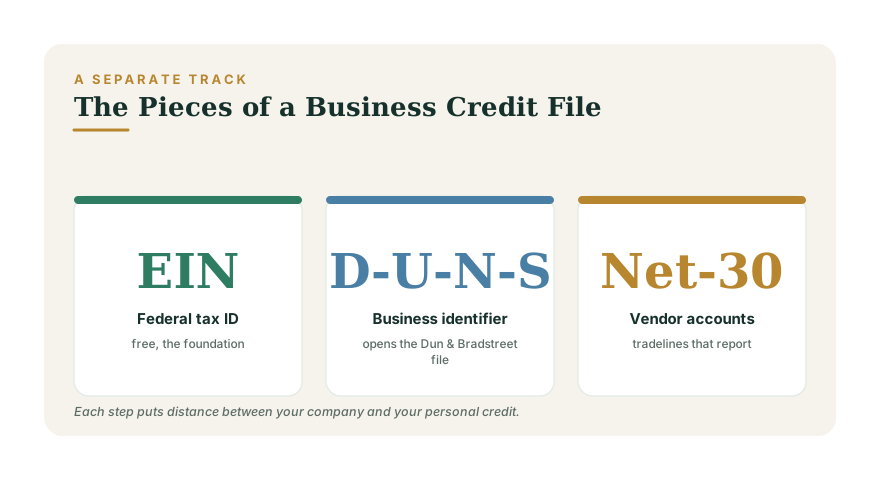
- Get an EIN. An Employer Identification Number is a free federal tax ID for your business — the business equivalent of a Social Security number. You apply directly with the IRS at no cost, and you use it instead of your SSN on business accounts.
- Open a business bank account and get a business phone and address. Run every business dollar through accounts in the business's name. Mixing personal and business money undermines both your credit-building and your liability protection, and it makes your taxes far messier.
Step two: get on the business credit bureaus
Business credit is tracked by its own agencies. The best-known is Dun & Bradstreet, which assigns a D-U-N-S number — a unique identifier that opens your business credit file and is often required to bid on contracts or get supplier terms. Registering for one is free. Other business bureaus build profiles largely from the tradelines below, so the key is making sure your accounts actually report.
Step three: build tradelines that report
A credit profile is just a history of borrowing and repaying on time. To build one for the business:
- Vendor (net-30) accounts. Many suppliers will let an established business buy now and pay in 30 days, and some report your on-time payments to the business bureaus. A handful of these "starter" tradelines, paid early, builds an initial profile.
- A business credit card. A card in the business's name (using the EIN) adds a revolving tradeline. Keep utilization low and pay in full, just as you would personally.
- Pay everything early. Business scores reward paying before the due date, not merely on time, so early payment is a genuine lever.
The discipline mirrors personal credit, but the payoff is a profile the business owns. As it matures, lenders and suppliers extend larger limits and better terms with less reliance on your personal guarantee.
Why it pays off
Strong business credit unlocks better loan rates, higher supplier limits, longer payment terms that smooth your cash flow, and — eventually — financing the business qualifies for on its own. For a freelancer, that can be the difference between turning down a big project for lack of working capital and accepting it. The other half of that equation is charging enough in the first place, which is the subject of How to Set Your Freelance Rates.
Build it the same way you would build personal credit: slowly, with on-time payments and low balances, starting before you need it. To keep the personal side healthy while you do — since lenders will still look at it — run a quick check with the Credit Score Simulator and fold the whole picture into your financial plan.