Traditional budgeting assumes a number most freelancers, gig workers, and creators do not have: a steady monthly paycheck. When one month brings a flood of client payments and the next brings a trickle, the usual advice to "spend a fixed amount on each category" collapses. The solution is not more discipline — it is a different structure that turns your unpredictable deposits into a predictable salary you pay yourself.
Know your baseline number
Start by finding the floor: the minimum it costs to run your life for one month. Add up rent or mortgage, groceries, utilities, insurance, transportation, and minimum debt payments — the non-negotiables. This baseline is the target you must hit reliably no matter how the income swings. Everything else, from dining out to subscriptions, is discretionary and flexes with your month. Building this floor is the foundation, and a bare-bones budget is the exact tool for defining it.
Pay yourself a salary from a buffer
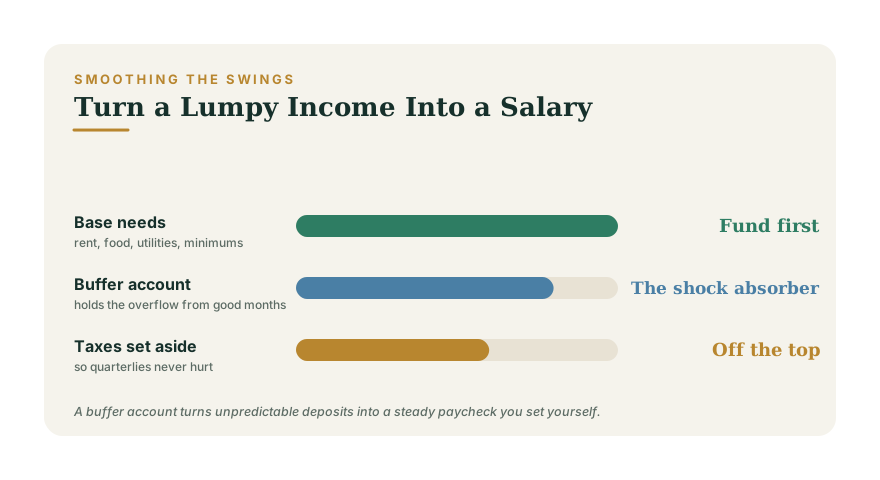
The core technique for irregular income is the buffer account. Instead of spending whatever hits your account each month, you route all income into a holding account and pay yourself a fixed "salary" from it on the same day every month. In fat months the surplus stays in the buffer; in lean months the buffer tops up your salary so your spending never lurches. Over time the buffer grows large enough that you are effectively living on last month's income — the calmest place a freelancer can be. The mechanics of this approach are explored further in Budgeting on an Irregular Income.
Base your salary on a conservative average
What should your self-paid salary be? Resist the urge to base it on your best months. Instead, look back over the past year, ignore the peaks, and set your salary near the low-to-middle of your range — ideally at or a little above your baseline number. Paying yourself conservatively means the buffer fills faster and rarely runs dry. You can always give yourself a raise once the buffer is deep. When a big month arrives, the extra funds the buffer, taxes, and goals rather than lifestyle creep.
Take taxes off the top first
The costliest mistake irregular earners make is spending money that belongs to the tax authorities. Because no employer withholds for you, a portion of every deposit is not really yours. The moment income arrives, move a set percentage — commonly 25% to 35% of profit — into a separate tax account before you calculate anything else. That way your quarterly payments are already funded and never blow up your budget. The full logic is in Taxes for Content Creators and Online Sellers.
Layer in sinking funds and a real emergency fund
Irregular income needs deeper reserves than a salaried job does, because a slow quarter is a real possibility, not a hypothetical. Two layers help:
- Sinking funds for known irregular costs — annual insurance, gear replacement, quarterly taxes — so they never become emergencies. See Sinking Funds, Explained.
- A larger emergency fund than the standard advice. Where a salaried worker targets three to six months of expenses, a freelancer with volatile income should lean toward the higher end.
Managing the day-to-day rhythm of unpredictable work has its own tactics, gathered in Managing Money With an Unpredictable Schedule.
Put the system in place
Irregular income is not a budgeting problem so much as a smoothing problem. Define your floor, funnel everything into a buffer, pay yourself a steady conservative salary, skim taxes off the top, and keep deep reserves. Once that machine is running, a lumpy income feels remarkably like a stable one. Build and stress-test your numbers with the Budget Analyzer and the Emergency Fund Calculator, check your footing with the Financial Resilience assessment, and pull it together at the planning hub.