If you work variable hours — shift work, hospitality, gig driving, freelance, seasonal, commission, or a job where the schedule changes week to week — standard budgeting advice can feel like it was written for someone else. "Budget your monthly income" assumes you know what your monthly income is. When some months are flush and others are frighteningly thin, the real problem is not how much you earn over the year; it is the timing, and the anxiety of never knowing what the next check will be.
The good news is that a few simple structures turn lumpy, unpredictable income into something that feels almost like a steady paycheck. The core idea is to stop living off this week's earnings and start living off a buffer you control.
Start with your true baseline, not your best month
The first trap is anchoring your lifestyle to a good month. To budget safely on variable income, build your plan around a conservative baseline — roughly what you reliably bring in even in a slow stretch. Look back over the past several months (a year is better) and find your lowest realistic month, not the average and certainly not the peak. If your essential expenses fit inside that low number, you are durable. If they do not, that gap is the most important problem to solve, and a bare-bones survival budget tells you exactly how low your essentials can go.
The buffer-account method
This is the single most powerful tool for irregular income. Here is the structure:
- Open a separate buffer (or holding) account where all your income lands first — every paycheck, gig payment, and tip.
- Your spending account is funded only by a fixed monthly transfer from the buffer. You spend from the spending account; you never spend straight from the buffer.
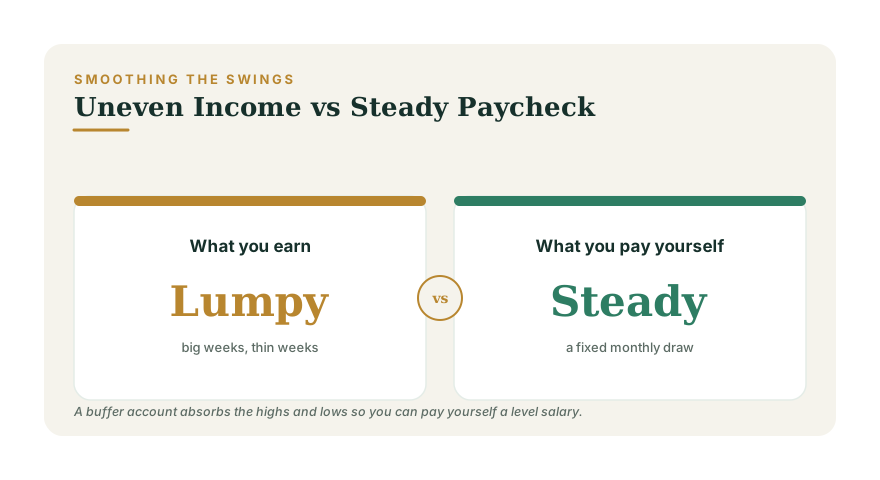
- In fat months, the buffer grows. In lean months, the buffer covers the shortfall. Your spending account — and therefore your life — stays level either way.
The buffer absorbs the volatility so you do not have to feel it. The goal is to build the buffer up to roughly one full month of expenses ahead, so you are always spending money you already earned last month rather than money you are nervously hoping to earn this week. That one-month lead is what transforms the whole experience of variable income.
Pay yourself a steady "salary"
The fixed monthly transfer out of the buffer is, in effect, the salary you pay yourself. Set it at or below your conservative baseline so it is sustainable through the slow months. This accomplishes two things at once: it smooths your cash flow, and it forces excess from good months to accumulate instead of evaporating into lifestyle creep. When the buffer grows well beyond one month's cushion, you can give yourself a modest "raise" — but do it deliberately, not on a whim after one great week. The detailed mechanics of this approach are in Budgeting on an Irregular Income.
Prioritize expenses for the lean months
Know in advance the order in which bills get paid, so a thin month does not turn into a scramble. A workable priority: essentials first (the four walls), then minimum debt payments, then savings, then discretionary spending. In a strong month, fund all of it and push the surplus into the buffer. In a weak month, you cut from the bottom up — discretionary and extra savings pause, essentials never do. Having decided this sequence ahead of time means you are executing a plan, not panicking.
An emergency fund matters more here, not less
The buffer handles normal month-to-month swings. A true emergency fund is a separate, deeper reserve for the real shocks — a long dry spell, an injury that stops you from working, a major repair. Because variable income offers less certainty than a salaried job, people in this situation generally benefit from a larger emergency fund, often toward the six-month end of the range. Keep it distinct from the buffer so you always know which money is for smoothing and which is for survival.
Don't forget taxes if you're self-employed
If your variable income is gig or freelance work, taxes are not withheld for you. Set aside a percentage of every payment into yet another holding account for quarterly estimated taxes, so a tax bill never blows a hole in your buffer. Treating tax money as money that was never yours to spend is the safest habit.
Map your conservative baseline and your steady draw in the Budget Analyzer, and pressure-test your reserves with the Financial Resilience assessment. Irregular income will never be perfectly predictable — but a buffer account and a steady self-paid salary make it feel remarkably close.