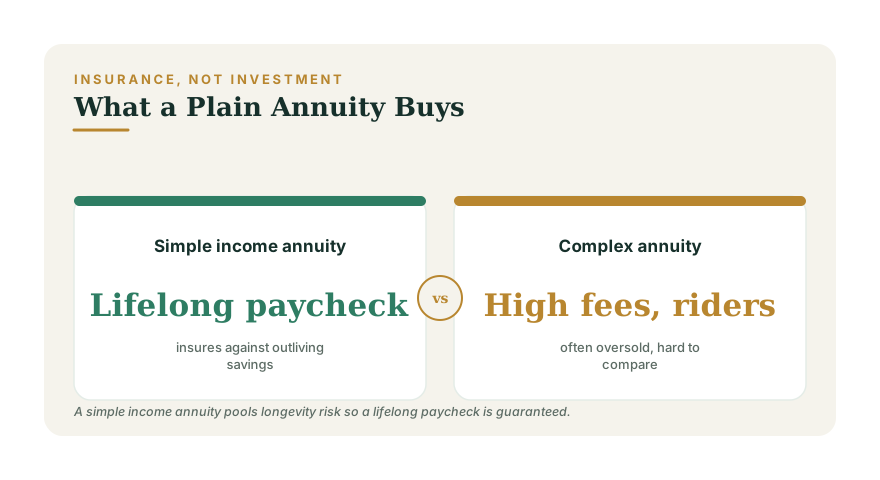
Annuities have earned much of their bad reputation. Variable and indexed annuities are often sold with high commissions, opaque fees, surrender penalties, and features so complex that even the buyer cannot explain them. But buried under that marketing is a genuinely useful, boring product: a plain income annuity, which is not an investment at all but a form of insurance against a real risk — outliving your money. Understanding that distinction is the difference between a smart, narrow purchase and an expensive mistake.
The risk annuities actually insure
Longevity risk is the risk of living longer than your savings last. It is the one retirement risk you cannot diversify away, because no one knows their own lifespan. If you plan for 90 and live to 100, you can run out of money at the worst possible time. Insurance is the natural answer to a risk you cannot predict individually but can pool across many people — the same logic behind every other policy you own. A lifetime income annuity does exactly that: you hand an insurer a lump sum, and it promises a set payment for as long as you live, no matter how long that is. The broad case is laid out in Annuities: When They Make Sense.
The one kind worth understanding first
Strip away the complexity and two simple versions do the core job:
- Single-premium immediate annuity (SPIA). You pay a lump sum and payments start right away for life. It is the purest form of longevity insurance — easy to compare across insurers because there is little to hide.
- Deferred income annuity (DIA), including a QLAC. You pay now and payments begin years later, say at 80 or 85. Because the insurer holds your money longer and some buyers will not live to collect, the eventual payments are large relative to the premium — making it an efficient hedge against a very long life. A qualified longevity annuity contract (QLAC) is a DIA bought inside a retirement account under IRS rules, which can also defer some required minimum distributions.
These are the annuities that behave like insurance. The variable and indexed products layered with riders are a different animal, and usually the wrong starting point.
Why the pooling works in your favor
An income annuity can pay more than you could safely withdraw from the same lump sum on your own, and the reason is mortality pooling. The insurer collects premiums from many retirees; those who die earlier effectively subsidize those who live longer. That pooling is precisely what lets the product guarantee income for life — something a self-managed portfolio cannot promise, since a portfolio has to plan for the possibility of a very long life by spending less. This is the same reason a pension can feel generous, a trade explored in Pension: Lump Sum vs Annuity.
The honest drawbacks
Even a plain income annuity involves real trade-offs you should weigh with clear eyes:
- You give up the lump sum. The money is generally gone as a liquid asset — you cannot get it back for an emergency, and a bare version leaves nothing to heirs if you die early (riders that add a death benefit or period-certain payments reduce this, and reduce your payment).
- Inflation erodes fixed payments. A level payment loses purchasing power over decades. Inflation-adjusted annuities exist but start lower.
- You take on insurer credit risk. The guarantee is only as good as the insurer, so financial strength and state guaranty limits matter.
- Rates matter. Payouts are tied to interest rates at purchase, so timing and shopping several insurers affect what you get.
Where an annuity fits — and where it does not
The measured use is narrow: cover your essential expenses — housing, food, healthcare, which only grow later in life as covered in Healthcare Costs in Retirement — with guaranteed income (Social Security plus, if there is still a gap, a simple annuity), and invest the rest for growth and flexibility. Annuitizing only part of your savings gets the longevity protection without surrendering all your liquidity. It makes less sense if you already have a pension and Social Security that cover the essentials, if you have health reasons to expect a shorter life, or if leaving a large inheritance is a priority. And it almost never makes sense to buy a complex, high-fee product a salesperson pushes hard.
A tool, used sparingly
Most annuities are best avoided, but a plain income annuity is real insurance against a real risk — outliving your money — and for the right retiree, converting a slice of savings into a guaranteed lifelong paycheck brings genuine peace of mind. Treat it as one narrow tool inside a broader plan, buy the simple version, and shop several insurers. Model your income gap and how an annuity would fill it with the Retirement Planner and the Insurance Needs Calculator, take the Financial Resilience assessment, and put the pieces together at the planning hub.