Most families will never owe federal estate tax, because the exemption is very large. But for those with substantial assets — and for anyone who simply wants to help loved ones sooner and watch it matter — giving money away during your lifetime is one of the cleanest estate-planning moves there is. Done consistently, an annual gifting habit can move meaningful wealth out of a taxable estate over the years, entirely tax-free, using rules the IRS resets each January.
The annual exclusion: the workhorse
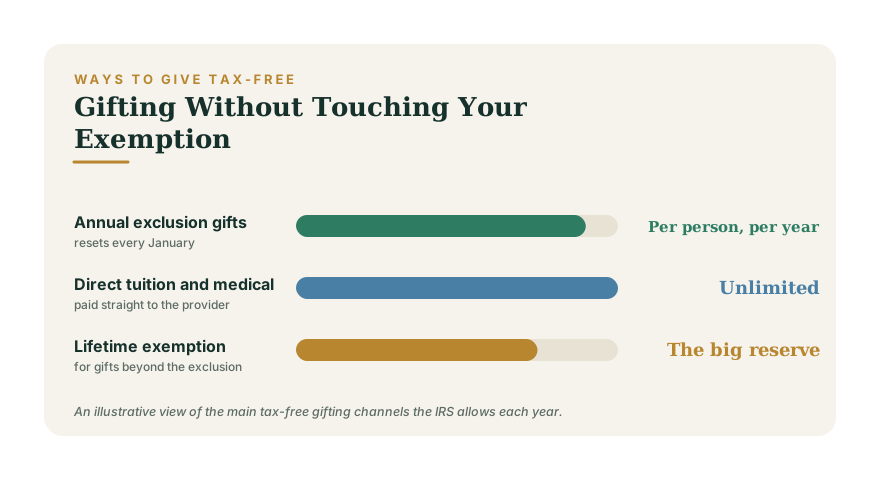
The centerpiece is the annual gift tax exclusion. Each year you can give up to a set amount to any number of people without filing a gift tax return and without using any of your lifetime exemption. The IRS adjusts this figure for inflation periodically; see the agency's overview of gift tax rules at irs.gov. The power is in the multiplication. The exclusion is per recipient, so a couple with three children can give each child the exclusion amount, from each spouse, every year — and can extend that to children's spouses and grandchildren. Repeated annually, this quietly relocates a large sum out of the estate while helping the family in real time.
Gift splitting for couples
A married couple can combine their exclusions through gift splitting, effectively doubling what one recipient can receive tax-free even if the money comes from one spouse's account. This usually requires filing a gift tax return to elect the split, but it does not create a tax — it simply documents that both spouses are treating the gift as jointly made. For couples, it is the easy way to double the annual reach.
The unlimited exclusions people forget
Two categories of gifts are completely unlimited and do not count against your annual exclusion or lifetime exemption at all:
- Direct payments of tuition. If you pay a school, college, or university directly for someone's tuition, it is not a taxable gift, no matter the amount. It must go straight to the institution, not to the student.
- Direct payments of medical expenses. Paying a provider directly for someone's medical bills or health insurance is likewise unlimited and untaxed, again only if paid straight to the provider.
These are enormously useful for grandparents funding education or helping with a family member's medical costs, because they move money out of the estate without touching any exclusion. Just remember the rule: pay the institution, never the person.
When you go beyond the exclusion: the lifetime exemption
Give one person more than the annual exclusion in a year and you are not automatically taxed. Instead, the excess is reported on a gift tax return and draws down your lifetime gift and estate tax exemption — a single large amount that covers both lifetime gifts and what you leave at death. You only owe actual gift tax after exhausting that entire exemption, which few people do. The mechanics of how the gift and estate exemptions interlock are laid out in Estate and Gift Tax Basics, and the reporting details are in Gift Tax Rules Explained. One important note: the exemption is scheduled to change under current law, so large gifting decisions should be timed with an advisor.
Smart ways to structure gifts
- Fund education directly or via a 529. Direct tuition payments are unlimited; 529 contributions use the annual exclusion but grow tax-free and even allow front-loading several years at once.
- Give appreciating assets thoughtfully. Gifting an asset removes future growth from your estate, but the recipient keeps your original cost basis — which matters, because assets kept until death get a basis step-up instead. Weigh which outcome serves the family better.
- Be consistent. The strategy works through repetition. A modest annual habit compounds into a large transfer over a decade or two.
- Keep records. Document what you gave, to whom, and when, and file gift tax returns when required even if no tax is due.
Give with a plan, not by reflex
Gifting only makes sense once your own security is assured — never give away money you might need for retirement or care. But for those with a comfortable cushion, an annual gifting strategy shrinks a taxable estate, delivers help when family needs it most, and uses generous rules that reset every year. Size up what you can comfortably give using the Net Worth Tracker, sanity-check your plan against the Lifetime Wealth Projector, then confirm the estate side is buttoned up with the Estate Readiness assessment and the planning hub.