Insurance is one of the few recurring bills most people set once and never revisit. That inertia is exactly what insurers count on: loyal customers frequently pay more than new ones for identical coverage, and premiums drift upward year after year. Shopping deliberately — even for an afternoon — is one of the highest-return chores in personal finance, because the savings repeat every month for as long as you hold the policy.
It helps to remember what you are actually buying. Insurance is not a product you want to use; it is protection against a loss large enough to derail your finances. The goal of shopping well is not to find the absolute cheapest policy, but the cheapest adequate policy — enough coverage to absorb a real catastrophe, bought at the best available price. Under-insuring to save a few dollars a month can be far more expensive than overpaying. The trick is to get the coverage right first, then compete the price.
Compare quotes the right way: apples to apples
The single biggest mistake is comparing premiums on policies that are not actually the same. A cheaper quote often hides a higher deductible, lower coverage limits, or thinner protection. To compare honestly, lock the coverage details first, then compare prices:
- Match the coverage limits — the maximum the policy will pay — across every quote.
- Match the deductibles so you are comparing the same out-of-pocket exposure.
- Match the add-ons and exclusions — riders, covered perils, and what is specifically left out.
Only when those are identical does the premium tell you anything. Get quotes from at least three insurers, and re-shop every couple of years or after any major life change — a move, a marriage, a new car, a paid-off mortgage.
Raise your deductible to cut the premium
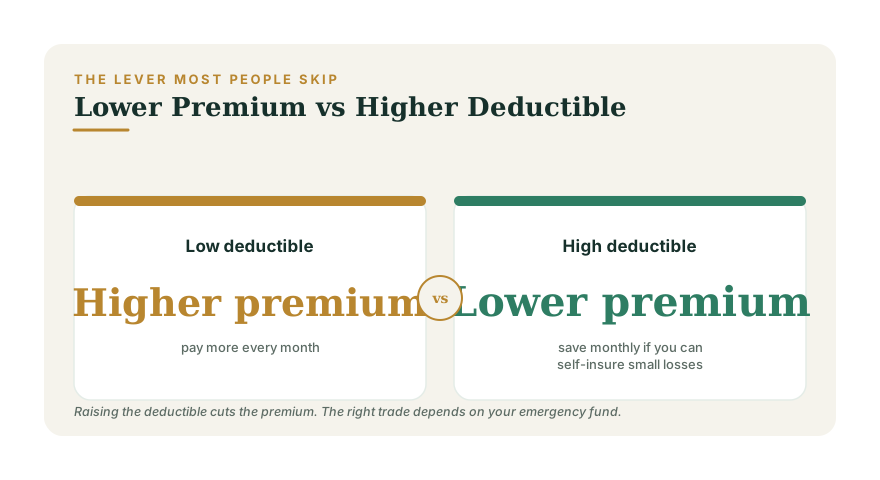
The deductible is the most powerful lever you control. Because you are agreeing to absorb more of a small loss yourself, raising the deductible can noticeably lower the premium. The trade is sound only if you can comfortably cover that higher deductible from savings. This is precisely why an emergency fund and insurance work together: a solid cash cushion lets you self-insure small losses and pocket the premium savings. For home and auto especially, the math usually favors the highest deductible you can absorb without stress — a decision broken down in How to Choose Your Home Insurance Deductible.
Insure the catastrophe, not the inconvenience
The core principle of buying insurance well: transfer the risks you cannot afford, and self-insure the ones you can. A $400 phone, a low-value old car, an extended warranty on a toaster — these are losses you could cover out of pocket, so paying a premium to insure them is usually a bad deal. Reserve insurance for the genuinely ruinous events: a totaled car with injuries, a house fire, a disabling illness, an early death with dependents. That is also the logic behind getting life insurance right — buy it for the catastrophe, skip it where there is no one to protect.
When bundling helps — and when it does not
Insurers love to sell you "bundles" — home and auto together, for instance — with a multi-policy discount. Bundling can genuinely save money and simplify your life with one bill and one company. But it is not automatically cheaper:
- Bundling helps when the combined, discounted price actually beats the best standalone quotes you found for each policy separately.
- Bundling hurts when the discount on one policy masks an overpriced other policy, leaving the total higher than buying each from the cheapest specialist. It can also make you lazy about re-shopping, because splitting the bundle later feels like a hassle.
The fix is simple: always price the bundle and the separate policies, then pick whichever total is lower. Do not assume the discount makes the bundle the winner. A genuine multi-policy discount applied to two competitively priced policies is a real saving; the same discount applied to one inflated policy is just marketing. The only way to tell the two apart is to do the side-by-side math yourself.
Other levers that quietly cut cost
- Take the discounts you have earned. Good driving records, security systems, bundled accounts, paperless billing, and even good credit can lower premiums. Ask what you qualify for.
- Pay annually if you can. Many insurers charge extra to split payments monthly.
- Drop coverage that no longer fits. Collision coverage on a car worth little, or duplicate coverage you already have elsewhere, is wasted money.
- Watch your credit. In many states it influences your premium, so the habits that build credit also lower your insurance cost.
Make it a habit, not a one-time event
Overpaying for insurance is rarely about one bad decision — it is about never revisiting old ones. Put a recurring reminder on your calendar to re-shop your major policies every year or two, keep your deductibles as high as your emergency fund allows, and insure only what would truly hurt to lose. Use the Insurance Calculator to size your coverage, and run the Financial Resilience assessment to confirm your policies protect your finances without draining them.