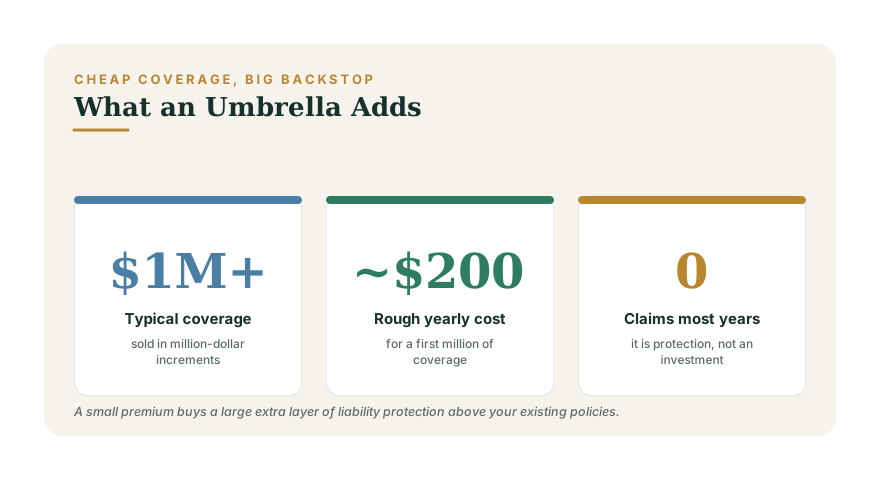
Umbrella insurance is one of the best value-for-money policies most households never buy. It sits on top of the liability coverage already built into your auto and homeowners policies, and it does one job: if you are found responsible for injuring someone or damaging their property, and the damages exceed what those underlying policies pay, the umbrella covers the rest — up to its limit. For a premium that is often a couple hundred dollars a year, it can protect you against a judgment that would otherwise reach your savings, your home equity, and even your future wages.
What umbrella insurance actually covers
An umbrella policy covers liability — your legal responsibility to others — not damage to your own stuff. Think of a serious at-fault car accident with major injuries, a guest badly hurt on your property, a dog bite, or a claim of libel or slander. When the injured party's costs and any court award climb past the liability limit on your auto or home policy, the umbrella picks up where those leave off. It also often covers some claims your base policies exclude entirely, such as certain personal-injury lawsuits. What it does not do is pay to repair your own car or house — that is the property side of your regular coverage, explained in Auto Insurance Coverage, Explained and Homeowners Insurance, Explained.
How it stacks on your existing policies
An umbrella almost never pays first. Insurers require you to carry minimum liability limits on your underlying auto and home policies — commonly $250,000 to $300,000 — before the umbrella will attach. Those base policies pay up to their limits, and only then does the umbrella layer engage. That is why raising your underlying limits and adding an umbrella work together: the umbrella is affordable precisely because the base policy absorbs the first slice of any claim.
Who really needs one
The honest answer is that umbrella coverage is less about how much you have and more about how much you could lose. A judgment can be collected from assets you already own and, in many states, from future earnings through wage garnishment. You are a stronger candidate if you:
- Own a home or have meaningful savings and investments a court could reach.
- Have teenage drivers, who statistically raise your accident risk.
- Own a pool, trampoline, dog, or boat — classic sources of injury claims.
- Rent out property, host guests often, or serve on a nonprofit board.
- Have a high or rising income that a garnishment could target for years.
If a large liability judgment would be financially survivable because you have almost nothing exposed, an umbrella is less urgent — a version of the logic in When Self-Insuring Makes Sense. But because the premium is so low relative to the protection, most homeowners and higher earners come out ahead buying it.
How much coverage to carry
A common rule of thumb is to carry an umbrella limit at least equal to your net worth, and often more, since a judgment can also reach future income that your current net worth does not capture. Coverage is sold in million-dollar increments, and each additional million costs far less than the first because catastrophic claims are rare. Tally your exposed assets with the Net Worth Tracker, then size the policy to cover that figure with room to spare. You can pressure-test whether your overall protection has gaps with the Insurance Needs Calculator.
The fine print worth reading
Umbrellas are broad but not unlimited. They typically exclude business activities (a separate commercial policy handles those), intentional acts, and liability you take on by contract. Some exclude specific breeds of dog or certain watercraft. And the whole structure collapses if you let an underlying limit lapse below the required minimum — so keep your auto and home liability limits where the umbrella demands. For the mechanics of the underlying product and how limits interact, see Umbrella Insurance, Explained.
Small premium, large peace of mind
Umbrella insurance is rarely used and almost never regretted. It is one of the cheapest ways to keep a single bad day — an accident, an injury, a lawsuit — from unwinding years of saving. Confirm your auto and home liability limits meet the umbrella's requirements, size the coverage to your exposed net worth, and add it. To see how it fits your broader safety net, run the Insurance Needs Calculator, take the Financial Resilience assessment, and map your full protection plan at the planning hub.