At open enrollment, alongside your main health plan, you are often offered add-ons with reassuring names: accident insurance, critical-illness insurance, hospital indemnity. They are usually inexpensive, the pitch is emotional, and it is tempting to check the box "just in case." Sometimes they are worth it. Often they are not. The difference comes down to how they pay out and whether you already have the coverage they duplicate.
How these policies actually pay out
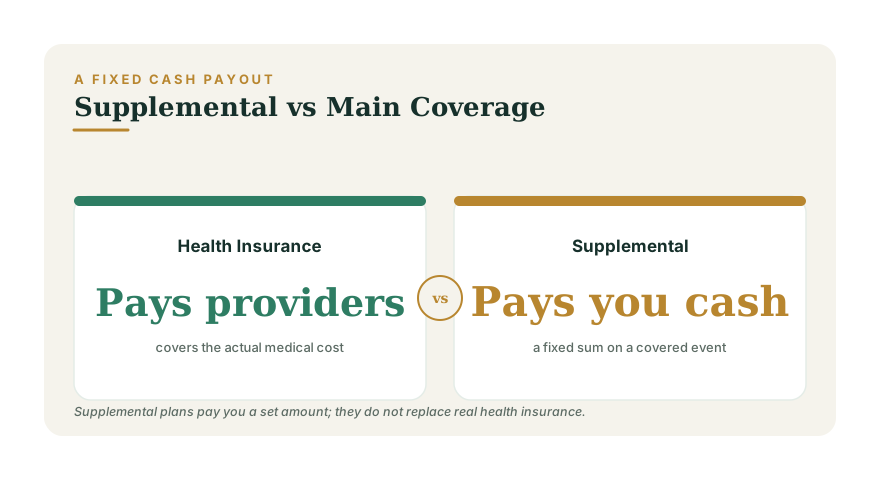
The crucial thing to understand is that supplemental policies are fixed-benefit products. They do not pay your medical providers and they do not track your actual costs. Instead, when a defined event happens, they pay you a set dollar amount:
- Accident insurance pays a fixed sum for specified injuries or events — a broken bone, an ambulance ride, an ER visit.
- Critical-illness insurance pays a lump sum if you are diagnosed with a covered condition such as cancer, a heart attack, or a stroke.
- Hospital indemnity pays a flat amount per day you spend admitted to a hospital.
The cash is yours to use for anything — your deductible, lost income, childcare, or rent. That flexibility is the genuine appeal. But the payout is unrelated to your real bill, which is exactly why it can fall short of, or overlap with, what you already have.
The overlap with your main coverage
Modern health plans, thanks to the ACA, already cap your annual out-of-pocket spending. Once you hit your out-of-pocket maximum, your insurer covers the rest for the year. That single feature blunts much of the case for supplemental insurance: the catastrophe these add-ons are sold to protect against — being financially wiped out by one illness — is already limited by your main plan.
So the real question is not "what if something terrible happens?" It is "what gap is left after my main plan, and is this the cheapest way to fill it?" To answer that, you have to know your own plan's deductible and out-of-pocket max cold; see How Health Insurance Actually Works.
When supplemental insurance makes sense
There are real situations where these policies earn their keep:
- You have a high-deductible plan and a thin emergency fund. If a sudden injury would force you to a high deductible you could not comfortably cover in cash, an inexpensive accident policy can bridge that gap while you build savings.
- Your income would stop if you were hospitalized and you lack good short-term disability coverage. A critical-illness or hospital-indemnity payout can buy breathing room.
- A known family or personal risk makes a specific event meaningfully more likely than average.
When to skip it
For many people, supplemental insurance is a poor deal:
- You have a solid emergency fund. A funded cushion does everything a fixed-benefit policy does — pays cash on any emergency — without premiums, exclusions, or claim paperwork. This is self-insuring, explained in Self-Insuring: When It Makes Sense.
- The fine print is narrow. Many policies pay only for tightly defined events and have waiting periods and exclusions, so the real-world payout is smaller and less likely than the marketing implies.
- You are buying it out of anxiety, not math. Insurance should cover losses you cannot absorb, not small, manageable ones.
A useful rule: insure catastrophes, self-fund inconveniences. A few thousand dollars of accident benefit is, for most households, an inconvenience an emergency fund handles better.
Read the fine print before you buy
If you do decide a supplemental policy fills a real gap, treat it like any other insurance purchase and read the terms, not just the brochure. A few questions cut through the marketing:
- What exactly triggers a payout? Critical-illness policies often pay only on specific, severely defined diagnoses, and an early-stage diagnosis may pay a fraction or nothing.
- Is there a waiting period? Many policies will not pay for a covered event in the first weeks or months, and they exclude pre-existing conditions.
- Is it portable? Workplace supplemental coverage may end when you leave the job, just when you might most want it.
- What is the real expected value? A low premium can still be a bad deal if the odds of collecting are tiny and the payout is modest.
Insurers price these products to be profitable, which means on average policyholders get back less than they pay in. That is true of all insurance — you are buying protection against a tail risk, not an investment. The question is only whether this tail risk is one you genuinely cannot absorb on your own.
The bottom line
Supplemental insurance is neither a scam nor a must-have — it is a niche tool. It earns its place when a high deductible meets a thin emergency fund or fragile income; it is dead weight when you already have a healthy cash cushion and a plan with a reasonable out-of-pocket cap. For most people, the stronger move is to fund the safety net first. Size yours with the Emergency Fund Calculator and start with the emergency fund guide before adding another premium.