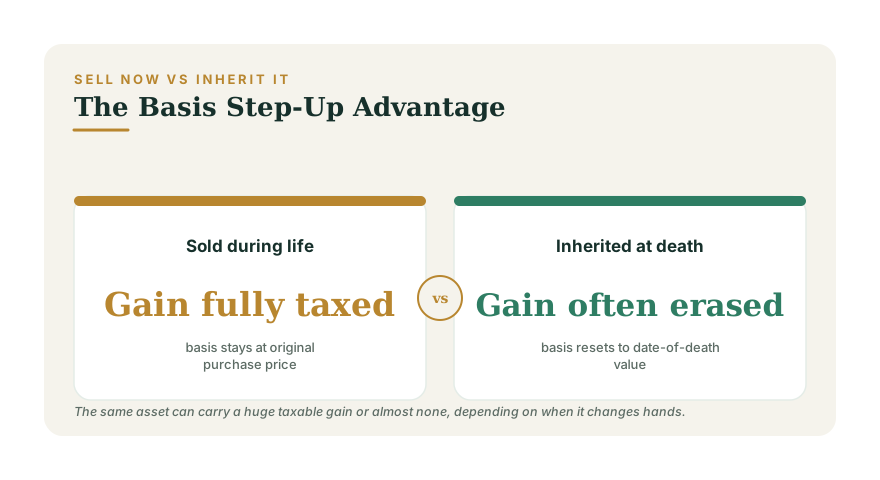
It is one of the most valuable and least understood rules in the tax code. When you inherit an asset — stock, a home, a rental property — its cost basis is generally reset to its fair market value on the day the previous owner died. This is called a step-up in basis, and it can erase decades of accumulated capital gain, meaning an heir who sells shortly after inheriting may owe little or no capital gains tax at all. Understanding it changes how thoughtful families decide what to gift, what to hold, and what to sell.
A quick refresher on basis
Your cost basis is essentially what you paid for an asset, adjusted for things like improvements or reinvested dividends. When you sell, your taxable capital gain is the sale price minus that basis. Buy a stock at $20,000, sell at $120,000, and you have a $100,000 gain to be taxed. If the mechanics feel fuzzy, start with Understanding Your Cost Basis. The step-up rule is powerful precisely because it changes that starting number at death.
How the step-up works
Say your father bought shares for $20,000 decades ago, and they are worth $120,000 when he dies and leaves them to you. Under the step-up rule, your basis is not his $20,000 — it becomes the $120,000 date-of-death value. If you sell right away at $120,000, your gain is essentially zero, and that entire $100,000 of lifetime appreciation is never taxed as capital gain. The IRS explains how basis is determined for inherited property in its guidance at irs.gov. The same logic applies to a house, a piece of land, or a portfolio: the built-in gain that would have been taxed if the owner sold during life is wiped clean for the heir.
Why it reshapes your planning
The step-up creates a genuine tension with lifetime gifting, and it is the single most important nuance to grasp:
- Gifting during life carries over the old basis. If your father gives you those shares while alive, you take his original $20,000 basis — and you inherit the $100,000 latent gain along with it. Sell, and you owe tax on the full gain.
- Inheriting at death steps the basis up. Hold the same shares until death and the gain evaporates for the heir.
This is why highly appreciated assets are often best held until death rather than gifted, while cash or low-gain assets are better candidates for the lifetime gifting described in An Annual Gifting Strategy to Reduce Your Estate. The right choice depends on whether estate tax or capital gains tax is the bigger concern for your family.
Spouses and community property
The rule can be even more generous for married couples. When one spouse dies, the deceased spouse's share of a jointly held asset typically gets a step-up. In community property states, both halves of community property can receive a step-up when the first spouse dies — a full step-up on the entire asset, not just half — which is a meaningful advantage for surviving spouses in those states.
Important limits and cautions
- Basis can step down too. If an asset lost value, the basis resets down to the lower date-of-death value, wiping out a loss the heir might otherwise have used. It is a reset, not a one-way benefit.
- Retirement accounts do not get a step-up. Inherited traditional IRAs and 401(k)s are taxed as ordinary income to the heir as withdrawn — the step-up rule does not apply, which surprises many families. See Inheriting Money: What to Do.
- Document the date-of-death value. Heirs should get a formal appraisal or record the market value of inherited property, since that figure is the new basis and must be provable if the asset is later sold. Estimate the resulting tax with the Capital Gains Estimator.
- The rule could change. Proposals to limit or repeal the step-up surface periodically, so plans built entirely around it should stay flexible.
Use it deliberately
The step-up in basis is a rare case where doing nothing — holding an appreciated asset until death — is the tax-optimal move, and it should temper any instinct to gift your most-appreciated holdings away during life. Weigh it against estate tax, family needs, and your own income requirements rather than in isolation. Map your assets and their built-in gains with the Net Worth Tracker, model a sale with the Capital Gains Estimator, and pull the whole inheritance plan together with the Estate Readiness assessment and the planning hub.